




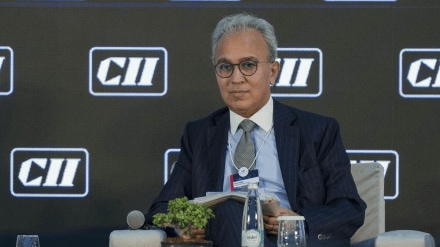
In the run up to the Union Budget FY26, the government has been engaging with different stakeholders, including industry associations like Confederation of Indian Industry (CII). In a conversation with FE’s Manu Kaushik, CII President Rajiv Memani discussed the industry body’s agenda for the budget, impact of the rupee depreciation, progress on the trade deals with US and EU, and the outlook on key economic indicators.
What should be the priorities of the government next year? What suggestions have you given for the upcoming Budget?
Memani: One of the highlights of this year is the amount of reforms that the government has done. We have done a comprehensive study which we call PACT. A lot of our budget recommendations are taken from that study. We also did a study of India’s imports profile. The total merchandise imports this year will be about $725 billion.
About $250-300 billion would be minerals, fertilisers, rare earths, fuel, and energy, which cannot be replaced. But we can look at $300-400 billion of imports. We have come out with top 50 categories where manufacturing could be encouraged. In addition, we looked at high-growth sectors such as electronics, data centres and the entire energy space where there’s going to be a substantial increase in demand. We have recommended strengthening the manufacturing in these sectors as well.
We need to have a more pronounced strategy around privatisation and disinvestment. Historically, we have had numbers which are in the range of Rs 20,000-40,000 crore. India should be looking at almost Rs 1.5-2 lakh crore of disinvestments over the next two years. Today, the market value of listed PSU stocks is Rs 45-50 lakh crore. This is a big number which can help in creating a sovereign wealth fund or a strategic fund for India or fund some large-scale projects like high-speed railway corridors.
We are not recommending reduction in tax rates. Today, we have Rs 30 lakh crore stuck up in disputes. Ninety per cent of them are at CIT (Commissioner of Income Tax) appeal stage. We have made specific recommendations on how to reduce the disputes and (explore) alternate dispute resolution mechanisms.
The trade deals with the EU and the US have been in the works for some time. How will these deals benefit the economy?
Memani: At a macro level, the key highlights of this year has been the way India has engaged globally on trade, especially after the US trade deal got delayed. The speed at which we have engaged with Middle Eastern countries, Australia and New Zealand, the UK, then with the EU, is impressive. India has just signed the FTA with Oman, and we are starting discussions with Israel.
The government has been engaging a lot with the industry to get their feedback. These trade deals have a strong commercial business orientation and once they get fully implemented, we would see significant increase in trade. The industry is hopeful that the E U trade deal will get done shortly because there is equal keenness on the side of the EU to conclude the deal.
On the US front also, our understanding is that there has been significant progress. Some parts of agriculture will be no-go areas for India; there could be some no-go areas for the US as well. But we have to find ways to address other issues.
CII on falling rupee
What is CII’s view on the falling rupee? It’s making exports competitive but do you see the threat of imported inflation for the economy?
Memani: As long as there’s no major volatility, a bit of weakening of the rupee will not have a bad outcome for India. It raises the cost of imports, and therefore, encourages people to look at more domestic alternatives. In a benign energy environment today where the oil & gas prices are on the lower side, the inflation impact will be lesser than what we had anticipated.
A lot of what’s happening to the rupee has to do with the factors that are beyond India’s control. While the gross FDI has gone up significantly this year, because of the (FII) exits there was some concern. The trade numbers in November show that merchandise export is still growing at 2-3%, service exports are growing at 9-10%, and the current account deficit is well under control. So, on the rupee side, there’s no real need to worry. The RBI is doing a good job by stepping in when they see too much volatility.
CII president on the possibility of future rate cuts
RBI governor has recently said that real interest rates need to be lower due to the benign inflation. Do you see the possibility of more rate cuts going forward?
Memani: The rates could come down by 0.25%, so we could see the repo rate at 5% by the end of fiscal year. In comparison to other countries, India is still a few percentage points higher, and India’s inflation rate is still amongst the lowest today.
The winter session of Parliament saw the passage of the Insurance Bill that allows 100% FDI in the sector. How is it going to benefit end consumers?
Memani: If the sector attracts more capital and a larger number of players, the benefit will eventually come to the end consumer. They have also tried to address some of the other issues like total agency charges that can be paid. The government has a strong focus in trying to ensure that the overall insurance coverage grows. We still don’t have the unified license. Once the unified license comes, it will further accelerate.
ADB has just revised its India’s GDP growth estimate for FY26 upwards to 7.2% and the RBI is also giving an estimate of 7.3%. What is the CII’s outlook on the GDP growth this fiscal?
Memani: We started the year with estimates in the range of 6.5-6.8%. Our estimate is that given where things are today and the overall economic momentum, we should be looking at 7.3-7.5% growth.
The gross tax receipts are likely to be moderate this fiscal which could affect the fiscal deficit situation. What’s your take on it?
Memani: The overall tax buoyancy this year is lower than last year. The real GDP growth is 8% but the nominal GDP growth, when adjusted, would probably be 8.6-8.7%. Normally India is used to a 10% nominal GDP growth. Now that nominal GDP growth’s biggest impact is in terms of computation of the tax revenues.
Also, because of the GST relief that the government gave, our view is that we may fall short of our overall tax revenue targets. On the GST side, we have to fully understand the impact of the benefits that have been passed on. The revenue expenditure is still lower than last year, and the capital expenditure growth has been strong. Overall, the gross tax revenue collections may be low but the overall fiscal deficit numbers should be met.
What is your view on the short-term potential of private investment?
Memani: We did an analysis of 1,500 companies. From 2019 onwards till now, the average CAGR growth of gross fixed assets is about 15-16% whereas the net fixed assets growth is about 22%. Between 2024-end and 2025-end, the growth is even more. It slowed down a bit at the beginning of this year because of the trade deal (uncertainty). But we are seeing pickup in private investments. The number of stalled projects are coming down. The capacity utilisation rates are almost 75%. The credit growth is about 11-12% which is strong because there are a lot of other ways of financing such as IPOs and bond markets. In the next 6-12 months, the private capex will grow at a faster rate than what we have seen in the last 3-6 months.


