There is an over 1/5th probability of India?s decadal per capita growth rate falling below 6%, if the pace of economic reforms remains at the level prevailing during the last five years or so
The paper has four interlinked objectives. (1) To learn from the experience of fast-growing economies, how to sustain growth. (2) To show that the reforms of the 1990s are the cause of the higher growth of the Indian economy in the 2000s. This also helps understand the nature of successful reforms and the mechanism through which they operated and thus to identify potential growth-sustaining reforms. (3) To explain the paradox of higher growth potential co-existing with either unchanged or declining growth trend. (4) To identify and recommend reforms that will help sustain fast growth in India.
We can define High Growth Economies (HGEs) as countries that had an average growth rate of per capita GDP of 7% or more, for a contiguous period of 10 years or more. This would mean that their per capita GDP doubled during the decade. We can define potential HGEs (pHGEs) as countries whose per capita GDP has grown by an average of 6% or more for at least a decade. Though India is not among the current HGEs it is a potential HGE.

The contrasting response of the Asian HGE and pHGE countries? to major shocks like the oil crises of 1973 and 1979 and the Asian crisis of 1997 illustrate the importance of a pragmatic response. As most Asian countries including the HGEs were net importers of oil, they were affected by 1973 and 1979 oil crises and associated rise in prices. Japan was unable to respond adequately to both crises so its long-term growth rate (measured by the compound annual average per capita GDP growth over 10 years) declined after each crisis. In contrast, South Korea was strongly affected by the 1979 oil crisis but responded to the shocks and adapted its economy to the new environment: ?There was a devaluation, a tightening of monetary policy and a programme aimed at increasing energy efficiency.? ?Though it had budget deficits and a rising debt, its falling dollar-denominated labour costs provided the country with external competitiveness and allowed it to maintain fast growth and rising shares of exports to GDP.? Korea?s long-term per capita growth declined from over 6% in 1978 to around 5% in 1982 but was back up over 6% in 1987 and peaked at 7.9% in 1991. Similarly the Asian crisis of 1997 hit many Southeast Asian countries. Vietnam responded adequately and was able to accelerate its per capita growth (10 year) to 6% by 2001. Korea with a per capita decadal growth of 7.3% in 1996 and Thailand with a per capita decadal growth of 7.1% in 1997 were unable to respond and their growth fell below 5%.
India?s move from a low growth to a high growth economy has occurred in two stages, each higher stage being set of by economic reforms and liberalisation, first in the 1980s and then in the 1990s. What set it apart from many other growth accelerations, particularly in Asia are the role played by domestic entrepreneurs and the minimal direct role played by the government. The government?s role in both sets of reforms was to lift controls and restriction on entrepreneurs and give them greater freedom. Its role in providing public goods and service, particularly ?public good infrastructure? has been highly inadequate compared to fast growing economies in Asia and elsewhere. As FDI flows and stock are still a relatively small fraction of total investment and capital stock, the growth acceleration in both phases can therefore be largely attributed to domestic entrepreneurship, whence the term, ?domestic entrepreneur led growth?. This contrasts with Korea and the Taiwan Province of China, where the State played a much more active role in accelerating growth, Singapore where FDI was important in accelerating growth though the State continued to play a critical role, and the role of the Party and State in China.
Sustained, fast economic growth is the key to transforming a low income economy to a middle income one. Accelerating an economy?s growth is not sufficient to success in this transformation. What sets apart successful from unsuccessful countries, is the time period during which growth is sustained. Too many countries? growth rate collapses after a period of fast growth; they are shooting stars that burn bright for a short period. The policy reforms needed to sustain fast growth are not necessarily the same as those needed to accelerate growth. One of the differences is, that in the latter case it is more important to focus on and address problems that are apparent and visible to all informed observers, and to do so in pragmatic problem-solving manner. An ideologically focused or theoretical obsession with historical problems can distract from and dissipate the limited room for manoeuvre a government may have at any given time. This does not rule out a clear focus on long-term policy and institutional reform objectives to ensure consistency in reforms, while addressing the immediate problem. The latter is more important to sustaining growth than long-standing constraints that the system has adapted to. If growth is allowed to fall back to slower levels, there is unlikely to be much net benefit from addressing these long-term problems.
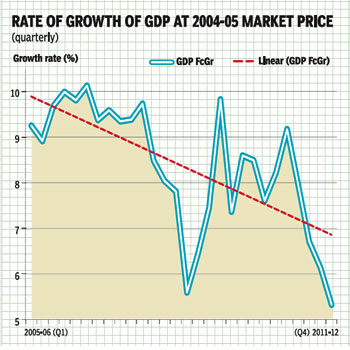
The 1990s structural reforms, including the liberalisation of the external trade, investment and technology policy, raised the potential growth of the Indian economy from around 5.5% per annum to over 8.5%. Consequently, the economy grew at around 9% per annum during the five years 2003-4 to 2007-8. The average growth rate has fallen to 7.7% in the next four years (2008-9 to 2011-12) following the US financial crises of 2008. There are two factors in the slowdown. The first is the continuing financial crises and its accentuation of capital flow volatility into India, and the global economic slowdown and consequent global demand deficiency-excess capacity in tradable goods and services. The second is the negative fallout of India?s growth acceleration and the political consequences of the V shaped recovery from the 2008 global financial shock. These induced complacency in policy among the economic and political elites of the country. More importantly the growth acceleration has given rise to a number of economic bottlenecks and constraints and socio-political conflicts that must be resolved through economic policy and institutional reform if fast growth is to be sustained. These include conflicts related to land, water and natural resources. These conflicts can effect economic growth not just directly (e.g. inadequate supply of urban land) but also through their effect on the political system and its ability to act decisively in resolving issues not directly connected to them, such as macro-economic response to external shocks and fundamental policy reforms.
There is a significant probability of external shocks during the next two years, such as euro melt-down and sharp spike in oil prices. Emerging market economies such as China and India have the policy options and ability to minimise the effect of the continuing global financial crisis on their economies and resume/sustain growth at close to its potential in each country. There are currently eight countries with an average growth rate of per capita GDP of more than 6% over the previous decade (2002 to 2011). Seven of these are in Asia: three in South Asia (India, Bhutan and Maldives), three in ASEAN (Vietnam, Cambodia, Myanmar) and one in East Asia (China). Of these the fast growth rate of four countries, all in Asia (China, India, Cambodia and Maldives), is not fuelled by natural resource riches and resource rents.
History shows that there is an over 1/5th probability of India?s decadal per capita growth rate falling below 6%, if the pace of (real/genuine) economic reforms remains at the level prevailing during the last five years or so. If India learns and adopts the lessons from the highly successful HGEs and pHGEs of Asia, it still has the potential to attain HGE status by reversing the downward trend in its growth and going back to its underlying potential of per capita GDP growth of 7-7.5% (GDP 8.5%+). This requires urgent policy actions to remove bottlenecks to growth, eliminate rents, and facilitate removal of supply constraints. Some, if not all these policy reforms may require a reorientation/adjustment of the approach to political cooperation and competition.
The above is extracted from an IMF Working Paper, ?Accelerating And Sustaining Growth: Economic and Political Lessons?, dated July 2012.
The author is former chief economic advisor and executive director on the board of the International Monetary Fund