Never do private-sector players fail to sense the opportunities thrown up by the unshackling of state control on markets. Reliance Industries and Essar Oil are busy crafting plans to take on public sector oil marketing companies in the cooking gas market segment freed by the recent decision to cap subsidised LPG cylinders per year at six.
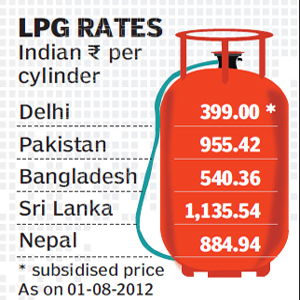
At current prices of R900 a cylinder and assuming that an average family requires 7-8 cylinders a year, the size of the free market in LPG is estimated at around R20,000 crore: A pie juicy enough for the private players to take note.

Although the companies refused to give details of investment plans for this new business, a market analyst said the amounts may not be big for players which already have some presence in the market. Private companies, he said, may offer higher commissions to distributors and dealers to acquire markets from PSUs and outsource bottling to reduce investments, he said.
At present, there are around 14 crore domestic LPG customers. About 1.2 crore customers were added in 2011-12 indicating a growth of around 10%. State-owned Indian Oil, Bharat Petroleum and Hindustan Petroleum together meet the country?s entire LPG cylinder demand.
?PSUs guarantee supply from the last three decades. We are not worried about the competition,? said Makrand Nene, director marketing, Indian Oil Corporation.
Private companies were waiting in the wings as these policy decisions could revive the competitive spirit and reactivate retail plans.
The companies also expect the government to take similar measures in other petroleum products like diesel and kerosene, which will enable them to revive their retailing plans.
?The market is open for competition to meet the needs of consumers after they exhaust their quota of six subsidised consumers. Private companies could not only offer discounts over the market price but also come up with innovative schemes to win over consumers,? said another analyst tracking the developments in the sector.
On September 13, the Union government had announced a consumer would get up to six subsidised cylinders (currently Rs 410 a cylinder in the capital). From the seventh cylinder, consumers must pay market rate (which is Rs 900 per cylinder). There is, however, no restriction in the number of domestic non-subsidised cylinders that customers can avail of beyond the three subsidised LPG refills.
For private oil companies, the government?s decision is also said to give added strength to their ailing retail plans to sell products like petrol and diesel. The expectation is that the government will now move towards complete decontrol of diesel prices, helping them revive retail plans and recover investments.