




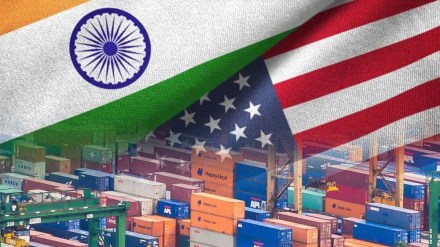
Three US politicians, including one of Indian origin, is moving to formally challenge US President Donald Trump’s tariff hit on India. Deborah Ross, Marc Veasey, and Raja Krishnamoorthi, aka members of the US House of Representatives, have introduced a resolution to end the high duties. All three have often emerged as leading voices opposing the American leader’s tariff agenda.
The Republican POTUS had raised the previous 25% tariffs to a final 50% level, the highest faced by any country, earlier this year in light of the South Asian nation’s continued purchase of Russian oil amid the ongoing Ukraine crisis.
Resolution to end Trump tariffs on India
As detailed in an ANI report, the US lawmakers’ resolution seeks to get rid of the additional 25% “secondary” tariffs imposed on India in August.
US Congresswoman Ross highlighted the deep connection between North Carolina and India through “trade, investment and a vibrant Indian American community.” She further laid emphasis on Indian companies’ massive billion-dollar investments in the American state, which brought about the creation of thousands of jobs in sectors across life sciences and technology.
On the other hand, she divulged that North Carolina manufacturers export hundreds of millions of dollars in goods to India every year.
Meanwhile, Indian-American Congressman Krishnamoorthi slammed the tariffs as “counterproductive” for disrupting supply chains, harming American workers, and driving up costs for consumers. He further argued that cutting off these tariffs would ultimately help build stronger ties between the US and India, giving way to strengthened economic and security cooperation.
Additionally, Congressman Veasey called India “important cultural, economic and strategic partner,” branding the tariffs “illegal,” and adding that they have become a tax on everyday North Texans already struggling with inflation.
US Democrats’ repeated steps to get India tariffs rescinded
Democrats have repeatedly challenged Trump’s tariffs on the imports of Indian goods. Back in October, these very three lawmakers joined forces with Indian-origin Congressman Ro Khanna and 19 others Congress members, urging Trump to call off the tariffs so that strained ties with India could be rebuilt.
A press release (dated Dec 12) issued by Krishnamoorthi’s office added, “Ending Trump’s India tariffs is part of a broader effort by congressional Democrats to reclaim Congress’ constitutional authority over trade and to stop the President from using emergency powers to unilaterally impose his misguided trade policies.”
Krishnamoorthi’s office statement further underlined that their measure challenging India tariffs comes after a bipartisan Senate-passed initiative sought to end the POTUS’ Brazil tariffs, which the lawmakers view as an “abuse of emergency powers” on the part of Trump.
Just this week, another group of Democratic lawmakers voiced their concern about deteriorating US-India ties. Indian-origin US Rep Pramila Jayapal was one of them to prominently speak out at the House Foreign Affairs South and Central Asia Subcommittee’s hearing titled ‘The US-India Strategic Partnership: Securing a Free and Open Indo-Pacific.’
Firmly expressing her viewpoint against Trump’s tariff regime working as a double-edged sword for both countries, she said, “We also are facing challenges around tariffs, both here in the United States and in India. These tariffs are damaging India’s economy and also hurting American businesses and consumers.”
Turning the focus onto a long-running family-owned business and how it had been impacted by the current developments in the US, Jayapal added, “Just last week, I heard from a fifth-generation family-owned company in Washington State that relies on agricultural products from India that can’t be sourced at scale in the United States.
“They told me that these tariffs are the greatest threat to their business in over 120 years, and they’re looking at either downsizing or offshoring their production to meet increased costs.”
Indians in North Carolina and Texas
According to recent US Census estimates cited by Neilsberg, the Indian population in North Carolina totals 130,646, accounting for 2.7% of the US’ total Indian population of 4.9 million.
Texas, on the other hand, ranks among American states with large Indian populations in the country. According to Pew Research’s analysis, 570,000 Indian-origin people lived in the state.


