




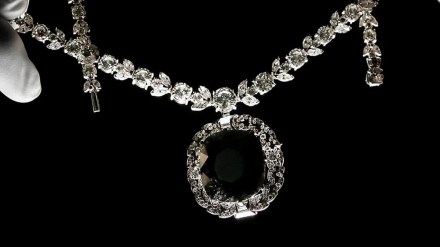
The history of the infamous Black Orlov Diamond, also known as the “Eye of Brahma Diamond” has often served as a popular horror story in the circle of high end jewellers and collectors.
The seventh-largest black diamond in the world is less known for its price and more for the dark legends attached to it. A 67.49-carat, cushion-cut fancy black diamond, the stone has been blamed for a string of high profile suicides, thefts from a Hindu temple, and decades of whispered superstition.
In 2006, the diamond returned to global headlines when it was sold at Christie’s in New York for about $352,000 (over Rs 3 crore) , nearly double its estimated price. But the story behind the stone remains far more valuable than the sale itself.
Tracing the origin of the Black Orlov Diamond?
According to a popular lore, the Black Orlov Diamond was originally part of a 195-carat stone known as the “Eye of Brahma” and the gem was allegedly stolen from a statue of Lord Brahma at a hindu temple in Pondicherry.
This alleged act of theft is said to have triggered a longstanding curse, one that followed the diamond as it left India and passed through European hands. Historians, however, remain skeptical of this particular backstory as India is not known for producing natural black diamonds, and the colour black holds little ritual importance in Hindu iconography.
No concrete evidence of the temple, theft, or original statue has ever surfaced, as per media reports. The gem is believed to have originally weighed around 195 carats when it was allegedly stolen from India in the early 19th century.
Consecutive deaths and allegations
The Black Orlov’s reputation darkened further in the 20th century due to a series of alleged deaths linked to its owners. Starting with a European diamond dealer in 1932, when renowned jeweler J. W. Paris reportedly jumped to his death from a New York skyscraper shortly after selling the stone, according to NDTV. No official police record has ever confirmed the incident, the report said.
Following the diamond merchant’s suicide, the next tragedy struck in 1947 when two Russian princesses named as Nadia Vyegin-Orlov and Leonila Galitsine-Bariatinsky were said to have committed suicide after owning or being associated with the diamond. Many historians have cast doubts on the merits of the story and believe that it was a figment of imagination to carry forward the cursed legends of the diamond.
Was the curse ever ‘broken’?
Three years after the alleged death of two Russian princesses in the 1950s, an owner named Charles F. Wilson reportedly attempted to neutralise the curse by re-cutting the original stone into three smaller diamonds.
The largest piece became the modern Black Orlov, now mounted in a diamond-studded necklace. Public curiosity peaked again in 2006 when actress Felicity Huffman declined to wear the necklace at the Academy Awards fueling fresh speculation about the gem’s ominous reputation.
Months later, the diamond was sold successfully at Christie’s, seemingly without incident where it fetched $352,000 (approx 3 crore) valuation in 2006.
Myth versus modern reality
Today, the Black Orlov is admired primarily for its rare gunmetal grey colour and craftsmanship rather than its ghostly past. While the fate of the other two fragments from the original 195-carat stone remains unknown, the curse narrative continues to fascinate collectors and pop-culture enthusiasts alike.


