




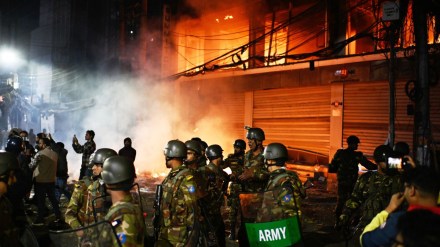
Bangladesh is seeing another round of massive unrest following the death of anti-India radical leader Sharif Osman Hadi. He was critical for a week after being shot in the head during a campaign in Bangladesh on December 12 and was airlifted to a hospital in Singapore. Despite the best efforts of the doctors, Hadi succumbed to his injuries. His death sparked huge violent protests in the country, with people throwing stones at the house of the Indian Deputy High Commissioner in Chattogram.
The protesters also targeted the office of Awami League seeking the return of Sheikh Hasina, who took shelter in India following the July uprising last year. Hadi was a key figure of the agitation that challenged Hasina’s regime in 2024, and his death has now caused a rapid chaos in the neighbouring country.
Offices of several media organisations have been set ablaze, as authorities rushed to mitigate the crisis. Several journalists were also trapped inside the burning buildings, leading to rescue operations.
Big media companies attacked
The demonstrators vandalised and set ablaze the office of the country’s largest newspaper, Daily Prothom Alo. Besides, the office of Daily Star newspaper was also targeted. These attacks began around 12 midnight on Thursday. As soon as the news of Inquilab Mancha spokesperson Sharif Osman Bin Hadi spread, a group of people gathered in front of the offices of the newspapers and attacked them, Nagorik reported, quoted ANI.
According to BD News, at least 25 journalists of The Daily Star were rescued from their office more than four hours after a mob vandalised it. The crowd chanted slogans, saying Hadi’s name as they marched towards the offices of media companies.
They first attacked the ground and first floors of the newspaper’s office before setting it on fire at about 12:30 am. The blaze quickly engulfed two floors, sending a huge column of smoke into the air, as per BD News, quoted ANI. Due to a blockade by the crowd, the fire service could not reach the building for some time.
“I can’t breathe anymore. There’s too much smoke. I am inside. You are killing me,” Zyma Islam, a reporter of the paper trapped inside the building, wrote.
People rushed to the roof to save their lives and pleaded for help on phone calls and social media posts.
Parliament panel on Bangladesh
The current development in Bangladesh comes a day after a parliamentary committee headed by Congress’s Shashi Tharoor flagged the ongoing situation in the neighbouring country poses the “greatest strategic challenge” for India since the Liberation war of 1971 and while it “will not descend into chaos and anarchy”, New Delhi must be careful of it.
“While the challenge in 1971 was existential, a humanitarian and a birth of a new nation, the latter was of a graver, a generational discontinuity, a shift of political order, and a potential strategic realignment away from India,” the Committee said.
“If India fails to recalibrate at this moment, it risks losing strategic space in Dhaka not to war, but to irrelevance,” it added.
India expresses concern
The anti-India protests have been held in Bangladesh for the past few days under the banner of “July Oyikko” (July Unity), with protesters marching to the office of the Indian Assistant High Commission in Dhaka on Tuesday. They demanded that all persons whom they consider fugitive accused, including former Prime Minister Sheikh Hasina, must return to the country.
Despite Bangladesh’s Chief Adviser, Muhammad Yunus, appealing to the citizens to maintain peace in the nation and allow law enforcement to conduct investigations professionally, the protests intensified.
“I make a sincere appeal to all citizens of the country–maintain patience and restraint. Allow law enforcement agencies and relevant institutions to conduct their investigations professionally. The state is fully committed to establishing the rule of law,” Yunus said, quoted PTI.
Indian Visa Application Centre (IVAC) in Rajshahi And Khulna were also closed in view of the security situation on Thursday.
On Tuesday, the Ministry of External Affairs (MEA) summoned the Bangladesh High Commissioner to India, Riaz Hamidullah, and was apprised of India’s strong concerns at the deteriorating security environment in Bangladesh.
His attention was drawn, in particular, to the activities of some extremist elements who have announced plans to create a security situation around the Indian Mission in Dhaka, the MEA said.
India completely rejected the false narrative sought to be created by extremist elements regarding certain recent events in Bangladesh. The MEA said it was unfortunate that the interim government has neither conducted a thorough investigation nor shared meaningful evidence with India regarding the incidents.


