




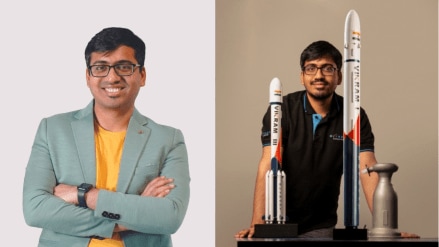
People on social media have been taking inspiration from Pawan Kumar Chandana, co-founder and CEO at Skyroot Aerospace. Wondering why? Because this founder, who “launched India’s first private rocket to Space”, was once an average student who scored just 51 marks in mathematics. His inspirational journey was shared by Deedy Das on social media.
Ambitious father didn’t give up
So how did he fall in love with the subject he struggled with? All thanks to his “ambitious” father, who didn’t give up after those low marks and instead got him enrolled in IIT JEE coaching. During his preparation for the entrance exam, Chandana not only improved academically but also fell in love with both maths and science.
In 2007, he joined IIT Kharagpur after clearing the coveted examination in his first attempt to study mechanical engineering. He has a dual BTech-MTech degree in Mechanical Engineering. While many of his classmates chased high-paying jobs and international careers, he chased rockets and space.
From working at ISRO to signing MoU with them
His love for space took him straight to ISRO in 2012, where he joined as a scientist right out of campus. Despite a low-paying salary, he thought of retiring from ISRO because he loved his work. Yet, the entrepreneurial spark he had carried since his IIT days remained with him. He dreamed of building a global space-tech company from India at a time when private rocket development was neither allowed nor funded.
Five years later, in 2018, he quit ISRO despite having no business background or professional network to fall back on. His first bold move as a founder was to seek funding, and he did that by cold-messaging Mukesh Bansal, founder of Myntra, CureFit and NuRX, on LinkedIn.
To his surprise, Bansal, also an IIT Kharagpur alumnus, believed in his vision and invested $1.5 million. But soon after, COVID-19 disrupted markets and raising a Series A round became a struggle as most investors remained sceptical of space startups.
Just when things seemed impossible, the founders of renewable energy giant Greenko believed in him and stepped in with financial backing, the support that helped keep his dream alive.
2021 became his year. It was the year when the Indian government opened the space sector to private companies. Skyroot immediately became the first private player to sign an MoU with ISRO, and later raised India’s largest DeepTech cheque of $51 million.
Launch of privately developed suborbital rocket
A year later, in November 2022, his company launched Vikram-S – India’s first privately developed suborbital rocket – which reached an altitude of 90 km. Soon after, Prime Minister Narendra Modi inaugurated his company’s new facility as Skyroot’s team grew to nearly 1,000 employees and established the country’s largest private rocket manufacturing unit.
Today, his company is valued at around $527 million and is preparing for its next milestone – Vikram-1, the orbital launch scheduled for 2026. If successful, Skyroot will join the top five private companies globally capable of regular orbital missions.
Inspirational? Absolutely. As Das wrote while sharing Chandana’s story: “We talk a lot about Elon Musk and SpaceX, but imagine having no prior wealth, being in a developing country, being unable to raise venture funding multiple times, saying no to money, being called crazy, and still persevering to dream beyond the stars.”
He added, “I’d call Pawan’s story inspirational, but honestly, it’s more than that. It’s beyond what I can fathom.”

Chandana responded to Das’ LinkedIn post about him and expressed gratitude towards him. “Thanks, Deedy Das, for such a thoughtful deep dive into my journey,” he wrote on LinkedIn in response to his long post on the platform about him.
How did social media users react?
“Amazing, and the best part is that he didn’t choose to leave India. This proves that India has enough talent to send out as well as to build at home,” said one social media user.
Another added, “From 51 in math to launching rockets to space. That’s not a redemption arc, that’s a full glow-up! Proves that grades don’t define genius—only execution does.”
“This 1 guy has compensated for the void that thousands of IITians create when they leave India,” commented a third.
A fourth posted, “Cherry on the top is he touched an area where a handful of private players in this space in India. It is way bigger than it looks.”


