




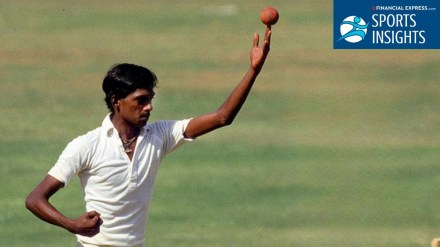
Calendar says Laxman Sivaramakrishnan was born today. That name still rings bells for old-timers who watched cricket in the eighties. Three Hindu gods in one surname, yet not one of them stuck around when things went bad. He was sixteen when he spun Tamil Nadu to an impossible win. Seventeen when he faced the West Indies in Antigua and got spanked for ninety-five runs without a wicket. Eighteen when he single-handedly demolished England in Bombay and became the boy wonder of Indian cricket. Twenty when he played his last Test match. The gods had left the building by then.
The boy who was not meant to play
Sunil Valson woke up unfit on the morning of the match. That one sore shoulder changed everything. Tamil Nadu had prepared a turner for Delhi, banking on Venkataraghavan and Vasudevan. They didn’t need a third spinner, especially a schoolboy who weighed less than his kit bag. But Valson couldn’t bowl, so the kid got thrown in. Sixteen years old. No warning. No preparation.
First innings he went for two wickets and 70 runs in 27 overs. Respectable, nothing more. Delhi had a batting line-up that could scare grown men. The second innings was when the magic happened. Delhi were 90 for 3, cruising. Sivaramakrishnan took 7 for 28 in eleven overs. They collapsed to 117. The ball didn’t just turn, it obeyed his commands like a trained dog. People who saw it still talk about it in hushed tones.
Too young, too soon
They picked him for Pakistan first. He didn’t play. Then came the West Indies tour, the most frightening place for a spinner in those days. Viv Richards, Clive Lloyd, Gordon Greenidge. Men who ate spinners for breakfast. Siva got thrown to the wolves.
He bowled 25 overs. Zero for 95. The figures look kinder than the reality. The ball disappeared into concrete stands. West Indian batsmen didn’t respect him. They didn’t need to. He was a child throwing stones at tanks. The captain probably didn’t know what to say to him. The coaches in those days were short-term visitors, not real guides. You were on your own, especially when you were seventeen and the world was watching.
18 and unstoppable in Bombay
Then came England at home in 1984-85. Different story. Same boy, different conditions. He took 12 wickets in Bombay. 6 for 64 in 1st innings, 6 for 117 in 2nd. English batsmen looked like they were batting with toothpicks. He bowled legbreaks, googlies, topspinners. The ball fizzed and spat and did things that defied physics. He got 23 wickets in the series. Still a teenager. Still learning where to put his confidence.
The World Championship of Cricket in Australia followed. Gavaskar wanted a leggie for the big grounds. Siva kept taking wickets in the middle overs. The team had been written off after losing to England. They went to dinners together. They practiced together. They fought together. India won the tournament. Siva was a key soldier, not just a mascot.
The ball Miandad will never forget
Melbourne, March 10, 1985. The final against Pakistan. The selectors had gambled on the boy. The large Australian grounds suited him, they said. He gave the ball air, something Indian spinners had stopped doing. He was lucky a few times, full tosses that dipped and landed in fielders’ hands because batsmen couldn’t clear 95 meter boundaries.
Then came the spell. Kapil Dev had already taken early wickets. Pakistan were wobbling. Javed Miandad and Imran Khan were at the crease. Two masters of spin. They couldn’t afford to hit out. That respect made Siva more creative. He teased them until they froze. A mix-up, and Imran was run out.
Then the ball. A beautifully flighted legbreak on leg stump. Miandad stepped out. The ball dipped at his feet, snapped across, and Sadanand Viswanath whipped off the bails. Miandad stood frozen. Shane Warne would have been proud to bowl that delivery. Siva was nineteen.
When the music stops at twenty
He played one Test in Sri Lanka later that year. Did nothing. Went to Australia again. The magic had left. The ball came out of his hand flat and expected. Batsmen read him like a newspaper. He was still a boy, but the boy wonder tag had become a curse.
The human cost gets glossed over in scorecards. Captains didn’t know how to handle him. The coaching structure changed every series. One coach told him one thing, the next told him the opposite. He was shy. He didn’t fight back. He just tried to please everyone and pleased no one, least of himself.
He tried to return as an allrounder. His batting improved enough to help Tamil Nadu win the Ranji Trophy in 1987-88 after thirty-three years. But it was desperate stuff. You don’t become an allrounder because your main skill has deserted you. You become one because you always had both.
The comeback that wasn’t
The 1987 World Cup squad. Brief, unsuccessful. By the late eighties he was fighting for his place in the Tamil Nadu side as a batsman. Think about that. The boy who could spin a ball around corners was now trying to survive on his batting. The nineties brought reports of the boy wizard on the comeback trail. They were just reports. The road led nowhere but obscurity.
In interviews later, Siva talked about lack of handling by his captain. About coaches who were temporary visitors. About the absence of guidance for a teenage phenom. He talked about the decline of spin bowling in India, as if his own story was a symptom of a larger disease. He was right.
Numbers don’t lie but they don’t tell the truth either
Nine Tests. 26 wickets at 44 average. 16 ODIs. 15 wickets. That’s the career. The stats hide the teenage genius who took seven for twenty-eight on debut. They hide the boy who won a Test match for India at eighteen. They hide the kid who made Javed Miandad look foolish in a world final.
The stats are honest. The story is tragic. Indian cricket has a graveyard of teenage spinners. Siva is the biggest headstone. The lesson is clear: talent means nothing without handling. Promise means nothing without structure. Being a boy wonder means nothing if nobody helps you become a man.
He has four gods in his name. Maybe they were there all along. Maybe they were shouting. But nobody was listening. Not the selectors. Not the captain. Not the coaches who came and went like seasonal workers. And when you’re seventeen and the world loves you, you don’t listen either. You think it will last forever.
It doesn’t. Siva learned that by the time he could legally drink in most countries. The rest of us are still learning it, every time another teenage sensation appears and disappears before we can even learn how to spell his name.


