


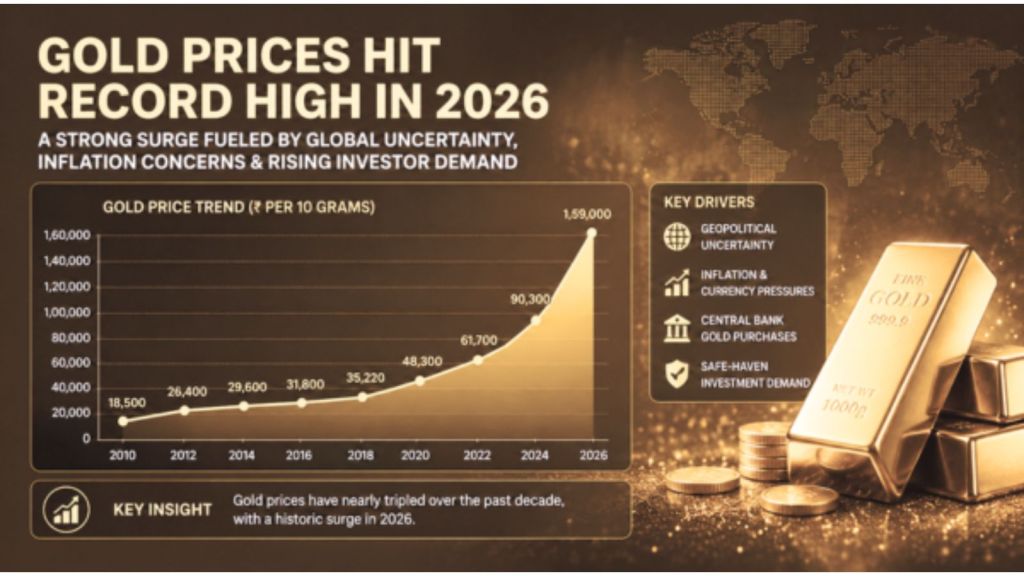
India’s dependence on gold imports presents an unusual economic contradiction.
Nearly all of the country’s gold demand continues to be met through imports, even as Indian households are estimated to already hold roughly 25,000 tonnes of gold accumulated over decades.
That tension is becoming harder to ignore.
According to SBI Research, India’s gold imports rose over 24% from $57.9 billion in FY25 to an all-time high of $72.4 billion in FY26. With rising gold prices, pressure on foreign exchange reserves and continued volatility in global markets, the import of gold in India is increasingly attracting attention not just as a trade issue, but as a consumption question.
The question is straightforward: can a larger share of India’s gold demand be met by bringing existing household gold back into circulation?
Across the organised jewellery sector, some early signs suggest consumer behaviour may already be moving in that direction.
Exchange-led purchases are becoming more prominent within organised jewellery retail, as consumers increasingly look to unlock the value of jewellery already available to them rather than funding entirely fresh purchases.
This shift is not driven only by economics. It is also being enabled by improvements in process transparency, standardisation and organised retail practices around gold exchange.
Historically, one of the biggest friction points in gold exchange has been trust.
Consumers have often expressed hesitation around purity testing, deductions, inconsistent valuation methods and uncertainty around exchanging jewellery bought from other jewellers. In response, organised players have increasingly tried to reduce these barriers by making exchange processes more visible, standardised and easier to understand.
Several jewellery brands have strengthened exchange-led propositions in recent times. Among the more prominent examples is Tanishq’s “Your Old Gold. India’s New Strength” initiative with Sachin Tendulkar, launched several months before gold imports became a major mainstream discussion point.
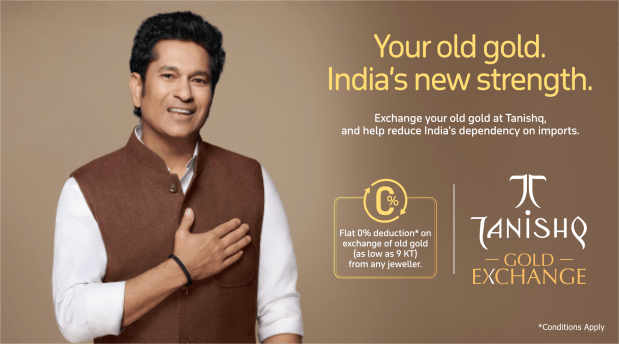
Rather than positioning exchange purely as a promotional mechanic, the initiative framed it as a responsible way to reuse domestic gold already available within Indian households.
The scale of adoption offers an interesting indicator of changing consumer acceptance. According to company data, more than 36 lakh Indians have exchanged old gold with Tanishq over the years, while over 14,000 kilograms of gold has been brought back into circulation through its exchange programme in the last year alone.
Equally important is how this brand has solved for the trust barrier. At Tanishq stores, the customer’s gold remains visible throughout the exchange process. Purity testing, weighing, valuation and melting are conducted transparently in front of customers’ eyes. Karatmeters are used for purity assessment, gold and stone weights are measured separately, and old jewellery purchased from any jeweller can be exchanged across purities, even without bills.
The company says valuation is designed to remain transparent as well, with exchange rates being the same as gold buying rates and no hidden deductions.
For the organised jewellery sector, this may point to something larger than a retail trend.
If consumer trust, process transparency and organised exchange infrastructure continue to strengthen, gold exchange could gradually evolve from a niche transactional service into a more meaningful component of India’s domestic gold economy.
India’s appetite for gold is unlikely to diminish. But the future of gold consumption may increasingly depend not only on how much gold the country imports, but also on how efficiently existing gold assets within Indian households are reused, upgraded and brought back into circulation.