




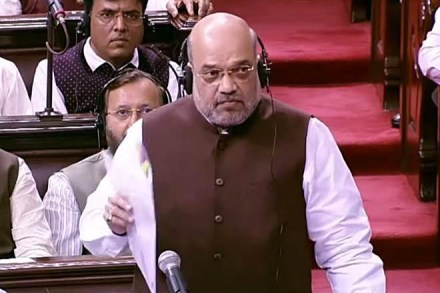
India’s bold move to alter the status of Jammu and Kashmir comes at the moment of rapid diplomatic developments in Afghanistan. It was the intensification of the efforts for a political settlement in Afghanistan that had emboldened Pakistan in the first place to escalate tensions on the Line of Control and prepare a major offensive in Kashmir. Delhi’s Kashmir move begins a rewrite of India’s strategy for coping with an entrenched conflict on its north-western frontiers.
But first to Afghanistan. Contrary to the widespread scepticism about a political breakthrough in the peace process, there is a new momentum since Pakistan’s army chief General Qamar Javed Bajwa and PM Imran Khan travelled to Washington last month.
The US-Pakistan talks arrived at a broad understanding that Pakistan army will help “extricate” (in Trump’s words) the US from its longest war and Washington will reset the relationship with Islamabad that has frayed badly in recent years. American mediation in Kashmir is part of Pakistan’s wish list in the planned reset.
Meanwhile, the Bajwa-Imran visit to Washington set the stage for the eighth round of talks between the US and the Taliban over the weekend in Doha, Qatar. Just before the talks, US special envoy for Afghanistan Zalmay Khalilzad said the Taliban might be willing to compromise that the US is “ready for a good agreement.”
Khalilzad’s visit to Kabul and Islamabad on his way to Doha has generated expectations that a deal between the US and the Taliban may well be signed by next week. The agreement is expected to be built around a US commitment to withdraw troops and assurances from the Taliban that it will not let al-Qaeda and other international terror groups operate from Afghanistan.
Until now, the Taliban has insisted that the US must withdraw all its forces from Afghanistan. The US, on the other hand, wants to leave a small force to execute counter-terror missions. Pakistan is expected to nudge the Taliban into accepting a phased withdrawal of American troops.
The US also wants early talks between the Taliban and the Afghan government. The Taliban has so far resisted any direct engagement with what it calls America’s ‘puppet regime’ in Kabul. Last month, the Taliban acquiesced in the participation of Kabul’s representatives, in their personal capacity, in an intra-Afghan dialogue in Doha.
There is speculation that talks between the Taliban and the government might take place soon in Oslo, immediately after the US and the Taliban agree on withdrawal and counter-terror assurances. Kabul is said to be preparing to send a delegation to the Oslo talks. If these reports turn out to be true and the Taliban agrees to observe a ceasefire as part of the dialogue with the government, Pakistan can claim to have ‘delivered’ the Taliban to the US.
Sceptics would say these are very big ‘IFs’. On top of it, there are reports the US wants all elements of the deal—a phased withdrawal of US troops, Taliban’s terror assurances, talks with Kabul and a ceasefire—tied up pretty quickly. President Trump seems to have set a deadline of September 1.
If a comprehensive framework is ready by then, Trump might visit Afghanistan to preside over the signing ceremony. From there it is but a short hop to Islamabad for a thanksgiving visit.
The Pakistan army certainly understands that an Afghan peace deal would be a huge personal and political triumph for President Trump as he approaches his election campaign next year.
Facilitating a deal, even a shaky one, that is in tune with Trump’s political calendar will help Pakistan repair the damaged relationship with the US. Islamabad also hopes that it will restore Pakistan’s value in US strategy towards South Asia that had tilted in favour of India in recent years.
India learnt, through repeated crises since the 1980s, to fend off Pakistani pressures on internationalising the Kashmir question. Delhi has also got better at navigating the triangular dynamic with Pakistan and the US. Delhi has also become adept at turning the crises with Pakistan to focus less on Kashmir and more on the sources of terrorism originating from Pakistani soil.
A number of factors have facilitated this. For one, Delhi is a lot stronger than it was at the time of the first Afghan crisis in 1979 after Soviet Union occupied Afghanistan. For another, the gap in comprehensive national power has widened in favour of India. And the quality of India’s relations with the great powers, too, has significantly improved.
The biggest change is Delhi’s decision to stop being defensive on Pakistan and Kashmir. We have seen that in the response of the Modi government to the terror attacks at Uri in 2016 and Pulwama in 2019.
Having rolled the dice on Kashmir, Delhi now needs an effective strategy to contain potential violent reactions at home and manage international diplomatic fallout.
If India plays its cards well, the change in the internal status of Kashmir might provide the basis for addressing the international dimensions of a question that has long hobbled India and the subcontinent. Much in the manner the creative diplomacy that followed India’s defiant nuclear tests of 1998 helped end the nation’s prolonged atomic isolation, Delhi must now develop an external strategy that will facilitate a final settlement of the Kashmir question.
(The writer is Director, Institute of South Asian Studies, National University of Singapore, and contributing editor on international affairs for The Indian Express)


