




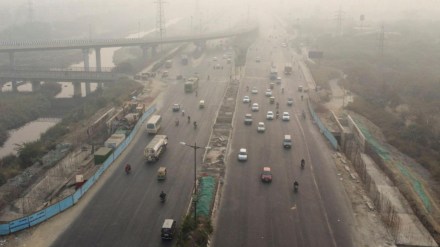
In the national capital region (NCR), this is a dreaded time of the year from the public health perspective. As winter sets in, a thick haze usually envelops the region as weak winds cannot disperse pollutants in the air due to vehicular and industrial emissions, construction activities, paddy residue burning in neighbouring states, and the festive burning of crackers, all of which makes the NCR a noxious gas chamber. The big question is whether this year will be any different from past experience. Unfortunately, indications are for more of the same, as air quality has worsened ahead of Diwali, forcing authorities to impose stage 1 restrictions of the graded response action plan across the NCR to curb rising pollution. Whether such measures that are too little, too late will prevent further deterioration of air quality is debatable.
The irony is that the Delhi-NCR states, along with the Centre, which seek to reduce pollution, also successfully petitioned the Supreme Court to temporarily relax its absolute ban of firecrackers and permit only government–approved green crackers during Diwali and other festivals during specified time slots. The pollution season is only likely to kick in as before. The SC described its temporary relaxation as a “test case” to determine whether a carefully-regulated framework could coexist with efforts to mitigate air pollution. Accordingly, it directed the central and state pollution control boards in the NCR to monitor and submit a report on air quality during October 14-25. Public health professionals, however, fear the worst as green crackers still release fine particulate matter and toxic gases—although less by 30% than conventional firecrackers as is claimed. It will trigger a surge of respiratory and cardiac ailments during this season.
Interestingly, the Delhi government has plans to carry out cloud seeding to induce artificial rain in the nation’s capital just after Diwali to curb pollution and awaits a green signal from the India Meteorological Department. Here again, the alleged benefits of cloud seeding are debatable as the rain will have to be more than a drizzle to washout the pollutants.
As for farm fires, which contribute 15-30% to the particulate matter in the NCR, the favourable news so far is that they are substantially down in the first month of the stubble burning season (September 15-November 30) compared to the previous year. In Punjab and Haryana, such fires have sharply dropped by 84% and 95.5% respectively according to the Indian Agricultural Research Institute, only being up by 39% in Madhya Pradesh. Contributory factors include the wettest monsoon season that has delayed harvesting of paddy. But as the window between harvesting and sowing of wheat, which starts in the first week of November, gets narrower, there will be more paddy stubble fires which will contribute to the haze over the NCR.
Being the most polluted region in the world seriously detracts from the ambitions of the ruling dispensation to make India a developed nation by 2047. This really calls for a determined effort to address pollution in the NCR all year around rather than only during the pollution season. Among the various policy options, what can make a big difference to make the region more livable from a public health standpoint is to incentivise a greater adoption of public transportation as the explosion in the use of personal vehicles is not sustainable.


