




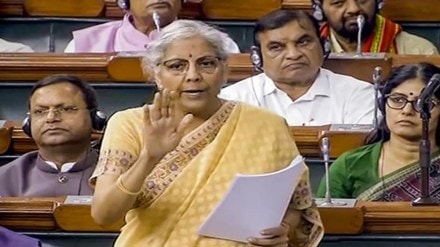
In less than two months from now, Finance Minister Nirmala Sitharaman will present the Modi 3.0 government’s third Union Budget. And like every year, the bulk of the speculation is around the possible tax proposals. One major question is whether the government will finally scrap the old tax regime altogether.
Speculation has intensified ahead of Union Budget 2026–27 that the government may indeed phase out the old tax regime. This comes at a time when a large majority of taxpayers have already shifted to the newer, simpler system.
Official data suggests that around 9.19 crore returns were filed in FY 2024–25. It is expected that these numbers could rise to nearly 10 crore filings in FY 2025–26. After the last Budget’s big relief — making income up to Rs 12 lakh effectively tax-free under the new regime — the government had indicated that nearly 75% taxpayers had already migrated to the new tax regime. It can easily be assumed that this figure would have easily crossed 80% by now.
So, with such a large majority already on the new regime, will the government scrap the old one in Budget 2026? Experts say not yet — and for several strong reasons.
Why the old tax regime may not go away just yet
1. India’s savings structure still depends on the old regime
According to Sandeep Bhalla, Partner, Dhruva Advisors, the old regime has long acted as a backbone for India’s household savings. He explained that tax deductions like Section 80C, 80D and 24(b) have guided people toward PPF, EPF, life insurance, pension plans and home ownership.
He says removing these incentives abruptly could “weaken India’s savings rate and jeopardise the retirement planning of millions”.
Advocate Sharanya Tripathi of Jotwani Associates echoed a similar sentiment, adding that deductions under 80C, 80D, HRA and housing loan interest continue to drive long-term savings into essential sectors like life insurance, provident funds, and health insurance. A sudden withdrawal could cause “a drop in long-term savings and investments, which still form a significant part of domestic capital formation”.
2. Middle-class cashflows are built around tax-linked products
A major chunk of India’s middle class has structured their finances around tax-saving instruments.
Bhalla notes that many have long-term home loans, insurance policies and pension products bought with tax benefits in mind. A sudden withdrawal, he said, could “disrupt these commitments and create dissatisfaction”.
Tripathi also warned that salaried taxpayers, especially those relying on 80C or HRA benefits, may feel their tax burden rise even if the new regime is cheaper on paper — because the psychological link between tax-saving and disciplined investing would break.
3. A dual system helps maintain stability
Bhalla said that keeping both regimes helps maintain overall confidence, as the new regime boosts consumption, while the old one supports “disciplined savings”. A dual framework, he explained, avoids sudden behavioural shocks in the economy.
Businesses and financial institutions also rely on continuity. Abrupt removal could “trigger disputes, increase compliance burdens, and strain administrative bandwidth,” he added.
4. Administrative and legal complexity of scrapping the old tax regime
Tripathi points out that the Income Tax Department is already handling returns under both regimes smoothly. Scrapping the old regime would require amending many sections of the Income Tax Act and could lead to cases from taxpayers who had planned finances based on existing deductions.
She added that the government appears to be following a “let it wither on the vine” strategy — making the new regime more attractive each year while letting the old regime fade gradually, without the complications of an abrupt abolition.
5. A phased, non-coercive transition is the government’s preferred path
The government has so far nudged taxpayers gently — making the new regime the default, reducing rates, and expanding rebates. Bhalla said this gradual approach allows behavioural adjustment “without mandating an abrupt break from entrenched practices”.
Could scrapping the old regime now cause disruption? Experts say THIS
Both experts agree that a sudden withdrawal now could create unrest among taxpayers.
Even though nearly 80% of taxpayers have transitioned to the new tax regime, the government is unlikely to withdraw the old regime immediately due to a combination of economic, social, and administrative factors, Bhalla said.
He also said it would pose “significant behavioural and economic challenges” as it requires a shift away from India’s savings-oriented financial habits. Without tax-linked nudges, households may spend more in the short term but risk long-term financial vulnerability.
Tripathi stressed that sudden removal would be seen as a “retrogressive” step by the middle class, especially close to an election year, making a complete phase-out unlikely in Budget 2026.
What conditions are needed before phasing it out?
According to Bhalla: The government must protect household savings behaviour even without tax deductions. It should assess the impact on long-term commitments like home loans and insurance bought for tax benefits. A proper balance between consumption and savings must be ensured. A single regime must also lead to real simplification, without new complexities.
According to Tripathi: Migration to the new regime should reach 90–95%. Standard deduction and rebate under the new regime should fully offset benefits most taxpayers get under 80C or HRA. Non-tax incentives (like better small savings rates) should support long-term savings. A grandfathering window should allow existing investments and home loans to continue enjoying deductions until their tenure ends. A multi-year sunset clause could make withdrawal practical and acceptable.
Conclusion: Old regime likely to continue in Union Budget 2026
Even though more than 80% of taxpayers may now be using the new tax regime, both experts believe the government is unlikely to scrap the old one in the upcoming Budget. The savings ecosystem, middle-class financial structures, long-term commitments, and the need for a smooth transition all make a strong case for retaining both systems for a few more years.


