




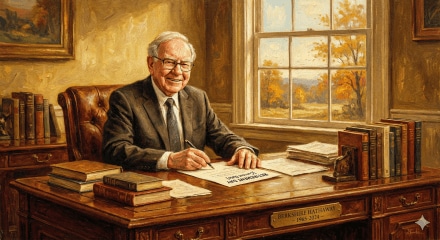
Warren Buffett didn’t invent anything new.
He didn’t build software, launch a startup, or disrupt a sector. What he did, consistently and for over six decades, was buy a few good businesses often when they were unpopular and hold them long enough for the market to catch up to reality.
He bought Coca-Cola in the late 1980s and never sold. He bet on American Express, even when others doubted it. He came to Apple late, and still turned it into Berkshire Hathaway’s largest holding.
Along the way, he turned dull virtues – restraint, selectivity, consistency into a compounding engine that outperformed generations of cleverer, faster investors.
This is not a tribute to his returns. It’s a closer look at how those returns were earned and more importantly, why the core skill that powered them still doesn’t get the respect it deserves.
In today’s market, dominated by instant headlines, algorithmic trades, and performance measured in months, patience feels like a luxury or worse, a weakness. But for Buffett, patience wasn’t passive. It was a disciplined, strategic advantage: the ability to sit still while good businesses did the work.
This article explores that edge. It examines how Buffett used patience not just as a habit, but as a tool through specific long-term holdings, through market crashes, and through long periods of doing nothing.
And it asks why, despite all the evidence, most investors still struggle to adopt it. Because in a world that keeps getting faster, the ability to slow down might be the last edge left.
1. What Buffett did differently
In a world where most investors constantly search for the next big opportunity, Buffett kept returning to the same principle: buy a great business at a fair price, and hold it long enough for the rest of the world to notice.
That was the only strategy.
Consider Coca-Cola.
Buffett bought the stock in 1988, in the aftermath of a market crash, when investor sentiment was brittle. He invested $1.3 billion for about 6.2% of Coca Cola’s at the time and then… did nothing. He never sold. Thirty-five years later, the position is worth over $25 billion. But more importantly, the company now pays Berkshire over $600 million a year in dividends. The original investment is returned every two years and that too just in cash. That’s what happens when you let time, not timing, do the work.
Or take American Express.
Berkshire bought it in the early 1990s and still owns it today. Over the years, the dividend has grown so steadily that the yield on Buffett’s original cost is now north of 35%.
Apple, a more recent purchase, was added in 2016, long after Buffett famously avoided tech. But he approached it not as a gadget maker, but as a consumer brand with deep customer loyalty. It became Berkshire’s single largest equity holding, crossing $100 billion at its peak.
In all three cases, Buffett didn’t trade around the positions. He sized them with care, bought at rational prices, and held through volatility, underperformance, and cycles.
It was informed patience – a deliberate choice to let a business compound instead of constantly reallocating capital. Even within Berkshire’s core insurance operations, Buffett played a long game: using insurance float to patiently fund investments while most others chased speed.
He built his track record not on prediction, but on restraint. While others reacted, Buffett waited. And the longer he held, the stronger the edge became.
2. Why patience worked and still does
Patience is often dismissed as a personality trait. But in Buffett’s hands, it functioned like a system.
One reason patience worked is that markets don’t reward speed the way most people assume.
A Morningstar study found that even among professional fund managers, the ones with the lowest portfolio turnover – meaning the most patient, tended to outperform their peers over long periods.
Meanwhile, data from the Investment Company Institute shows the average mutual fund now turns over about 63% of its portfolio annually suggesting most managers are switching stocks every 18 months or less.
That churn is costly.
Buffett’s approach sometimes turning over less than 5% of his holdings in a year wasn’t just efficient. It avoided the silent bleed of fees, mistakes, and missed compounding.
Patience also aligned with how actual business value unfolds. Great companies rarely deliver in straight lines. Earnings stall, industries shift, cycles hit. Yet over time, businesses with pricing power, capital discipline, and customer loyalty tend to pull ahead. Buffett understood this.
He wasn’t trying to own perfect companies but he was trying to own resilient ones. By sitting through temporary pain, he captured permanent gains. Most investors, trained to react, sell before that inflection point.
There’s also the emotional gap. In studies of investor behavior, time horizon consistently emerges as the strongest predictor of long-term success. Those who track their portfolios daily or weekly are more likely to trade — and less likely to beat the market.
Buffett famously said he wouldn’t care if the market shut down for five years. That wasn’t bluster. It was insulation from panic, noise, and the itch to act.
Finally, patience gave him access to situations others couldn’t touch. Buffett was often willing to buy when others froze: mid-crisis, post-scandal, or in boring sectors. He once noted that investors willing to wait five years instead of five months were competing with far fewer people. That’s a form of arbitrage not on price, but on time. And in a hyperactive market, it remains one of the few edges that hasn’t been arbitraged away.
So yes, patience worked not because Buffett was slow, but because everyone else was in a hurry.
3. Why patience is rare and harder today
If patience works so well, why don’t more investors use it?
The answer is simple: it’s hard not intellectually, but psychologically. And in today’s market, it’s getting harder.
Start with the incentives.
Most professional fund managers are judged on quarterly benchmarks. CEOs are under pressure to meet earnings estimates every 90 days. Retail investors are fed a constant stream of market updates, opinion videos, and price alerts. Every part of the system nudges you to do more, react faster, act now. Patience, in that context, looks not just old-fashioned but it just looks wrong.
Then there’s the technology.
Zero-commission trading and real-time data have flattened the cost of action. A portfolio can be rebuilt with a swipe. There are fewer barriers between impulse and execution. What used to require calling a broker now happens in a second. The frictions that once gave investors time to reflect have all but vanished. In that frictionless world, inactivity feels like indecision when it’s often the better call.
Even the stories we admire work against patience. Media celebrates the fast turnaround: the trade that tripled in a week, the founder who scaled in a year, the meme stock that defied gravity. There’s little room in that narrative for someone who held the same stock for 20 years and quietly compounded. Buffett’s approach doesn’t generate many headlines until it does.
But perhaps the biggest challenge is internal.
Investors don’t like being bored. They don’t like lagging behind others, even briefly. And they especially don’t like doing nothing. Behavioural finance calls it “action bias” – the instinct to respond, even when staying put is the better choice. Combine that with loss aversion, performance envy, and social media’s constant scoreboard, and you get a market culture that systematically underprices stillness.
Buffett once joked that if he were on a desert island with access to only annual reports and no stock quotes, he’d probably do even better. In many ways, he built his success by protecting himself structurally and psychologically from the very pressures that modern investors now face in excess.
Patience hasn’t disappeared. But it’s now a contrarian position and that may be the strongest case for why it still works.
The edge that outlasts Buffett
Warren Buffett has retired. The meetings, the letters, the folksy quips – they will slowly fade. But the edge that defined his career doesn’t retire with him.
In a market that moves faster every year, patience remains misunderstood. It’s often mistaken for inertia or complacency. But Buffett showed it to be something else entirely: a form of discipline, of clarity, of confidence in both the businesses he owned and the process he followed. It wasn’t just that he held on. It was that he knew why he held on and trusted time to do its work.
That’s not easy.
Most investors today are surrounded by noise, rewarded for speed, and trained to act. But the markets haven’t changed as much as we think. Compounding still takes time. Good businesses still win slowly. And behaviour still separates outcomes far more than information.
Buffett’s retirement is a reminder that the rarest skill in markets is restraint. That edge is still available. It always has been. The question is whether more people will learn to use it now that he’s retired.
Disclaimer: This article is for informational purposes only and does not constitute financial advice. Please consult a qualified professional before making investment decisions.
Note: This article relies on data from fund reports, index history, and public disclosures. We have used our own assumptions for analysis and illustrations.
Parth Parikh has over a decade of experience in finance, research, and portfolio strategy. He currently leads Organic Growth and Content at Vested Finance, where he drives investor education, community building, and multi-channel content initiatives across global investing products such as US Stocks and ETFs, Global Funds, Private Markets, and Managed Portfolios.


