




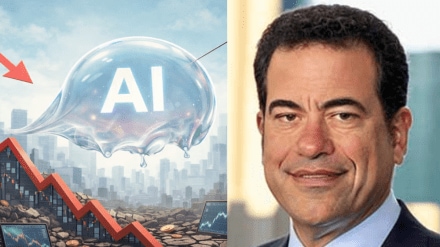
Discussions around a possible AI bubble have been growing louder on Wall Street. Investors and analysts are increasingly debating whether the rapid rise in artificial intelligence stocks is sustainable or if the market is heading toward a sharp correction.
Several market veterans, including The Big Short investor Michael Burry, have already raised red flags. Now, Danny Moses, another trader made famous by the 2008 financial crisis, is also warning the investors.
As the AI boom continues, Moses says investors should focus on two key questions, Is there an AI bubble forming, and does it resemble the dot-com crash of the early 2000s?
According to Moses, the answer to both is yes.
AI growth is real, but risks are rising
About the current AI rally, Moses told Business Insider that he does not deny that artificial intelligence is a long-term growth story. However, he sees strong similarities with the dot-com era, when excitement ran ahead of financial reality.
“The growth was real, but the math didn’t work,” he told Business Insider. “And I think that we’re reaching a point where the math is starting not to work.”
Moses believes that while AI adoption will continue, the amount of money being spent, especially on infrastructure and computing, may not justify current valuations for all companies involved.
This is not a call to short AI stocks
Importantly, Moses stressed that his warning should not be taken as a signal to bet against the AI sector. Instead, he says investors need to do deeper research and be selective about which companies they invest in. His advice is to focus on large, established tech firms that have strong balance sheets and can afford to slow spending if needed.
Big Tech has an advantage
Moses believes that the strongest AI exposure lies with companies that already dominate the tech sector and generate steady cash flows.
He specifically named Amazon, Google, Meta, and Microsoft as examples of companies that are better positioned to handle the costs of AI expansion.
“They can turn down their capex at any point, and they’re still cash flowing positive, as opposed to these other companies, which are dependent upon that spending within AI,” he said to Business Insider. These firms, according to Moses, have other profitable businesses to rely on if AI investments take longer to pay off.
Not all AI-linked stocks are safe bets
Moses also warned that some companies tied closely to the AI supply chain face higher risks. He pointed to Oracle, citing concerns around its high debt levels and the large cash requirements needed to meet demand from tech clients.
He also flagged Super Micro Computer and CoreWeave as examples of more volatile and riskier AI-related stocks.
Investors are starting to separate winners from losers
Regardless of the caution, Moses sees a positive sign in how the market is evolving. He believes investors are becoming more selective and are beginning to distinguish between strong and weak AI plays.
“I think it’s proof that investors are beginning to sort out the winners and losers of the trade, and they’d much rather have comfort and other businesses with stronger balance sheets to fall back upon to express the AI theme,” Moses added.
AI needs massive infrastructure and time
Moses also explained a key mismatch between expectations and reality when it comes to AI growth. He noted that building the infrastructure needed to power AI, especially energy and data capacity, will take far longer than many investors expect.
“One of the trades that I like is uranium, which thematically, should work, but it takes a long period of time,” Moses told Business Insider. “There’s a mismatch in the timing of how people think that companies will experience AI growth and actually the infrastructure that it’s going to take to power it.”
Markets still rally as AI stocks lead gains
Regardless of these warnings, markets ended higher for the second straight session on Friday, December 19, as investor risk appetite returned.
Nasdaq rose 1.3%, the S&P 500 gained 0.9%, and the Dow Jones Industrial Average advanced 0.4%. A day earlier, the indexes had climbed 1.4%, 0.8%, and 0.1%, respectively.
Disclaimer: This article provides factual analysis only and is not, and should not be construed as, an offer, solicitation, or recommendation to buy or sell securities. Investors must conduct their own independent due diligence and seek advice from a registered financial advisor in the respective jurisdiction.


