




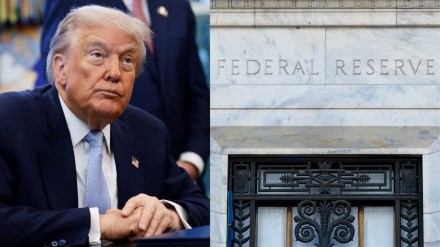
President Trump is set to announce the new Federal Reserve chair in the new year. He has made no secret of his desire for substantially lower interest rates. Whoever he appoints is likely to move in the direction, relative to the current chair Powell. Trump’s most recent appointee to the Fed board is Stephen Miran. He has consistently voted for half point rate cuts at every meeting. He recently suggested that current data is significantly overstating inflation.
The market predicts that Trump will get his wish when it comes to interest rates. Futures contracts suggest that the Fed will cut rates another two or three times by December 2026.
The India Parallel: Rajan, Patel, and the RBI
A similar dynamic played out with the RBI. Raghuram Rajan was RBI governor between 2013 and 2016. Towards the end of this term, the central government wanted the RBI to lower rates. Rajan was known as a hawkish governor focused on inflation. He was replaced rather than offered a second term. The new governor Urjit Patel lowered interest rates soon after taking office.
Central banks are in general structured to be independent. The chair or governor is appointed by elected officials, but after that they have considerable freedom to operate. The primary role of a central bank is to set interest rates, with the goal of keeping inflation stable and low.
Mission Creep: From Interest Rates to ‘Everything’
Over time, central banks have grown in their operations. Since the financial crisis of 2007-08, central banks have expanded their toolkit. A good example is the rise of asset purchases and quantitative easing. Another is the increase in interventions in the foreign exchange market. Yet another is the rise in regulatory powers given to the central bank. Central banks now respond more quickly to declines in economic activity. They monitor threats to financial stability. Plenty of evidence suggests they also respond to stock market declines.
And herein lies the tension when it comes to maintaining independence. As the central bank’s role has grown, it inevitably attracts further scrutiny. The reality is that central banks can never be truly independent. And nor should they be. The public sector must ultimately be accountable to elected officials. And to the people that elect them.
What happens when more central banks take an active role? Or when they shape economic policy and financial markets? Well, they become more accountable to politicians. And this is not a road worth going down.
Overly active central banks are also bad for economic growth in the long run. Too much intervention reduces incentives for private investors. They stop taking responsibility for bad investments.
The Solution: Stick to the Basics
The best thing for central banks to do is to pare down. Focus on the core task of setting interest rates to keep inflation low and stable. This turns out to be a relatively simple task too. Leave the rest of economic policy and management to elected officials. This will restore central banks to their proper function and restore their limited independence.
Note: The purpose of this article is to share interesting charts, data points and thought-provoking opinions. It is NOT a recommendation. If you wish to consider an investment, you are strongly encouraged to consult your advisor. This article is for strictly educative purposes only.
Asad Dossani is an assistant professor of finance at Colorado State University. His research covers derivatives, forecasting, monetary policy, currencies, and commodities. He has a PhD in Economics. He has previously worked as a research analyst at Equitymaster, and as a financial analyst at Deutsche Bank.


