




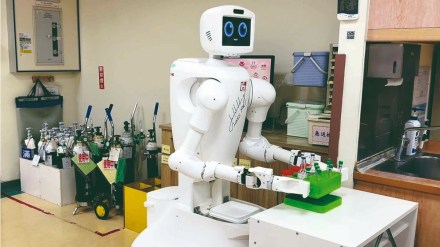
1. The Nurabot:
The Nurabot is an autonomous, AI-powered nursing robot designed to help nurses with repetitive or physically demanding tasks. It is scheduled for commercial launch in early 2026, and has been undergoing testing in Taiwan for 10 months.
As per the company developing the robot, the humanoid can reduce nurses’ workload by up to 30%.
2. Deepview for burns:
Spectral AI’s Deepview System has outperformed burn physicians in identifying non-healing tissue, the company reported. Deepview achieved 86.6% sensitivity when identifying non-healing tissue at an image-wise level of assessment, while the clinical judgment annotation of burn physicians scored 40.8%. The study also conducted assessments at the pixel-wise level. Spectral AI plans to launch the product in 2026.
3. Pregnancy Robot :
A first of its kind ‘pregnancy robot’ is reportedly being developed in China, and will be ready to ‘give birth’ in 2026. It would be a humanoid robot with a complete artificial womb. The fetus would grow within the robot’s belly, bathed in artificial amniotic fluid. The nutrients would be delivered through attached tubes, mirroring natural gestation. The robot would interact with humans during pregnancy with the goal of simulating the entire nine-month cycle from conception to birth.
4. Brain scan readings :
A new AI brain scan model is under development to identify strokes, brain tumours, multiple sclerosis, and aneurysms. A randomised multicentre trial by King’s College London will determine how it can be launched in medical workflow. The trials are slated to begin in hospitals in 2026. The study indicates that the model could be used at the time of scanning to flag abnormal scans and support clinical decision-making by suggesting findings to radiologists, detecting potential errors in reports, or retrieving similar cases from past examinations.
5. AI for AIDS control :
India’s National Aids Control Organisation is getting ready to roll out an AI model to warn one lakh high-risk people by 2026, as AI tools across the world report very strong results on the prediction of HIV infections before diagnosis. The NACO has proposed that AI will analyse behavioural, clinical, and digital signals to warn high-risk individuals well in advance of an HIV diagnosis for early testing and timely counseling with access to preventive treatment. This initiative falls in line with global findings from the CDC and WHO, stating that AI tools could avoid around 30% of the infections and have the potential to halt up to 5 million new cases every year by way of early warnings.
6. For broken bones:
AI is going to be used to identify and treat broken bones more efficiently, as a research conducted in 2025 has proved. The trial has been greenlit for hospitals to launch in December 2025, and can be used on patients aged over 2 years. Should this AI tool become cleared and available for commercial launch in 2026, it has proven to help doctors identify more minute bone fractures and dislocations in scans. This tool is also programmed to provide immediate treatment suggestions. The AI tool is being brought to life in the UK in collaboration with Google NHS Foundation.
7. AI mammogram readings:
Several advancements were made in the usage of AI in enhancing mammography tech. In December 2025, DeepHealth announced The Breast Suite, and Lunit, another leading provider for AI in cancer studies is also powering the PBCD (Personalised Breast Cancer Detection) software, which allows for AI assisted readings of mammograms, aiding doctors’ workload by 40% without compromising performance accuracy. If adopted by healthcare systems in 2026, this could increase the rate of early detection, and reduce the cost of diagnosis.
8. AI blood test sans needle:
India’s first non-invasive blood test tool has been launched in a Hyderabad hospital in 2025, and is looking at expanding into Maharashtra and other states as well in the upcoming months. The app called Amruth Swasth Bharat which was completed and launched in 2024 can deliver blood test results just by scanning the user’s face on the app under a light source. It gives results about blood pressure, haemoglobin levels, heart rate, oxygen saturation rate, respiration rate and even stress levels, by employing photoplethysmography, a method that detects changes in light absorption through the skin. The tool specifically looks for pulsating blood in the arteries to assess various health metrics.


