




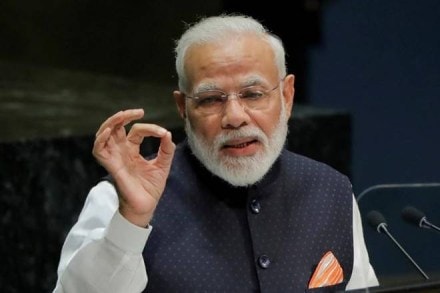
PM Modi Live speech today on National Education Policy NEP 2020: Prime Minister Narendra Modi today hailed the newly unveiled National Education Policy 2020 saying the NEP 2020 focuses on inquiry-based, discovery-based, and analysis-based methods to help children learn. PM Modi has also said the past National Education Policies used to encourage herd mentality and emphasized on ‘What to think’ whereas the NEP 2020 stresses on ‘How to think’. PM Modi said a new global standard is rising and it has become essential for India to change its education system accordingly. PM Modi said the NEP 2020 is a step in this direction.
PM Modi said this while delivering the inaugural address at the ‘Conclave on Transformational Reforms in Higher Education under National Education Policy’ today. The conclave focused on changed aspects from NEP 1986 to NEP 2020. The address was through a video conference. The Ministry of Education and University Grants Commission is organizing the ‘Conclave on Transformational Reforms in Higher Education under National Education Policy’. The conclave is taking place days after the Central government the National Education Policy (NEP) 2020.
Apart from PM Modi, Union Minister for Education Ramesh Pokhriyal, Union Minister of State, Education, Sanjay Dhotre are the guests in the event. A number of dignitaries including the Chairman and Members, Committee for Draft NEP as well as eminent academicians and scientists delivered lectures on different aspects of NEP 2020. Vice-Chancellors of universities, Directors of Institutions, and Principals of colleges and other stakeholders participated in the programme.
National Education Policy 2020 highlights: The highlights of the National Education Policy 2020 are education sector include multiple entry and exit points in the higher education sector, replacement of University Grants Commission (UGC), All India Council for Technical Education (AICTE), and National Assessment and Accreditation Council (NAAC), do away with the MPhil programme, proposed National Research Foundation.


Highlights
The National Education Policy 2020 can not be implemented by issuing circulars. Stakeholders must strive towards the successful implementation of NEP 2020 to build India's present and future. The implementation of NEP 2020 must be taken as a "Maha Yagna".
"Our education system focussed on 'What to think' so far. New policy emphasizes on 'How to think'. There's no dearth of information and content in the time in which we're today. The effort is to lay emphasis on inquiry-based, discovery-based and analysis based ways to help children learn," said Prime Minister Narendra Modi.
Prime Minister Narendra Modi has thanked eminent scientist Dr. K. Kasturirangan and his team for the National Education Policy 2020.
"Changing times has given rise to a new global system. A new global standard is rising. It was essential that India changed its education system as per this. Creating a 5+3+3+4 curriculum, while moving ahead from school curriculum's 10+2 structure, is a step in this direction," Prime Minister Narendra Modi said.
'There were no major changes in our education system in past few years. It caused our society to encourage herd mentality, instead of curiosity and imagination. How can youth develop critical and innovative ability if there's no passion in our education, no purpose of education?, wondered Prime Minister Narendra Modi.
The National Educational Policy 2020 focuses on virtual lab which must be taken to students who couldn't study lab-based subjects, said Prime Minister Narendra Modi.
The National Education Policy focuses on freeing higher education from the stream, that's why options have been provided for multiple entries, exit, and credit bank. We are heading towards an era during which people will not stick to one profession. For that, people need to continuously re-skill and up-skill themselves, said Prime Minister Narendra Modi.
Every country goes ahead by connecting its education system to its national values and reforming it as per its national goals. It's aimed at keeping its present and future generations 'future ready', said PM Narendra Modi.
The past National Education Policies used to focus on 'What to think', but NEP 2020 emphasizes on 'How to Think'.
Our students must become global citizens but they must be linked to root. The National Education Policy 2020 focuses on that, said Prime Minister Narendra Modi.
After the National Education Policy came, no section of the country said that the Policy has any bias. It is a matter of happiness, said Prime Minister Narendra Modi at 'Conclave on transformational reforms in higher education under National Education Policy'.
Prime Minister Narendra Modi has invoked Rabindranath Tagore to talk about the holistic approach and purpose of the National Education Policy 2020.
Prime Minister Narendra Modi has said that National Education Policy 2020 will lay the foundation for 21st Century Naya Bharat and strengthen our youth.
Prime Minister Narendra Modi has said people of India must participate in the implementation of National Education Policy 2020.
A healthy debate is on over National Education Policy 2020. This is a good sign, says PM Narendra Modi.
Prime Minister Narendra Modi is addressing a conclave on National Education Policy 2020.
The central government has said that the National Education Policy 2020 focuses on 'Ensuring Universal Access at all levels of school education', 'Early Childhood Care & Education with new Curricular and Pedagogical Structure', 'Attaining Foundational Literacy and Numeracy', 'Reforms in school curricula and pedagogy', 'Multilingualism and the power of language', 'Assessment Reforms', 'Equitable and Inclusive Education', 'Robust Teacher Recruitment and Career Path', 'School Governance', and 'Standard-setting and Accreditation for School Education'.
In May 2016, ‘Committee for Evolution of the New Education Policy’ under the Chairmanship of Former Cabinet Secretary Late T.S.R. Subramanian, submitted its report. Based on this, the Ministry prepared ‘Some Inputs for the Draft National Education Policy, 2016’. In June 2017 a ‘Committee for the Draft National Education Policy’ was constituted under the Chairmanship of eminent scientist Dr. K. Kasturirangan, which submitted the Draft National Education Policy, 2019 to the Human Resource Development Minister on May 31, 2019. The Draft National Education Policy 2019 was uploaded on MHRD’s website and at ‘MyGov Innovate’ portal eliciting views/suggestions/comments of stakeholders, including public.
National Education Policy NEP 2020 has been formulated after an unprecedented process of consultation that involved nearly over 2 lakh suggestions from 2.5 lakhs Gram Panchayats, 6600 Blocks, 6000 ULBs, 676 Districts. The MHRD initiated an unprecedented collaborative, inclusive, and highly participatory consultation process from January 2015.
The National Education Policy, 2020 reflects India’s aspirations and will contribute to improving the education sector. The NEP 2020 will make our education more fruitful, broad-based and one that guides our youth to their natural passions.
Gross Enrolment Ratio in higher education to be raised to 50 per cent by 2035. Around 3.5 crore seats to be added in higher education. The policy envisages broad based, multi-disciplinary, holistic Under Graduate education with flexible curricula, creative combinations of subjects, integration of vocational education and multiple entry and exit points with appropriate certification. UG education can be of 3 or 4 years with multiple exit options and appropriate certification within this period. Academic Bank of Credits to be established to facilitate Transfer of Credits. Multidisciplinary Education and Research Universities (MERUs), at par with IITs, IIMs, to be set up as models of best multidisciplinary education of global standards in the country.
New Policy aims for universalization of education from pre-school to secondary level with 100 % Gross Enrolment Ratio (GER) in school education by 2030. NEP 2020 will bring 2 crore out of school children back into the main stream through open schooling system. The current 10 2 system to be replaced by a new 5 3 3 4 curricular structure corresponding to ages 3-8, 8-11, 11-14, and 14-18 years respectively. This will bring the hitherto uncovered age group of 3-6 years under school curriculum, which has been recognized globally as the crucial stage for development of mental faculties of a child. The new system will have 12 years of schooling with three years of Anganwadi/ pre schooling. Emphasis on Foundational Literacy and Numeracy, no rigid separation between academic streams, extracurricular, vocational streams in schools ; Vocational Education to start from Class 6 with Internships. Teaching up to at least Grade 5 to be in mother tongue/ regional language. No language will be imposed on any student.
The National Education Policy NEP 2020 conclave has sessions dedicated to significant aspects of education covered under the National Education Policy, 2020 like Holistic, Multidisciplinary and futuristic education, Quality Research, and Equitable use of technology for better reach in Education.
The programme will be streamed live via the Ministry of Education Facebook Page, UGC YouTube Channel, PIB YouTube Channel, UGC Twitter Handle. It would also be broadcast Live on DD News.
Prime Minister Narendra Modi's speech at the 'Conclave on Transformational Reforms in Higher Education under National Education Policy' is scheduled to begin at 11 am.