




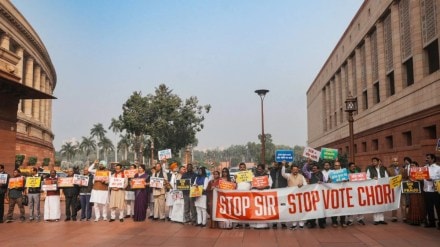
The Election Commission of India (ECI) made 2025 its own—but the year was riddled with controversies, questions, and doubts. The exercise triggered a massive trust deficit between the poll panel and the opposition, sparking an unprecedented campaign questioning the credibility of the election process with direct accusations of vote chori (vote theft).
Just before the Bihar elections, the SIR wave reached 12 other states and Union Territories. It is now expected to cover every state in the country, likely dominating the political skies through 2026 and leading up to the general elections in 2029.
The ECI on December 19 also published draft roll after SIR for Tamil Nadu and Gujarat. In the southern state, it has deleted 97 lakh names while in Gujarat, the poll panel has removed 73 lakh voters from the list.
Current SIR: Status, schedule and deadline
Unlike the usual annual updates, SIR involves a rigorous “intensive” check—often requiring door-to-door verification.Under the leadership of Chief Election Commissioner (CEC) Gyanesh Kumar, the ECI decided to conduct SIR in 12 specific states and UTs, five of which are bound for polls next year.
The chaos around the exercise—driven by strict timelines and extreme pressure on Booth Level Officers (BLOs)—forced the poll panel to extend the deadlines multiple times.
These 12 states/UTs are: Chhattisgarh, Goa, Gujarat, Kerala, Madhya Pradesh, Rajasthan, Tamil Nadu, Uttar Pradesh and West Bengal and 3 UTs namely Andaman and Nicobar, Lakshadweep and Puducherry.
Of these, five (Kerala, Bengal, Tamil Nadu, Puducherry and Assam) are going to polls in 2026. Assam will also vote in 2026, but its schedule was not announced along with other states. Also, the process is different for Assam as residents are not required to fill enumeration forms, as required in other states/UTs.
The chaos around the exercise, strict timeline, and extreme work pressure on booth level officers (BLOs) forced the top poll panel to first extend the exercise by 7 days. Then, it was further extended by three to 14 days in Tamil Nadu, Gujarat, Madhya Pradesh, Chhattisgarh and Uttar Pradesh — and the Union Territory of Andaman and Nicobar Islands (5 states and one UT).
No revision has been made so far in the schedule of the publication of the final roll – which is Feb 14, 2026.
Along with complaints, resolutions – the entire exercise will get completed in these 12 states/UTs, preparations for the elections will begin for Assam, Tamil Nadu, West Bengal, Kerala and Puducherry. But why is it all important?
Elections and the year 2029
Of the regions where the ECI is conducting SIR, three (UP, Gujarat, Goa) will go to polls in 2027 and three (Rajasthan, MP, Chhattisgarh) in 2028. The process hints that the poll panel is steadily revising electoral rolls in all the states first, where the elections are due in the next few years – till 2029. It is expected that before Lok Sabha elections 2029, the ECI will complete the revision across the country.
The ECI appears to be systematically revising electoral rolls in states where elections are due over the next few years. This steady cleanup is widely seen as the groundwork for the 2029 General Elections.
This aligns with the ‘One Nation One Election’ (ONOE) push. The Lok Sabha recently extended the tenure of the parliamentary committee examining ONOE bills (chaired by PP Chaudhary) to the last week of the Budget Session 2026. The Prime Minister Narendra Modi-led NDA government has already signaled that ONOE could be a reality by 2029.
The Delimitation Time Bomb
There is a final, explosive piece to this puzzle: The Census. Pending since 2021 due to the pandemic, the Census is expected to be completed before 2029. Its data will form the basis for delimitation—the redrawing of parliamentary seats.
This has raised alarm bells in Southern states. They argue that population-based delimitation will unfairly punish them for successful family planning by reducing their seat share, while rewarding North Indian states with more seats in the Lok Sabha and Rajya Sabha.
Combined with the ONOE push, the SIR is not just a list update; it is one of the foundational pillars driving the massive political and demographic overhaul ahead of 2029.


