




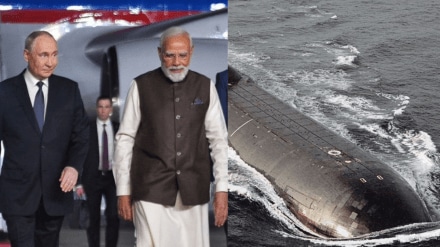
Russian President Vladimir Putin is all set to land in New Delhi this Thursday for his first trip to India since Russia’s full-scale invasion of Ukraine. Though the visit is of big importance, one of the biggest stories surrounding it has been the potential defense agreement between India and Russia. Some reports claimed that the two countries were on the brink of finalizing a $2 billion deal for a nuclear-powered attack submarine. However, the government refuted this claim.
PIB clarifies the Submarine lease deal
PIB took to X to clarify the situation. “The headline of an article by @Bloomberg claims that ‘India Clinches $2 Billion Russia Submarine Deal as Putin Visits.’ The claim made in this headline is misleading!” they wrote. “No new deal has been signed between India and Russia.
The submarine lease is based on an old contract that was signed in March 2019. There has been a delay in the delivery, and the new delivery is scheduled for 2028.” This means there is no fresh deal being signed, the lease arrangement has been in the works for some time.
What is the actual deal?
Bloomberg had reported that India had agreed to lease a nuclear-powered submarine from Russia. Negotiations for the lease had been stalled multiple times due to disagreements over pricing, but sources said that the terms had now been finalised. Indian officials had even visited a Russian shipyard in November to check on the progress of the submarine. It was expected to join the Indian Navy within two years, though sources cautioned that “technical complexity could affect the timeline.”
This nuclear-powered submarine will remain with India for 10 years under a training-focused arrangement and “cannot be used in active combat,” sources told Bloomberg. Instead, it will “train sailors and strengthen nuclear-boat operational expertise as India builds its own indigenous nuclear-powered submarines.”
Nuclear-powered submarines are more advanced than traditional diesel-electric ones because they can stay submerged for longer periods, operate quietly, and are much harder to detect, especially in vast oceanic regions like the Indian and Pacific Oceans.
The deal will also include maintenance and logistical support, ensuring the submarine stays operational throughout the lease period. India had previously leased a Russian submarine for 10 years, which returned in 2021 after completing its contract.
India’s growing submarine capabilities
India’s submarine fleet is expanding. At present, the country operates 17 diesel-electric submarines and several domestically designed nuclear-powered strategic submarines. It is also actively building its own nuclear-powered attack submarines that will be capable of hunting both enemy submarines and surface ships.
Next year, India plans to induct its third ballistic missile submarine, and two more indigenous attack submarines are currently under construction.
Interest in nuclear-powered submarines is growing around the world. Australia, under the AUKUS security pact with the US and UK, is working on its own fleet of nuclear-powered submarines. South Korea is collaborating with the US on similar projects.
Globally, only a handful of countries operate nuclear-powered submarines, including the US, UK, France, China, and Russia. As these nations continue to expand their underwater capabilities, nuclear-powered submarines are becoming increasingly essential for securing vast ocean territories.
Putin’s visit to India is not only about defense agreements. Russian president will also participate in high-level diplomatic meetings and a private dinner with Prime Minister Narendra Modi. Trade talks will be on the table, as well as the proposed launch of the Russian state-run RT channel in India.


