




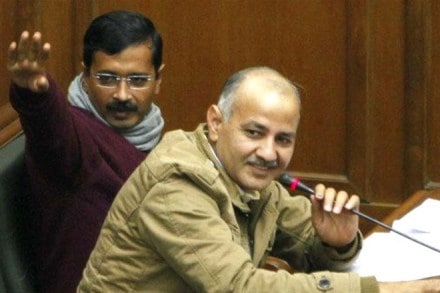
Delhi finance minister Manish Sisodia presented the budget for 2017-18 in the Delhi Assembly on March 8. Presenting an ‘outcome budget’ to increase accountability, the AAP government got rid of the plan and non-plan components. The Deputy CM said that there will be quarterly monitoring of the outcome to ensure performance, like a contractual agreement between the government and its departments. While many experts have lauded this year’s budget initiatives, opposition leaders have called it a damp squib and ‘disappointing’. Here is a look at what the Aam Aadmi Party government at Delhi got right and what it missed:
Hits:
Air Fares
Furthering Civil Aviation ministry’s proposal, with an aim to incentivise airlines for flying to remote locations, the AAP government in Delhi, in its budget proposal, announced a cut in the VAT on Aviation Turbine Fuel (ATF) from the current 25 percent to 1 percent for flights bound for remote areas. While presenting the 2017-18 Delhi budget, Deputy CM Manish Sisodia informed about a cut in VAT on ATF will be applicable for direct flights between Delhi and other remote locations which have been identified under the Regional Connectivity Scheme (RCS) according to prescribed conditions.
In February, the aviation ministry asked for a cut in the levy on jet fuel for flights under the new scheme, that constitutes more than 40 percent of an airline’s operating costs. The central government had then asked the state governments to decrease VAT to 1 percent on jet fuel for regional flights. Interestingly there are no RCS flights touching Delhi as of now, so how much revenue loss could be there, remains to be seen. However, experts have approved of what Sisodia said that the move will benefit people from the North Eastern parts of the country and other remote areas.
No new tax:
No new tax was introduced or hike effected in existing tax rates by AAP government in its Rs 48,000-crore budget for 2017-18 which lays major focus on education, healthcare, transport and social sectors. In its third Budget, the Kejriwal government abolished the plan and non-plan expenditure heads and presented it in terms of revenue and capital classification in line with the Centre’s decision. Sisodia said this was the first “outcome budget” of Delhi and that there will be quarterly monitoring of the outcome to ensure performance. Due to the ‘no new tax’ move, there will be a reduced tax on sanitary napkins, laminates, plywood and granite.
Education:
Education accounted for 24 percent of the total budget, which is a huge step. The Kejriwal-led government has announced a total expenditure of Rs 11,300 crore on education for the year, and it includes a revenue budget of Rs 10,186 crore and a capital budget of Rs1,114 crore. Deputy CM Manish Sisodia said, “Education is the most priority sector for our government. We have succeeded in creating huge infrastructure in the form of construction of new schools, new classrooms, sports grounds, clean toilet facilities.” Sisodia also announced that the mid-day meal scheme will be extended to girl students from classes 9 to 12. His budget also proposed the setting up of early childhood centres, besides the installation of computer labs and libraries at government schools.
Health:
On the list of priorities for the AAP government, came the Health sector. According to the proposal, it received an allocation of Rs 5,736 crore. This figure is around 12 percent of the total budget outlay. With the allocated fund, Kejriwal government wants to strengthen the three-tier system of mohalla clinics, polyclinics and multi-specialty/super-specialty hospitals in Delhi.
Also read | Delhi Budget 2017: Highlights of Financial Bill presented by Deputy CM Manish Sisodia
Misses:
Opposition parties have slammed the Delhi Budget for 2017-18 as ‘disappointing’ and ‘anti-development’. They said that there was a big gap between what the AAP had promised during the elections and its budgetary allocations.
Free WiFi
Free WiFi was a key Assembly poll promise of Aam Aadmi Party. It did not receive much attention in the Delhi Budget. In 2016 June, the AAP government had announced that more than 500 places around East Delhi would be made high-speed WiFi zones by the end of the year. It was promised that people will be allowed access to free internet till a limit per day. It was one of the most popular election campaign promises of the Aam Aadmi Party. Meanwhile, CM Arvind Kejriwal told reporters that his government was working on a few models of free WiFI and the decision to implement them will be taken soon. He said that one of the models has the provision of laying fibre optic cables while another one favours installation of hotspots. He added that government wants to avoid making mistakes in choosing among these models, because ‘it is not an easy task to provide free WiFi across the city’.
Mohalla Clinics
Another one of the most important poll promises of the AAP government in Delhi is the Mohalla Sabha. In 2016, the AAP government had allocated Rs 350 crore for mohalla sabhas, aimed at enabling locals to have a say on what civic projects are undertaken in their area. Meanwhile, Deputy Chief Minister Manish Sisodia said,”The file was pending with LG office (during the tenure of former LG Najeeb Jung) for around six months due to which the government could not spend allotted funds on mohalla sabhas. With new LG assuming office, we hope that mohalla sabha file will be cleared soon.”
Figures:
Yogendra Yadav’s Swaraj India has said that Manish Sisodia’s speech had ‘borrowed the language and practice of Jaitley’s and Chidambaram’s budget speeches’ and obfuscated more than it revealed. The party ‘The budget speech was a selective presentation of favourable statistics, highlighting trivial but popular schemes and burying the significant figures.’
Civic bodies:
According to BJP, in the Budget 2017-18, presented right before the civic body elections, no provision has been made, nor there is any indication, of implementation of the recommendations of the Fourth Delhi Finance Commission. This essentially means that the financial condition of the civic bodies will not improve.


