




The Prime Minister’s Office had asked the Commission for Air Quality Management (CAQM) and the Central Pollution Control Board (CPCB) to speed up work on a new emissions inventory and source-apportionment studies, according to a report by The Indian Express.
Earlier, the National Green Tribunal was told last week that Delhi-NCR’s anti-pollution measures were based on outdated emissions data.
Since dust is a major contributor to particulate pollution, the government also directed authorities to create a time-bound action plan with proper funding to redevelop key urban and industrial roads. The plan will focus on complete paving of roads and greening the sides to reduce dust.
These directions were issued during a high-level meeting on October 23, chaired by PK Mishra, the Principal Secretary to the Prime Minister. The meeting included top officials from pollution monitoring agencies, eight central departments – such as environment, agriculture, housing and power – and the Chief Secretaries of Delhi, Haryana, Uttar Pradesh, Punjab and Rajasthan, the report mentioned.
Delhi’s area-wise AQI today
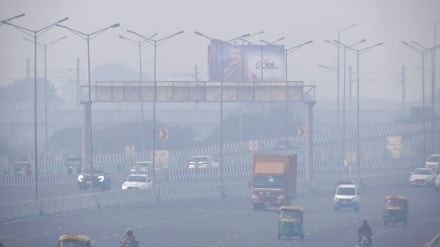
Delhi’s air quality worsened on Monday, with the AQI moving closer to the ‘very poor’ category. This came just a day after strong winds had temporarily improved the air quality from ‘very poor’ to ‘poor’ for the first time in 16 days. At 7 am, the AQI was 298, still in the ‘poor’ range, as fog and smoke covered the city, according to the CPCB.
#WATCH | Delhi: The area around Akshardham Temple is blanketed in a layer of toxic smog as the AQI in the area is 327 in the 'Very Poor' category, as claimed by the CPCB pic.twitter.com/LDvH25UDPh
— ANI (@ANI) December 1, 2025
On Sunday, the AQI had briefly improved to 279, the second-lowest reading for November after 202 on November 5, data from the CPCB’s Sameer app showed. Out of 39 monitoring stations in Delhi, 22 reported ‘very poor’ air quality. Nehru Nagar in south Delhi recorded the highest pollution levels at 351, classified as ‘very poor,’ while NSIT Dwarka in southwest Delhi had the lowest at 195, considered ‘moderate.’
Other pollution hotspots like Anand Vihar (323), Bawana (337), Burari Crossing (304), Jahangirpuri (319), Mundka (330), Punjabi Bagh (326), Shadipur (325), and Wazirpur (321) also saw AQI readings in the ‘very poor’ category.
Why emission studies matter
Emission inventories and source-apportionment studies help identify the exact sources of pollution and how much each one contributes to overall air pollution.
During the meeting, officials also reviewed actions taken so far to control major pollution sources, including dust, vehicle emissions, municipal waste burning, stubble burning, industries and thermal power plants, the report mentioned.
Vehicle emissions a major concern
Delhi alone has more than half of all vehicles registered in the NCR, and 37% of vehicles in the region still run on outdated BS I to BS III emission standards. Last Wednesday, senior advocate Sanjay Upadhyay, assisting the National Green Tribunal, informed the court that even though a real-time study was completed in 2023, the action plan had not been updated based on it, as per the IE report.
Industrial roads and construction dust issues
During last month’s review, CAQM said thousands of kms of industrial roads had been marked for redevelopment. Dust from construction and demolition waste was also flagged as a major issue, with around 8,000 tonnes of such waste generated daily, far more than current processing capacity.
On industrial pollution, the task force was told that IIT Kanpur is framing stricter emission norms for certain industrial sectors. Out of nearly 50,000 industries in NCR, around 11,000 are considered polluting. While many industries have shifted to piped natural gas, installations of pollution control systems and real-time monitoring devices are still underway.
Eleven thermal power plants located within 300 km of Delhi are also being monitored. Fourteen out of 35 units have installed flue gas desulphurisation systems to reduce sulphur dioxide emissions. The Maharashtra Power Ministry, CPCB and state boards have been told to ensure all plants meet emission standards.
According to a 2018 study by The Energy and Research Institute and the Automotive Research Association of India, transportation is responsible for 39% of Delhi’s PM2.5 pollution. Road dust contributes 18%, power plants 11% and industries 3%. Another report by the Indian Institute of Tropical Meteorology also identified transportation as the biggest source of PM2.5 in Delhi.
Delhi has recorded the worst air quality index (AQI) in India almost every year between 2015 and 2025, with the highest levels seen in 2016 when AQI averaged 250, according to a Climate Trends analysis based on CPCB data.


