




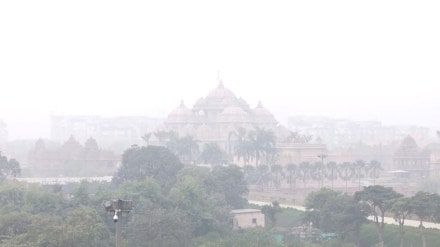
Delhi’s short break from polluted air ended on Sunday, as the air quality slipped back into the “very poor” category. The air quality index (AQI) was recorded at 298, in the “poor” category, at 8 am and further deteriorated to 300 by 11 am. This came just two days after strong winds had briefly improved pollution levels, official data showed. On Monday too, most parts of the city recorded “poor” to “very poor” air quality, with several areas seeing pollution levels worsen further, according to the Central Pollution Control Board data as of 6 am.
According to the Air Quality Early Warning System for Delhi, air quality is expected to stay in the “very poor” category over the next few days. The bulletin said air quality is likely to remain “very poor” from Monday to Wednesday, and the outlook for the following six days also points to similar conditions.
Most polluted hotspots on Monday
On Monday, some of the most polluted areas included Chandni Chowk, which recorded an AQI of 343, making it one of the worst-hit locations. Jahangirpuri also reported very poor air at 326, while Vivek Vihar stood at 321. Other heavily polluted pockets included Anand Vihar (323), Nehru Nagar (329), Rohini (313), Wazirpur (313) and IHBAS Dilshad Garden (310), all indicating very unhealthy breathing conditions.
Several industrial and residential zones also saw high pollution levels. Ashok Vihar and Okhla Phase-2 both recorded an AQI of 304, while Sirifort stood at 306. Areas like Patparganj (295), Dwarka Sector-8 (294), Narela (292), R K Puram (296) and Sonia Vihar (298) continued to remain in the upper end of the poor category.
The improvement in air quality had led the Commission for Air Quality Management to lift stage-3 measures of the Graded Response Action Plan (GRAP) across the National Capital Region with immediate effect on Friday. Even after air quality slipped back to the “very poor” category on Sunday, stage-3 restrictions were not reimposed. However, stage-1 and stage-2 measures of GRAP continued to remain in place.
Comparative air quality in Central and South Delhi
In central and south Delhi, pollution levels were slightly lower but still concerning. ITO recorded an AQI of 260, Major Dhyan Chand National Stadium stood at 255, and Sri Aurobindo Marg registered 247. North Campus, DU saw an AQI of 246, while Najafgarh reported 244.
As per the Central Pollution Control Board (CPCB), air quality is termed “moderate” when the AQI is between 101 and 200, “poor” when it ranges from 201 to 300, and “very poor” when it is between 301 and 400. AQI readings above 400 are classified as “severe”.


