




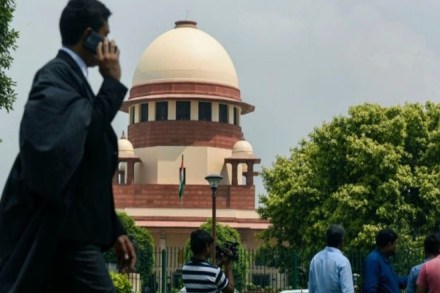
Ayodhya Verdict Details: A 5-judge Constitution of the Supreme Court headed by Chief Justice of India Ranjan Gogoi on Saturday delivered the verdict in the politically sensitive Ayodhya Ram Janmabhoomi-Babri Masjid dispute. The apex court bench also comprising Justices S A Bobde, D Y Chandrachud, Ashok Bhushan and S Abdul Nazeer ruled that the disputed land in Ayodhya be given for construction of a temple, while Muslims would get an alternate plot.
Here’s what Supreme Court said:
# Supreme Court dismissed appeal of Shia Waqf Board appeal, pronounces unanimous verdict in the case.
# Shia Waqf board’s claim was over the disputed structure which is dismissed by Supreme Court.
# Supreme Court said that the disputed land was the government land in the revenue records.
# Supreme Court held that Nirmohi Akhara’s suit is barred by limitation, not a ‘Shebait’ or devotee of deity Ram Lalla.
# Supreme Court said that terming the archeological evidence as merely an opinion would be a great disservice to the ASI.
# Supreme Court said Babri mosque was not built on vacant land. The underlying structure was not an Islamic structure.
# Supreme Court said that the fact that there lied a temple beneath the destroyed structure has been established by the ASI.
# ASI had not established whether temple was demolished to build the mosque, said Supreme Court.
# Hindus consider this place as birthplace of lord Ram, even Muslims say this about disputed place, said Supreme Court.
# Faith of Hindus that Lord Rama was born at demolished structure is undisputed, Supreme Court ruled.
# Supreme Court said the existence of Sita Rasoi, Ram Chabutra and Bhandar grih are the testimony of the religious fact of the place.
# The top court said title cannot be established on ground of faith, belief; they are kind of indicator for deciding dispute.
# UP Sunni Central Waqf Board has failed to establish its case in Ayodhya dispute. On the contrary, Hindus established their case that they were in possession of outer courtyard, said Supreme Court.
# Supreme Court directed allotment of alternative land to Muslims to build new mosque.
# Supreme Court asked Centre to frame scheme within three months and set up a trust for construction of a temple. Possession of disputed 2.77 acre land will remain with Central government receiver, rules Supreme Court.
The Allahabad High Court had in its 2010 judgment ordered that the disputed 2.77-acre land in Ayodhya be divided equally among the three parties in the case – the Nirmohi Akhara, Ram Lalla and the Sunni Waqf Board. However, the verdict was challenged in the Supreme Court.
Earlier this year, the Supreme Court set up a mediation panel over the matter. The mediation panel included former Justice FMI Kallifulla, spiritual guru and founder of the Art of Living foundation Sri Sri Ravishankar and senior advocate and renowned mediator Sriram Panchu. The mediation process continued for four months, however, there was no final settlement in the matter.
After the Supreme Court-mandated mediation process failed to yield any amicable resolution, day-to-day hearing commenced in the top court on August 6 and continued till October 16 when CJI Gogoi reserved the verdict.


