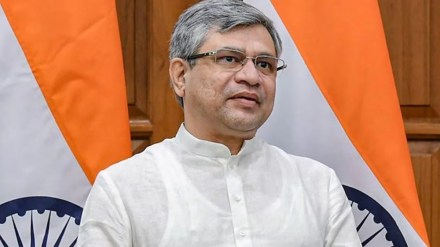
The Ministry of Railways is targeting a more than sevenfold increase in railway equipment exports to Rs 50,000 crore by 2030, Railway Minister Ashwini Vaishnaw said on Thursday. He said that India has a huge potential to cater to the global demand for railway products. “To generate export demand, we have to offer best quality at competitive prices. That’s why we invested almost a year to design a new suspension system for the Vande Bharat trains. Propulsion and bogie are two big technological features. The rest is metal work which is an easy job. India has now a gained a strong expertise in propulsion technology,” Vaishnaw said.
India is currently exporting rail products worth Rs 7,000 crore to various countries including the UK, Canada, Australia, France, Germany and Sri Lanka. The major exports item are bogies, passenger coaches, propulsion systems, locomotives and metro coaches.
Vande Bharat Sleeper
Vaishnaw said that the first Vande Bharat sleeper train connecting Guwahati to Howrah will commence operations by January 18, and the railways has plans to 8 such trains in 6 months, and 12 trains by end of 2026. “We are ramping up the production of Vande Bharat sleeper trains. This is going to be a full-service train, similar to the full-service carriers in the aviation. The manufacturing ecosystem for Vande Bharat trains has developed over the years with about 70 suppliers currently as against 4-5 in the initial days,” the minister said.
In terms of configuration, the Vande Bharat sleeper trains will have 16 coaches, including 11 three-tier AC coaches, 4 two-tier AC coaches, and 1 first-class AC coach, with a total capacity of around 823 passengers. With a design speed up to 180 km per hour, these trains would be deployed for long-distance journeys of 1,000-1,500 kms. Each coach of the train costs Rs 8-8.5 crore. At present, there are 164 Vande Bharat services (chair car) running across the rail network.
The minister said that with Vande Bharat sleeper service, the railways is shifting towards a “flat fares” system which is different the existing mechanism. In the first route, the fares are fixed at Rs 3.80 per km for first AC, Rs 3.10 per km for second AC and Rs 2.40 per km for third AC services. “This is a year of reforms for the railways with a lot of reforms lined up,” he said.
Bullet Trains and Infrastructure
In addition, Vaishnaw said that the first bullet train connecting Mumbai to Ahmedabad will commence operations from August 15 next year. The 508 km high-speed train project will be launched in five phases starting with Surat to Bilimora section.
To deal with the long waiting list in the passenger services across major cities, the minister said that the railways is working simultaneously on increasing the rolling stock production and track capacity. “We have added over 35,000 km of railway tracks in 11 years. Our locomotive production is bigger than that of the US and Europe combined. The trainset coaches and LHB (Linke-Hofmann-Busch) coaches are being produced at an unprecedented rate. The railways has identified certain cities where the capacity will be doubled. The intent is to carry as much passenger as possible. It’s expected that the issue of waiting list will be eliminated in 1-2 years in certain sectors,” Vaishnaw said.