




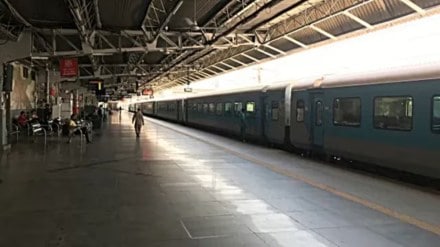
Years of legal battle has resulted in the Archaeological Survey of India (ASI) and the Railways and the citizens agreeing upon protection of monuments located within the premises of the Ahmedabad Railway Station. The battle had specifically focused on the brick minarets near platform number 1, The Indian Express reported. Now, the Railway Land Development Authority (RLDA) has included the historical structures into the redevelopment plan.
As of now, one petition, regarding the railway pit lines built within the 100 metres of prohibited zone of the bricks minarets, is pending in the Gujarat High Court. The monument has been given a wide berth in the redevelopment plan titled ‘Integrated Development Around Centrally Protected Monuments (Brick Minarets and Shaking Minarets)’. Under this, the design mandates a circular area open around the prohibited zone. This area will be turned into a pedestrian plaza, Sudhir Kumar Sharma, Divisional Railway Manager (DRM), Ahmedabad, said.
To ensure that the prohibited zone remains entirely undisturbed, the planned six-lane elevated road network above the existing main road near the railway station takes a semicircular turn in front of the brick minarets.
Kalpur main road: Elevated road network
The redevelopment of Ahmedabad Railway Station will integrate multiple modes of transport, including the Ahmedabad-Gandhinagar Metro and the High-Speed Rail (Bullet Train). Additionally, city-level transport will be seamlessly connected through the Multi-Modal Transit Hub (MMTH). Dedicated docking spaces will be provided for the BRTS (Bus Rapid Transit System), AMTS (Ahmedabad Municipal Transport Service), auto rickshaws, and taxis.
One of the key objectives is to alleviate traffic congestion on Kalupur Main Road, which has become increasingly problematic over the years due to space constraints in Ahmedabad’s old city.
To address this issue, the RLDA has announced the construction of an 8.5 km elevated road network, which will connect the previously planned Railway Over Bridges (ROBs) on the Kalupur and Sarangpur sides of the railway station.
“With regard to the Kalupur road traffic congestion, we are planning ahead for 2060. We have planned a network of elevated roadways that will join the Kalupur ROB and the Sarangpur ROB being built on both sides of the railway station. It will start at Kalupur chowk, and will be a six-lane flyover, over the current road, which will also be connected to the MMTH building – the main station building – and then merge into the Sarangpur ROB with an official ramp on the other end,” CPM Sanjeev Kumar said.
Upon completion of the redevelopment, officials stated that the Metro will be situated at the -10 meter level, the railway lines at ground level, and the High-Speed Rail at the +10 meter level, with seamless access to all modes of transport from both inside and outside the station premises.
“We want a wider road. Secondly, we are segregating road traffic into two parts, one at ground level and the other on the elevated road network that will drop people at concourse level on the elevated road that joins both ROBs. We are trying to bring all transport modes together to reduce traffic. The integration will also help decrease traffic when people don’t have to leave the premises to go from one mode of transport to another. This will also increase use of public transport. There are drop off points on both sides of the station from which you can enter the metro, high speed or railway,” DRM Sharma said.
Ahmedabad railway station redevelopment: Additional amenities
The number of railway tracks at the station is set to increase from the current nine to a total of 12, according to an RLDA official. While the existing station has the capacity to handle 1.2 lakh passengers daily, the long-term plan aims to accommodate a daily footfall of 3.10 lakh passengers by 2053. Officials also noted that the current provision of one lift and one escalator per platform will be expanded to four each, along with additional staircases on every platform.
Two tunnels will be constructed under the station for parcel movement, and parking facilities will be expanded to accommodate 3,316 cars. “We will have separate departure and arrival areas like airports. Arrivals need not enter the station but directly go towards the metro and bullet or out of the station,” Sanjeev Kumar said.
The officials emphasised that no trains have been canceled or diverted during the redevelopment, and no injuries or accidents have occurred so far.
The redevelopment contract was awarded to M/s Dineshchandra-DMRC JV on November 3, 2023, at a cost of Rs 2,383 crore. The project is expected to be completed within 36 months, with DRM Sharma confirming, “We are on schedule and will finish the work in 2027.”


