




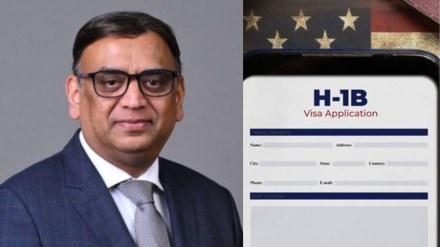
LTIMindtree, a global technology consulting and digital solutions company based in India, will no longer be filing new H-1B visa applications in the future, as per a Moneycontrol report. The leading IT firm’s CEO Venugopal Lambu (Venu) recently told the Indian news outlet that the company will be more focussed on hiring local talent overseas.
Lambu’s latest confession comes as the United States is embroiled in a heated debate over the ‘specialty occupations’ nonimmigrant visa category. Moreover, the Trump administration introduced a blanket fee of $100,000 for new H-1B applications through a September proclamation.
Countless MAGA politicians and supporters have repeatedly complained about companies in the country, especially tech giants, firmly relying on outsourcing talent from other countries instead of employing American workers. This has led many to view even the legal parameters backing the work visa category as a “fraud” or “scam.”
LTIMindtree CEO says no to H-1B visas
“We are hiring, we are hiring locally, and one of the things that I have made clear is that we are not going to make any new applications on H-1B,” Venu Lamba said in an interview with Moneycontrol. “Unless (we) have a strong business case to spend $100,000, we are not going to do that.”
Offering further clarification on the company’s new decision, he told the outlet that the rule would start applying to new petitions in the forthcoming H-1B lottery cycle. And so, renewals of existing visas don’t come under the negative call-out, just like Trump’s new $100,000 fee doesn’t apply to them but only new petitions.
Consequently, it’s safe to say that the additional visa fee played a major role in influencing the company’s decision. Lambu further affirmed to Moneycontrol that they would reconsider the move if the rules are changed in the future.
How many H-1B workers are part of the top Indian IT firm?
Lambu told Moneycontrol that 4,000 of LTIMindtree’s workforce (more than 86,000 employees) in the US are H-1B visa holders. Due to the company’s not-so-huge reliance on the visa classification, the CEO shared in the interview, “In the short term, since we already reduced the dependence on H-1B and we had machinery in place to do the onsite hiring.”
Like many other employers hopefully looking towards the locally presented workers, Lambu also insisted on continuing to hire locally.
He also told the news outlet that their decision to swear off H-1B sponsorships in the future was attributed to their commitment to increasing revenue by avoiding new filings. “If you look at our first half (H1FY26), we added $64 million of incremental revenue,” he told Moneycontrol, noting that LTIMindtree’s net experienced headcount actually dropped during this period.
Projecting a vision for the company’s future, Lambu added that the IT firm had big hopes of increasing revenue without adding more numbers to the workforce proportionally. “If we are growing 2X over the next five years or so, you should grow probably at 1.2X or 1.3X of your headcount,” he told Moneycontrol.
Other Indian IT companies cut H-1B visa
As it turns out, LTIMindtree hasn’t exclusively made the decision to cut down on its H-1B reliance. According to the National Foundation for American Policy’s (NFAP) analysis of USCIS data, the US-based Amazon had the highest number of approved H-1B petitions (4,644) for initial employment in FY 2025.
Meanwhile, the top seven Indian-origin companies had only 4,573 approved H-1B petitions for initial employment. It marked a 70% drop from FY 2015 and a 37% decline from FY 2024.


