




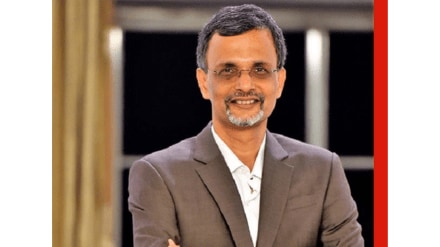
Calling for a more balanced assessment of India’s economic data, Chief Economic Advisor V Anantha Nageswaran on Tuesday defended the country’s GDP estimates and said methodological concerns are selectively raised only when growth numbers exceed expectations, the Indian Express reported.
Speaking at a workshop organised by the Ministry of Statistics and Programme Implementation (MoSPI), Nageswaran said similar questions were not raised when GDP data aligned with pessimistic expectations. He cited the April–June 2020 quarter, when India’s economy contracted by nearly 25% during the pandemic, reported the Indian Express.
“When the Indian statistical authorities reported a 25 per cent contraction, nobody got up to question the methodology, the reliability of the numbers, the single deflator being used, etc. All of them were kosher because the GDP data met their priors,” Nageswaran said. “It’s only when the GDP growth numbers surprise on the upside that we hear all these concerns being raised.”
According to the report by the Indian Express, his remarks come after data released in late November showed India’s economy grew 8.2% in the July–September quarter, following 7.8% growth in April–June, marking the second consecutive quarter of growth, beating expectations.
Debate over methodology
Several economists have argued that growth in recent quarters may have been overstated due to methodological issues, particularly the use of a single-deflator method to convert nominal gross value added (GVA) into real terms. Critics say that when input prices fall faster than output prices, this approach can inflate real GVA estimates.
Concerns have also been raised about the use of wholesale price indices to deflate services-sector GVA, especially when wholesale inflation is lower than sector-specific inflation. In the July–September quarter, the gap between real and nominal services GVA growth implied services inflation of about 1.2%, compared with around 3.3% inflation indicated by Consumer Price Index data, economists have pointed out.
Addressing these criticisms, the Indian Express reported, Nageswaran said similar objections were absent in FY22 and FY23, when wholesale inflation was high and may have suppressed real services growth. Using a hypothetical services price deflator applied to FY22 data, he said the discrepancy was “not even 1%”, arguing that the GDP numbers were not materially overstated.
“But unfortunately, all these under-informed or half-baked questions are left deliberately hanging so as to sow the seeds of doubt,” he said.
Call for symmetric scrutiny
Nageswaran also said India does not follow certain “questionable” methodologies used by developed economies while compiling official statistics, including inflation data. While all estimation methods have limitations, he argued that Indian data is scrutinised more harshly than international counterparts.
“As long as data are consistent, transparent, and reveal the true picture of the underlying economy broadly and pass the smell test, we need to be a lot more mature in the way we evaluate and publicise our critique,” he said, as per the Indian Express.
He added that MoSPI should make statistical manuals and documentation more easily accessible to allow replication of official estimates, arguing that “credibility comes from replicability.
Informality may be overstated
On the size of India’s informal sector, the Indian Express quoted the CEA saying that measurement remains challenging due to the lack of a uniform definition. He also suggested that informality may be overestimated, noting that many Indian businesses operate as sole proprietorships or small partnerships without maintaining separate personal and professional accounts.
“That is a reason, I think, that no matter how much we do, we actually are ending up overestimating informality,” Nageswaran said.


