




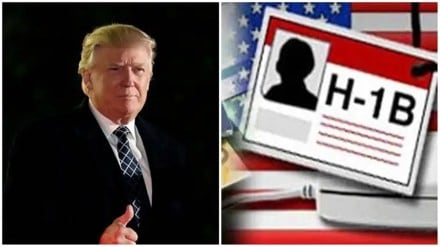
The Trump administration continues to tighten conditions around the H-1B visa program, making it difficult not only for US firms to hire foreign workers by imposing a high petition fee, but also for foreign workers to get H-1B visas.
The recent move by the Trump administration creates challenges for highly skilled foreign workers seeking to immigrate to the US on H-1B visas. Starting December 15, all H-1B applicants will have to meet the standards set by the ‘online presence review’.
All H-1B applicants will be required to change the privacy settings on all of their social media platforms to “public” as part of the “online presence review.”
The State Department has expanded the requirement that an online presence review will be conducted for all H-1B applicants and their dependents, which was already in place for the international students and exchange visitors entering the US.
Effectively, the Trump administration is incorporating ‘digital footprints’ as an essential element in the vetting process for immigrants’ visa adjudications.
New Vetting Rule
The new vetting rule requires all applicants for H-1B and their dependents (H-4), as well as F, M, and J nonimmigrant visa holders, to adjust the privacy settings on all their social media profiles to “public.”
US companies use the H-1B program to hire foreign workers in specialty occupations that require a bachelor’s or higher degree in a specific specialty that is directly related to the H-1B position. H-4 dependent spouses of H-1B nonimmigrants will also be required to adjust the privacy settings on all of their social media profiles to “public.” H-4 dependent spouses of H-1B nonimmigrants are allowed to work in the US after filing Form I-765, Application for Employment Authorization.
The State Department uses all available information in visa screening and vetting to identify visa applicants who are inadmissible to the United States, including those who pose a threat to U.S. national security or public safety.
All student and exchange visitor candidates in the F, M, and J non-immigrant classes undergo extensive screening by the State Department, which includes an internet presence review. This practice is now extended to H-1B visa applicants.
Consular staff will review profiles for any signs of antisemitic behavior, ties to terrorist groups, or anti-American attitude in accordance with State Department regulations. Twitter, Facebook, Instagram, and TikTok are just a few of the platforms that will be evaluated.
The new vetting approach will include an investigation of the applicant’s whole internet presence, not just social media activity, with officers encouraged to use any appropriate search engines or other online resources.
U.S. consular officers are required to conduct a comprehensive and thorough vetting of all H-1B and student and exchange visitor applicants to identify those who bear hostile attitudes toward US citizens, culture, government, institutions, or founding principles.
H-1B $100 K Petition Fee
President Trump proclamation mandates all US employers to pay a $100,000 fee before hiring foreign workers under the H-1B visa program. This applies to employers participating in the 2026 H-1B lottery and any H-1B petitions submitted after September 21, 2025.
The US has clarified that F-1 students and H-1B visa holders currently in the US are exempt from the $100k fee proclamation. Also, if the H-1B petitions have been submitted before September 21, 2025, the new fee will not apply.
H-1B renewals will also not be impacted, and employers need not pay the new $100K fee. H-1B status is valid up to 3 years and extendable up to another 3 years, for a total period of admission of 6 years in the US.
However, if you are an F-1 student interested in changing to H-1B status, your prospective employer must sponsor you and file that petition under the new rules. The US laws allow ‘change of status’ for non-immigrants under which F-1 visa holders can switch to H-1B visas. Foreign students undergoing the OPT program also qualify for being hired by US employers through a ‘change of status.’


