




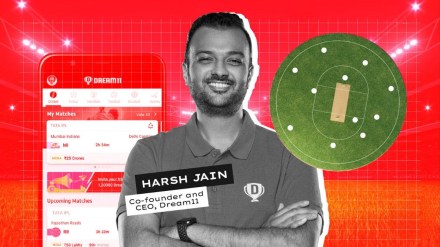
Dream Sports on Thursday announced a complete pivot for its flagship brandDrea, transitioning it from a fantasy gaming platform to a second-screen sports entertainment app built around creator-led watch-alongs and real-time fan engagement.
The pivot comes three months after Dream11 halted all paid contests after the Promotion and Regulation of Online Gaming Act, 2025, came into effect, banning real-money gaming nationwide. The move had effectively wiped out 95% of Dream Sports’ revenue and all its profits overnight.
Post ban promises
Immediately after the ban, while rivals began cutting staff and preparing legal challenges, co-founder and CEO Harsh Jain had promised employees there would be no layoffs, and that the company would not move court. Three months on, he has stuck to both.
“This is still a winning team. If you have a sports match where a decision went against you, a refereeing decision, and you lost the final, it doesn’t mean you change the team. It means you play another World Cup six months later and then you bring home the trophy,” Jain said at a media briefing on Thursday.
Dream Sports’ portfolio
Dream Sports has reorganised its 1,200-odd workforce into eight business units, each operating as “an independent startup with its own P&L structure,” he added. The portfolio comprises: Dream11; FanCode, its sports streaming platform; DreamSetGo, a sports travel venture; DreamCricket, a mobile game; DreamMoney, a fintech venture; DreamSports AI; Horizon, the company’s open-sourced technology stack; and the Dream Sports Foundation. “Each of them will live by the sword, die by the sword. They all have to go out there and survive like Series A to Series B kind of startups,” Jain said. He added that the company has enough cash reserves to survive for 2-3 years without external funding or workforce reductions.
The revamped app, now live on App Store and Play Store globally, will allow users to follow live matches alongside sports creators who provide commentary, banter, and reactions in real-time. Users can interact through chats, pay for shoutouts using virtual currency, and join creators on video calls during matches. The company is also overhauling its visual identity with a dark theme and neon colours. “We are moving away from the whole gaming piece altogether,” Jain added.
The platform will not broadcast any match content. Even for properties where FanCode holds rights, such as LaLiga and Formula 1, Dream11 will not stream any content. Instead, users can follow creators with integrated scorecards and live commentary on their phones while watching matches on existing streaming platforms.
Jain said Dream11 wants to do for sports what Twitch did for gaming. “Twitch today does almost $2 billion of revenue. It’s one of the world’s largest creator-driven streaming sites,” he said, adding that Indian users have shown potential in spending on such content.
The company plans to monetise the offering through a virtual currency called ‘DreamBucks’, as well as third-party advertising, with creators taking “the lion’s share” of earnings initially, Jain added. The platform has onboarded 25 creators so far. The company will be cautious while on-boarding, initially focusing on mid-sized creators.
Since inception, the company has raised around $940 million. It was last valued at $8 billion in November 2021 when it raised $840 million from the likes of Tiger Global, Falcon Edge, DST Global, D1 Capital, Redbird Capital, and TPG. In FY23, Dream Sports reported revenue of Rs 6,384 crore and net profit of Rs 188 crore, according to Tracxn.


