




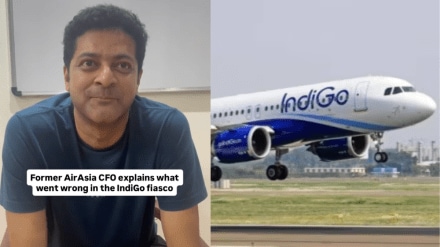
Former AirAsia CFO Vijay Gopalan has weighed in on the IndiGo fiasco, attributing the chaos largely to the revised Flight Duty Time Limit (FDTL) rules issued by the DGCA last year. The new rules, rolled out in two phases, increased mandatory rest time for pilots from 36 to 48 hours, among other changes.
Gopalan pointed out that it is not easy for airlines to quickly hire new pilots and expand their pilot pool, as the process involves mandatory notice periods, type-rating, training, and meeting minimum flying-hour requirements.
Following the fiasco, the DGCA has withdrawn the revised FDTL norms and relaxed certain conditions in order to ease the operational pressure on IndiGo.
Why was IndiGo hit the hardest?
Gopalan explained that IndiGo was hit the hardest as the increased rest period means airlines must employ more pilots to maintain the same number of flights. “So in a week, if they say the previous regulation was that they needed 36 hours of rest, now they say you need 48 hours of rest. Which means the number of hours available for a pilot to fly gets reduced. Unless you increase the number of pilots, the number of pilots available to operate all your aircraft, therefore, gets reduced logically,” he said.
He was also critical of IndiGo’s planning, saying the airline appeared complacent despite advance notice from DGCA. “Truth be told, I think it was extremely lag. The only thing that you can attribute this to is a very lackadaisical, nonchalant attitude from the airline,” he added.
Gopalan added that IndiGo’s business model has always been extremely lean, with minimal staffing buffers. “IndiGo has been a very lean and mean machine always, and this is not something new. Right from the start everything has been extremely lean. They are a low-cost carrier. The only other meaningful airline is Air India. Air India, probably, given that many of their aircraft are anyway grounded, they must have had a surplus of pilots from those aircraft to be able to cater to this.”
Why hiring from other airlines isn’t simple
When asked whether IndiGo could simply recruit from competitors to tackle this mess, Gopalan clarified that moving pilots between carriers in India is a slow process. Gopalan explained, “If you’re a senior pilot, there is a mandatory notice period of 12 months. And if you’re a co-pilot, the notice period is a mandatory six months. So you just can’t go poaching people.”
And even if one hires freshers, they must undergo a lot of training. “The second is if you want to bring in fresh pilots, they need to get type-rated. They need to go through the training. They need to finish the minimum number of flying hours, and I don’t think Indian infrastructure supports any of those things. It’s a long-term process. It’s not going to be easy. You just can’t build bench strength so easily,” he went on to say.
He also explained the maths behind the cancellation of around 500 flights – “They moved it from 36 to 48 hours of mandatory rest, which means that is about 20 to 25 per cent reduction in the available flying hours. If you don’t staff yourself adequately, then 25 per cent of the flights will have to be cancelled. IndiGo does about 2,200 flights a day. So 25 per cent of it is roughly about 500 to 550.”
Former AirAsia CFO Vijay Gopalan on the IndiGo fiasco, explains what went wrong and why the situation escalated the way it did #IndiGoCrisis #Indigoairlines #IndigoDelay pic.twitter.com/KDiu5Yvl23
— Rosy (@rose_k01) December 6, 2025
IndiGo flight status today
Following a week-long chaos, IndiGo announced that 1,500 flights will operate today across 135 active routes. The cancellation of flights has, however, not stopped.
Follow our live coverage for more details.
CEO gets show-cause notice
IndiGo’s CEO Pieter Elbers and its accountable manager & COO Isidre Porqueras have been issued show-cause notices following this week’s flight disruptions, according to The Indian Express. They have 24 hours to respond and explain why regulatory action should not be initiated against them.
The notices state that the widespread operational breakdowns at IndiGo suggest serious failures in planning, oversight, and resource management, and appear to reflect breaches of certain provisions under the DGCA’s Aircraft Rules, 1937, as well as the recently introduced FDTL regulations. The regulator also noted that IndiGo did not provide passengers with mandatory information and support during the delays and cancellations.
Sources, per The Indian Express report, suggest that strong enforcement measures could follow against the airline after operations stabilise and the inquiry panel submits its report.


