
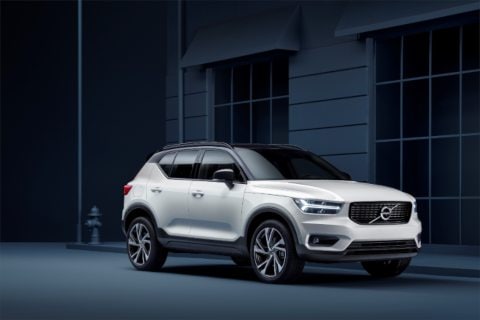

It might not be the ultimate driving machine, but then not all cars need a flashy slogan to prove their point. Some do it subtly. The newest SUV by Volvo Cars India, the XC40 R Design, looks more SUV than most SUVs in its segment, has semi-autonomous driving technologies, and is now available only in petrol. We drive it in Goa.
Because the XC40 is made for the city and younger customers, the design is compact but with authentic SUV proportions. From some angles, it appears to be inspired by sci-fi movies and even consumer electronics. Ian Kettle, the lead exterior designer, once called the XC40 ‘Tough Little Robot.’ It stands tall—the high ground clearance of 211mm and the large R18 tyres make the XC40 look bigger than it actually is.
It has practical storage areas, such as door bins large enough for laptops and handbags, and a bin under the centre armrest that can hold a full-size tissue box. Loading and unloading your luggage is easy, thanks to power-operated tailgate that opens by moving your foot under the rear bumper. While five people can comfortably sit inside, the XC40 is ideally for four people (the central tunnel eats into middle rear seat passenger leg space).
The nine-inch centre touchscreen is as responsive as an iPad or a Galaxy Tab—it gets both Apple CarPlay and Android Auto. The resolution is good, and the system’s voice control understands normal speech, often. Wireless phone charging is standard. The sound system is interesting, and how. Volvo has removed the woofers from the front doors and installed these under the dashboard, near the AC vents. The result is the sound appears to ‘spread’ better inside the cabin. The system is by Harman Kardon.
The cabin is bright. During the day, the panoramic roof lets in a lot of natural light. However, if you are tall, there’s one thing you have to take note of. When you shift the orientation of the sunshade from the windscreen to the side window, you’ll have to move your head away—the sunshade is big and can scrape against your forehead.
The world is gradually moving from diesel to petrol to hybrid to electric. The XC40 has a new 1969cc petrol engine (it replaces the diesel) that produces peak power of 190bhp and torque of 300Nm. It is mated to the eight-speed automatic transmission, and is now front-wheel drive. The feel of power, and acceleration, is intense. The cabin is quieter than the outgoing diesel variant. The Pirelli tyres provide very good traction.
It gets technologies that claim to protect not only the occupants, but also pedestrians. For example, City Safety identifies other vehicles, pedestrians, cyclists and even large animals ahead, and warns you if a collision is imminent; if you don’t react in time, it will brake automatically.
If the XC40 accidentally drifts out of its lane, the steering wheel sends an alert signal. If you don’t react, a technology called Lane Keeping Aid automatically steers it back. If you’re approaching a slower-moving or stopped vehicle, or an object, at a speed that suggests a collision is likely, a technology called Pilot Assist applies brakes. It also maintains a steady speed and distance to the vehicle in front.
If you fall asleep and the XC40 is about to leave the road, a technology called Run-off Road Mitigation uses steering input and brake support to guide it back. Airbags, ABS and other safety features, therefore, are a given. There is just one trim, so that makes buying simpler. The XC40 in R Design is a fully-loaded vehicle and there aren’t any compromises on luxury or safety. At Rs 39.9 lakh (ex-showroom), it’s expensive, as all other luxury cars are, in India. It competes with BMW X1 (closest competitor), Mercedes-Benz GLA (which looks more like a hatchback) and Audi Q3 (which has started to show its age).


