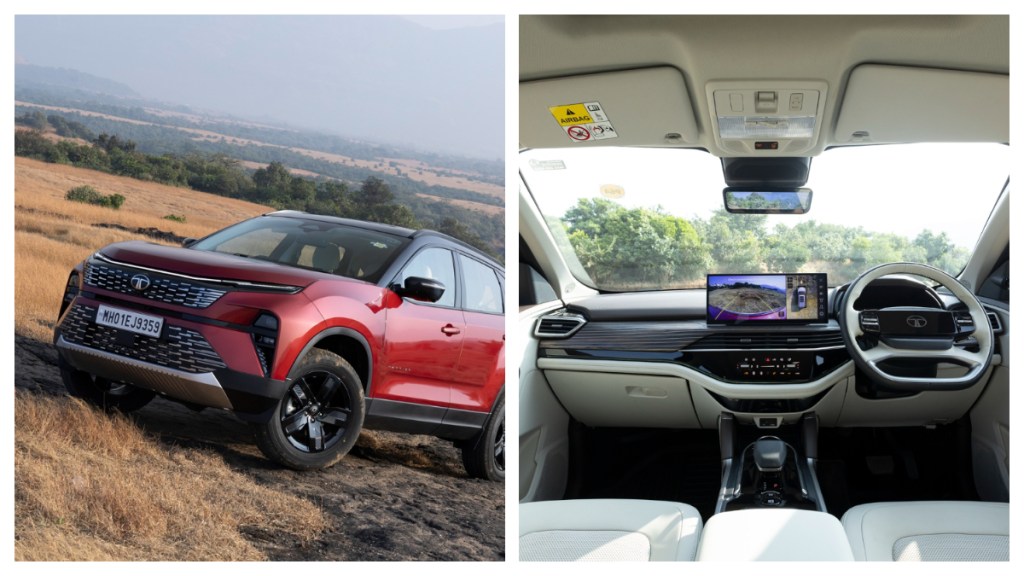
The Tata Harrier – built on a platform derived from Land Rover’s D8 – never really felt like a Land Rover. It was heavy, had a lot of body roll, and its diesel engine was noisy and coarse.
Is the new Harrier – powered by the 1.5-litre Hyperion turbo-petrol engine – worlds apart?
What all has changed?
The engine produces 170 bhp power and 280 Nm torque, and the first thing you’d notice is the silence. There is also a new trim – Fearless Ultra (only with petrol engine, as of now) – which raises its luxury quotient. It has the 14.53-inch Samsung Neo QLED infotainment screen, and a digital IRVM with integrated front and rear dashcams – both taken from the Harrier EV.
Read FE 2026 Money Playbook: Your Ultimate Investment Guide for the new year
How does it drive?
We drove the 6-speed AT, and in stop-and-go traffic, the Harrier petrol feels really light – exactly opposite of the diesel. The engine produces 160 Nm torque at just 1,000 rpm, which means you don’t have to wait for the turbocharger to spool up for instant power. The peak torque of 280 Nm is available starting 1,750 Nm, and when the turbo spools at around 2,000 rpm, there is an instant rush of acceleration. Although it’s a heavy SUV, the engine has enough power to tame it. But certain issues remain – there is body roll, and it ‘dives’ ahead when you brake hard.
What we like
Refinement: It doesn’t have the vibrations and noise of the Harrier diesel, and the cabin is serene, especially when driving on a highway.
Technology: The QLED screen, the 10-speaker JBL sound system with Dolby Atmos, and the digital IRVM make the cabin seem like from luxury cars.
Plated ride: The suspension swallows potholes and speed breakers.
Lower price: Although Tata Motors will announce its pricing only by the first week of January, we have a fair idea – the petrol will be priced at least Rs 80,000 to Rs 1 lakh less than the diesel, and that means the entry-level variant should be available under Rs 14 lakh, ex-showroom, even though the top-end Fearless Ultra will likely cross Rs 25 lakh.
What we don’t
Fuel efficiency: Although a test unit returned 25.9 km/litre at the Natrax testing facility near Indore, the Harrier is a heavy SUV (a little over 1.5 tonnes), and the expected real-world fuel efficiency would be 10-15 km/litre.
Top-end grunt: It’s got very good initial acceleration, but doesn’t seem to have the top-end grunt of the diesel engine.
Whom is it for?
Harrier petrol: If you’re primarily a city commuter with a monthly run of less than 1,000 km, the petrol makes perfect sense.
Harrier diesel: If you travel more than 1,500 km per month, and do a lot of intercity trips, diesel makes sense – it’s got higher peak torque (350 Nm) and is more fuel efficient than petrol.
Harrier EV: It’s a highly advanced EV with dollops of torque and intense acceleration (0-100 km/h in just 6.3 seconds). There are two battery pack options (65 kWh and 75 kWh, with the latter having a real-world range of almost 500 km).