
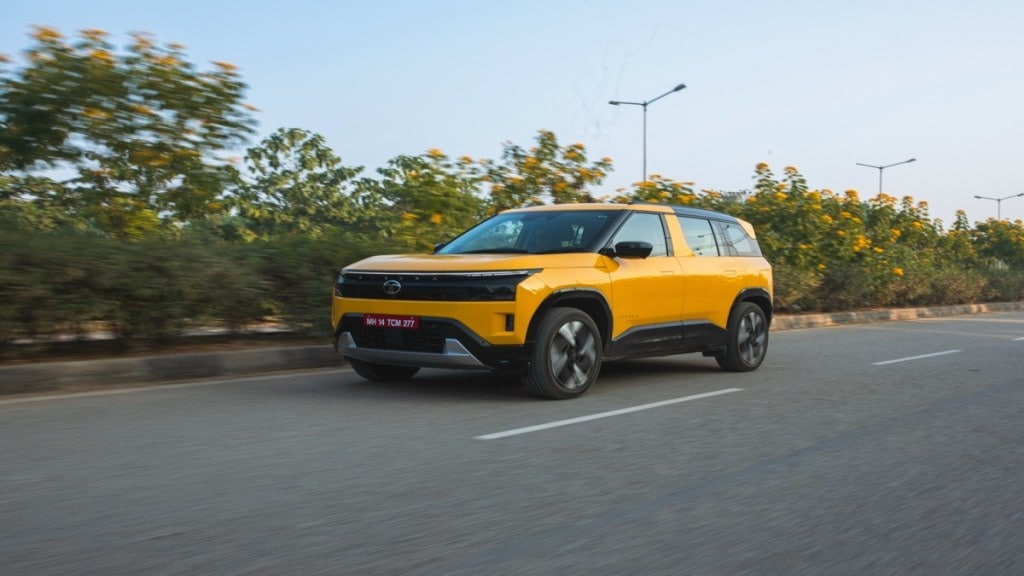
During the media test drive of the new Tata Sierra last week, something happened that we haven’t experienced with any car – it drew the attention of Gen X, Millennials, and Gen Z alike, appealing to the nostalgia of Gen X (who were young when the original was out, during 1991-97), and its tech-loaded cabin and futuristic design capturing the attention of the bred-on-smartphones Millennials and Gen Z.
The new Sierra unites generations, but is it a generational leap in design, engineering, and ownership? We drove the petrol and diesel variants on the beautiful roads of Chandigarh, where people kept waving at us to take a selfie with the Sierra.
What is it?
It’s a midsize, five-seat SUV positioned above the Curvv, and competes against special-edition or top-end variants of Hyundai Creta, Kia Seltos, Maruti Suzuki Victoris, etc. There are four variants: Smart+ (starts at Rs 11.49 lakh, ex-showroom), Pure (Rs 12.99 lakh), Adventure (Rs 15.29 lakh), and Accomplished (price will be revealed soon).
Voice-assisted panoramic sunroof is available in variants Pure+ onwards (Rs 14.49 lakh and above), the Accomplished variant has Level 2 ADAS, and the Accomplished+ variant gets the triple-screen infotainment. But even the entry-level Smart+ variant is loaded with features.
There are three engine options: 1.5 Revotron petrol (106 PS; 145 Nm), 1.5 Hyperion turbo-petrol (160 PS; 255 Nm), and 1.5 Kryojet turbo-diesel (118 PS; 260-280 Nm).
How’s the design?
It has reimagined the original Sierra’s most groundbreaking feature: the single-piece rear glass. A black-painted finisher along the roofline and a panoramic sunroof creates the illusion of continuous glass. The exterior communicates confidence and refinement, with smooth surfaces, muscular haunches, and a well-defined shoulder line. The rear design expresses stability, highlighted by a wide, clam-shell-style tailgate. This allows for full-width, single-piece sleek taillights. A partially blackened D-pillar enhances the floating roof effect, creating visual flow and ensuring the rear aesthetic is both modern and reminiscent of the original Sierra’s iconic appeal.
How’s the cabin?
It’s the most spacious not just in segment, but even roomier than SUVs a size bigger, thanks to its longest-in-class wheelbase of 2,730 mm. Rear seats have more legroom than in Mahindra Scorpio, and there is more boot space (622 litres) than most SUVs. The cabin feels airy, sunny, and lounge-like, thanks to a large glass area and light colours. Quality of plastics and fabric is good, and the 12 speaker JBL audio system in top variants is amazing.
How does it drive?
1.5 Hyperion: It’s a new turbocharged petrol engine, and impresses in parts. It’s quiet, accelerates fast (our test car did 0-100 km/h in about 11 seconds), and the 6-speed AT gearbox is slick. Vibrations are fairly controlled, and steering feedback is accurate. There is some amount of body roll, but even at sharp turns, the Sierra doesn’t seem to lose its line. Acceleration through the gears is also good, and the engine keeps pulling well past 100 km/h. But while it’s refined, it somehow doesn’t seem to be in the same league as the turbo-petrol of the Creta N Line.
1.5 Kryojet: It’s the trusted turbo-diesel, and is a good choice if you make a lot of highway runs. Initial acceleration isn’t as quick as the petrol (our test car did 0-100 km/h in about 14 seconds), but the top-end performance is good. You can drive all day at above 100 km/h and the engine won’t complain at all. But at city speeds, the diesel clatter is noticeable.
There also seemed to be some fit & finish issues with our test cars – on broken roads, the tailgate appeared to make unwanted sound.
Should you buy it?
If you want a head-turner, yes.
If you want space, yes.
If you have a driver, yes.
If you travel a lot with family and their luggage, most definitely yes.
But if you love driving and mostly drive alone, there are better options in the market.
Yes, it’s a generational leap in design and ownership, but there’s some way to go before it matches competitors in terms of engineering.


