
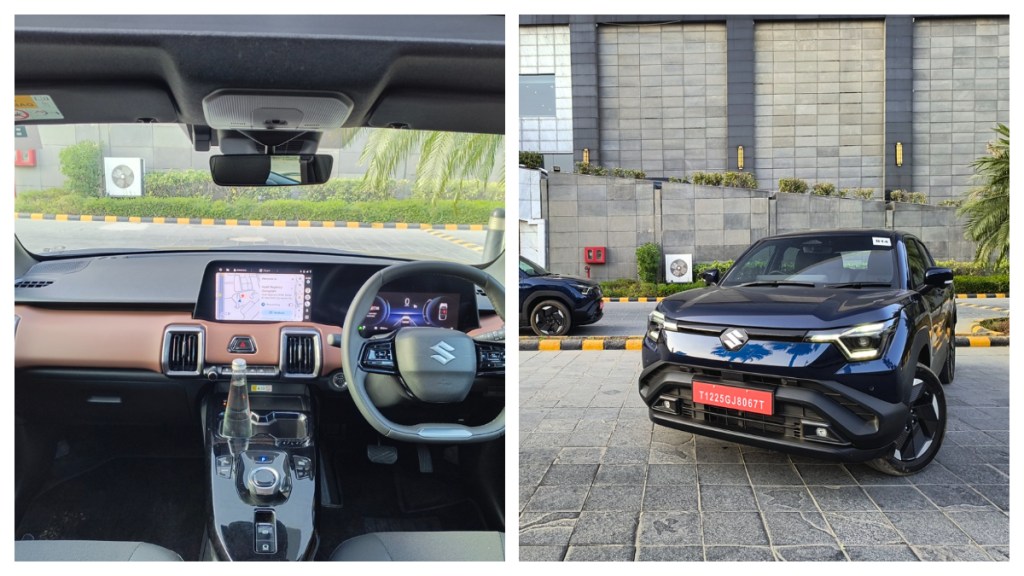
An electric car from Maruti Suzuki has been years in the waiting. Even when the eVitara was showcased in January 2025, the carmaker has taken another year for market launch. Has Maruti Suzuki been perfecting EV technology, and if so, is the eVitara the best EV ever? We tested this car on highways near Delhi.
What is it?
Developed in collaboration with Toyota, the eVitara is a born-electric car. It will come with two battery pack options (49 kWh and 61 kWh). It introduces an e-Axle system that integrates motor and inverter, and has an advanced all-wheel drive (AllGrip-e) variant for off-road capability. With heavy localisation at the Gujarat plant, it’s expected to be priced lesser than rivals Hyundai Creta Electric and Tata Curvv EV.
How’s the design?
The body is muscular – as if you merge the Baleno with Grand Vitara, and then send it to the gym for a year. While it’s shorter than the Creta Electric and Curvv EV, it has a longer wheelbase (2,700 mm), resulting in a roomier cabin.
The cabin isn’t like a traditional Maruti Suzuki car – it has a twin-deck floating centre console. Soft-touch brown upholstery and multi-colour ambient lighting provide a premium, modern feel.
How’s the space?
The cabin space is enough for five adults – and the large storage area under the gear selector is perfect for a handbag or small items. But its biggest weakness is the boot space (just about 300 litres, can be increased slightly by removing the parcel tray), far lesser than Creta Electric and Curvv EV. The eVitara also doesn’t have a frunk (front trunk) – hugely surprising because most born EVs come with a frunk.
Like most EVs with batteries under the floor, the floor is high, and this means the rear-seat passenger will sit in a knee-up position – uncomfortable on long journeys.
How does it drive?
We drove the 61-kWh variant, and the real range being shown on the display was 468 km. It drives like a comfortable family car, and doesn’t have that sporty appeal. The acceleration is not intense, but linear and smooth – perfect for people used to petrol/diesel cars.
What we liked: The steering is light in city traffic, but weighs up a little on highways. Thanks to the battery under the floor, the centre of gravity is quite low, and the eVitara feels stable and planted during sudden lane changes. Visibility from the driver’s seat is very good. We took it off the road, where its AllGrip-e appeared to give it an edge.
What we didn’t: On rough and broken roads, the ride turns harsh, and unlike the Grand Vitara that glides over potholes, the eVitara turns fidgety. An irritating miss is the absence of paddle shifters behind the steering wheel for setting levels of regeneration – you can set regen, but it’s buried inside the touchscreen menu. Lastly, the cabin isn’t as quiet as you’d expect from an EV.
Should you buy it?
Prices will be announced soon, and deliveries possibly in January 2026, and a few things we are certain about:
– It will be priced very competitively, and likely lower than Creta Electric and Curvv EV. The 49-kWh variant might even start under Rs 15 lakh.
– EVs are said to have low resale value, but the eVitara will be backed by Maruti Suzuki’s huge True Value network, and will likely be launched with an assured buyback programme, guaranteeing a fixed resale price after 3-5 years.
– The eVitara will be launched with India’s largest charging network – thousands of chargers at workshops in 1,100 cities, and 100,000 charging points by 2030.
– It offers a natural ICE-to-EV transition, and the focus is on comfort instead of sportiness.


