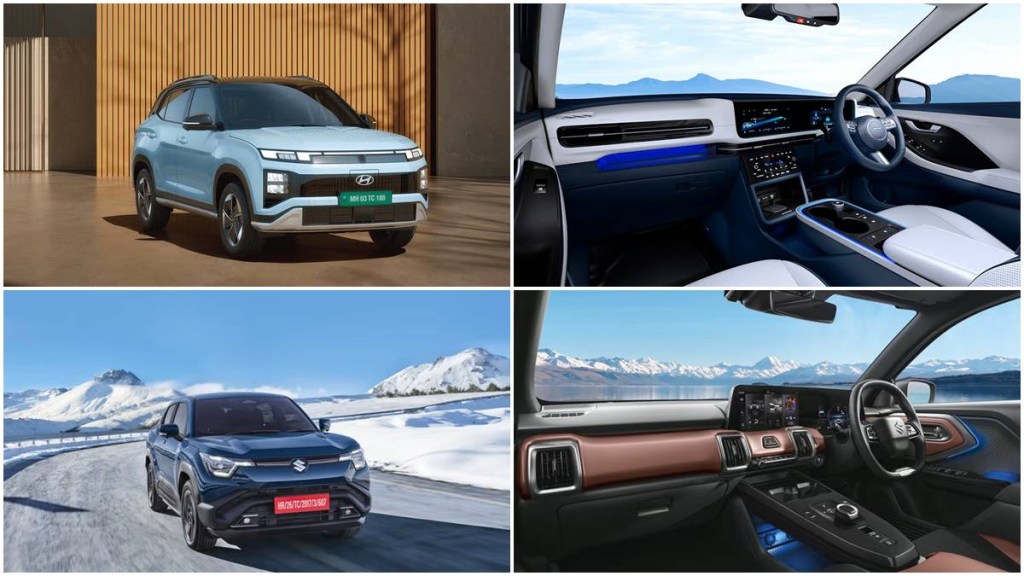
The electric vehicle (EV) segment is heating up, with Maruti Suzuki set to launch its first EV, the eVitara. Its biggest competitor will be Hyundai Creta Electric, launched earlier this year. Both these cars are similar in size, but differ in terms of battery, range, and acceleration.
In case you are in the market for the Creta Electric, should you wait for the eVitara?
The basics
Creta Electric: It comes with two battery options – 42 kWh (420-km ARAI range) and 51.4 kWh (510 km) – and is an ICE car turned electric. It has a pixelated-pattern front grille with a charging port; the alloy wheel design is unique; the floor houses the battery pack; in place of the engine are the motor and a frunk (front trunk); and it has an EV-specific user interface with a dual-screen set-up.
eVitara: It’s built on a dedicated EV platform, and will come in two battery pack options: 49 kWh (346-km WLTP range), and 61 kWh (428 km). It has a striking front fascia with a closed grille and thin LED headlamps. It also has flush-type door handles and blue accents (signifying electric mobility). The length is 4,275 mm, and the wheelbase is 2,700 mm. It will likely come with ventilated seats, dual-tone dashboard, 10.25-inch touchscreen infotainment system, Android Auto/Apple CarPlay, and an advanced digital cluster.
The drive
Creta Electric: Because the floor has the battery pack, the seating position is high. The suspension feels stiff (for the extra battery weight), and on broken roads the ride feels a bit harsh. On smooth roads, it’s really quiet. Throttle response is different in Eco, Normal, and Sport modes. In the Sport mode, the Creta Electric turns maniac – 0-100 km/h in just 7.9 seconds (51.4 kWh), and from any speed to any speed in the blink of an eye.
eVitara: We haven’t yet driven it, but reports say the 61-kWh variant does the 0-100 sprint in 8.7 seconds, and the 49 kWh in 9.6 seconds, making it possibly the fastest accelerating Maruti Suzuki car, but slower than the Creta Electric.
The price
Creta Electric: 42-kWh variants are priced from Rs 18.02 lakh to Rs 22.33 lakh, ex-showroom, and 51.4 kWh from Rs 19.99 lakh to Rs 24.69 lakh, making it way too expensive (in terms of rupee per kWh). Bigger EVs such as Mahindra BE 6 appear to offer far more value, whose 59-kWh variants start at Rs 18.9 lakh, and 79 kWh at just Rs 23.5 lakh. That’s a reason the Creta Electric hasn’t been able to replicate the success of the Creta ICE.
eVitara: While it’s logical to compare the eVitara with the Creta Electric, Maruti Suzuki should set its goals slightly higher, and target the price-value equation of EVs such as MG Windsor and BE 6, instead of taking the Creta Electric route.
Prices will be announced soon.
(Creta Electric range is calculated by ARAI, and real-world range will be lesser; eVitara range is WLTP for the European model exported from India, and the range is closer to real-world conditions.)