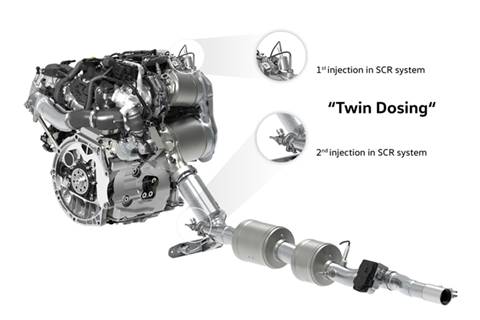
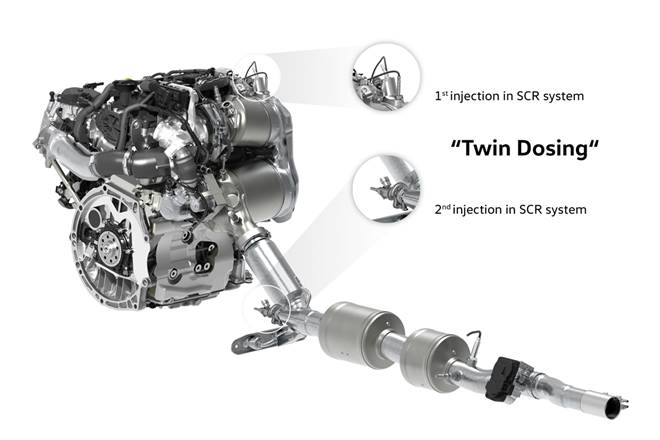

Volkswagen, the German carmaker has developed a new Selective Catalytic Reduction (SCR) system with ‘twin-dosing’. It selectively injects Adblue upstream of two SCR catalytic converters which are arranged in series. This new technology is available on the new Passat 2.0 TDI Evo which now meets the upcoming Euro 6d emission regulations. According to Volkswagen, realtime driving emissions have confirmed that the new twin dosing in the SCR helps in the reduction of NOX emissions by 80 per cent in comparison to the older generation models.
Volkswagen has announced that it is going to introduce this new SCR technology in all its models which are equipped with the 2.0 TDI Evo diesel engine. In addition to the new Passat, the new Golf, which is soon going to make its debut, is also going to get this twin dosing technology.
Volkswagen’s new twin dosing system uses two SCR catalytic converters with the second one being located in the underbody of the vehicle. This increases the distance from the engine and by the time the exhaust gases reach the second catalytic converter, they are up to 100-degree Celcius cooler. With the help of this, the overall time span for the treatment of the exhaust gases is increased. Though the gases are still at a temperature which exceeds 500-degree Celcius, through this process, a higher conversion rate is achieved. This further prevents excess ammonia slip.
The Adblue reducing agent is introduced into the exhaust gas in the SCR catalytic converter. This solution then evaporates, splitting the reducing agent, resulting in the production of Ammonia. In the SCR, the Annonia then reacts with the special coating of nitrogen oxides resulting in the formation of water and nitrogen, which are completely harmless and are the main constituents of the air that we breathe in.
Expect this technology to soon trickle down to cheaper Volkswagen diesel models as well. India, which is soon going to introduce stricter emission regulations, could also get this technology in future models from Volkswagen.