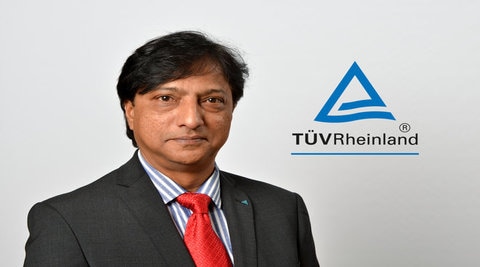

Leading automobile testing and certification company, TUV Rheinland India, a subsidiary of the TUV Rheinland Group, Germany. TUV Rheinland India is active in more than 100 locations in India. As a prominent service provider in the testing, training, inspection, consulting and certification industry (TIC), its testing capabilities include photovoltaic, Softlines, material testing and product safety laboratories as well as an EMC chamber, all of which cover an area of more than 100,000 sq.ft. TUV Rheinland claims to be the only certification body in India that boasts an accredited welding institute offering welding courses to the industry in order to enhance the technical skills of employees.
The company aims to set up many more laboratories across India in near future. We recently had the chance to meet and talk with Hemant Desai, Vice President –Mobility of TUV Rheinland India. He shared his company’s vision and its expansion plans in the Indian market.
Q: How has 2017 been for TUV Rheinland in India? Key challenges in the automotive space especially on the side of regulations and testing?
A: 2017 has seen a lot of ups and downs, sales volume going up or down really doesn’t matter to a testing agency like us. But we have seen that automakers are really investing a lot of R&D, new technologies are being either imported or being developed locally and India is becoming a global market. Our services, certification caters to both global and Indian market.
Q: What about electric mobility, is 100% electrification possible? What about charging infrastructure?
A: We are keen on e-mobility and excited about it. Our motto is to think globally and act locally. So we are catering to e-mobility in India and we have a substantial global experience. For example, in China, we helped a Beijing electric vehicle company to get its first functional safety certification. We also have State-of- The-Art laboratories to test EV batteries. We are now looking to expand our facilities to cater to the increasing demand.
We have adequate experience in testing the electric vehicle charging infrastructure. We can support the Indian EV initiatives in terms of laying down the specifications, testing of connectors and cables as well as assist in certifying the EV components and vehicles. Most of the Indian regulations are now aligned with global regulations. So a component manufacturer is able to get both Indian and International certificate from us. This will allow them to reduce the turnaround time and money spent on developing and marketing the product.
We have started a service called Global MAS (Market Access Services), where we support manufactures of tyres, lamps and other accessories to export to other markets, and support them with regulatory research, testing and getting the required approvals from those countries. We have a stable growth in this area where we are growing at a rate of 15-20 per cent.
Q: What’s the future like in R&D? Especially in the Indian auto space?
A lot of investments will come in India, perhaps not for the Indian market but for global markets. A lot of R&D, engineering will be done here. Outsourced R&D is going to increase and along with the design, there will be a push to make a working prototype. The design should be production enabled and that’s now happening in India. Skilling part is a big crucial and challenging part and we are into skill development as well. We have about 500 employees to develop skill development in India.
Disruptions are required to grow, you get a lot of challenges, India is being placed as an export hub. Many OEMs came to India, sold in India, decided not too, but are selling more than before just by exporting said Mr. Desai concluding the interaction.


