With increasing congestion in metropolitan cities, air taxi services for commuting between different points may gain ground for executives who do not mind shelling out the extra money.
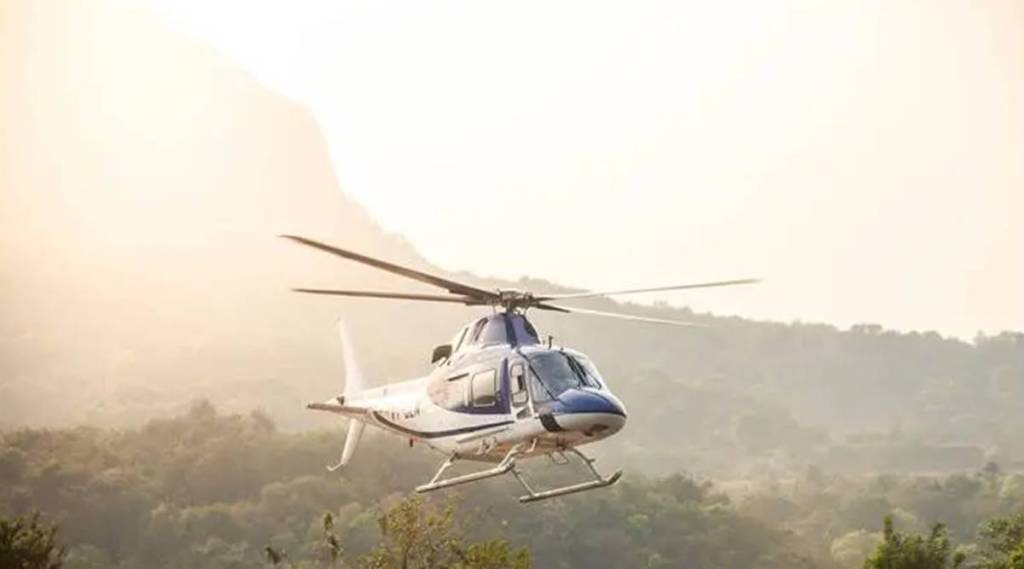
New Delhi-based Flyblade, a joint venture between Hunch Ventures and US-based firm Blade, is trying to explore the potential of using helicopters and electric vertical take-off and landing (eVTOL) crafts to get into this space.
Flyblade already offers cost-effective air transportation alternatives to some of the most congested ground routes in the country with helicopter-based flights from Mumbai, Shirdi, Pune, and Bengaluru. It is now expanding its reach by offering airport transfers in Bengaluru using helicopter taxis for just around Rs 3,500 later this month. The firm also recently announced plans to add another 200 VTOL aircraft across more routes in the next few years.
Speaking to FE, Amit Dutta, managing director, of Flyblade India, said the start-up has handled 1,000 passenger bookings to date between routes, including Mumbai-Pune and Mumbai-Shirdi. “We are targeting three main use cases, including airport transfers, tourism, and medical services. As part of our expansion, we plan to offer more intercity short-haul flights as a transport service and develop a new network of take-off and landing spots (helipads) in Maharashtra and Karnataka in the next few months,” Dutta added.
The Mumbai-Pune route, which usually takes a commuter an average of 4-5 hours can now be cut down to just around 50 minutes using Flyblade’s helicopter taxis which currently cost around Rs 15,000 for a one-way trip. However, Dutta is confident the one-way cost can be brought down considerably once Flyblade moves to electric VTOL aircraft. Currently, the cost per/km for fossil fuel-based helicopter taxis is around Rs 60; though experts point out this can be brought down to just around Rs 15-20 per/km using electric VTOL aircraft.
Vishesh Rajaram, managing partner of VC firm Speciale Invest which has investments in the air mobility space, told FE that air taxis can be efficiently deployed for shorter distance travel between 200-300 km, which existing aviation operators are unable to cover due to economic reasons. He, however, pointed out that for such businesses to flourish in the Indian context, they should make economic sense to customers by offering flights at the cost of existing road mobility prices. “For startups to build an air mobility play which connects towns and cities across every 200 km at around Rs 15-20 per/km, the only viable options right now are electric VTOL craft. But these can take another 2-3 years to be fully certified by the regulators to be used in Indian airspaces,” Rajaram added.
However, there are still teething troubles. VTOL aircraft cannot operate during monsoon between mid-June to September and the lack of availability of supply of helicopters is another challenge. Dutta said in India, there are only about 200 helicopters that are operated by NSOPs (non scheduled operator permit), and almost half of them belong to oil and mining firms. To solve for supply, Flyblade is currently banking on a leasing model that partners with non-scheduled operators (NSOPs) on a revenue-sharing basis.
“Flyblade has a sister company established in Gujarat which makes use of the government’s subsidy that promotes leasing. In this model, we work with (helicopter) manufacturers to lease craft to non-scheduled (flight) operators who will in turn lease back the aircraft to us at far more economical rates,” Dutta said. Globally, air taxis have been operating on a large scale, especially in cities such as New York, San Francisco and Los
Angeles. One such example is Uber Copter which was launched as an airport transfer service between JFK Airport and New York city limits for $200 per ride in late 2019. Uber also announced a plan to launch into electric VTOL space in 2020, but this was scaled back as the company was battling a fall in ridership numbers in its core taxi business. However, other companies such as Hyundai and Toyota are said to be working on their own business ventures to enter into the air mobility space globally.