
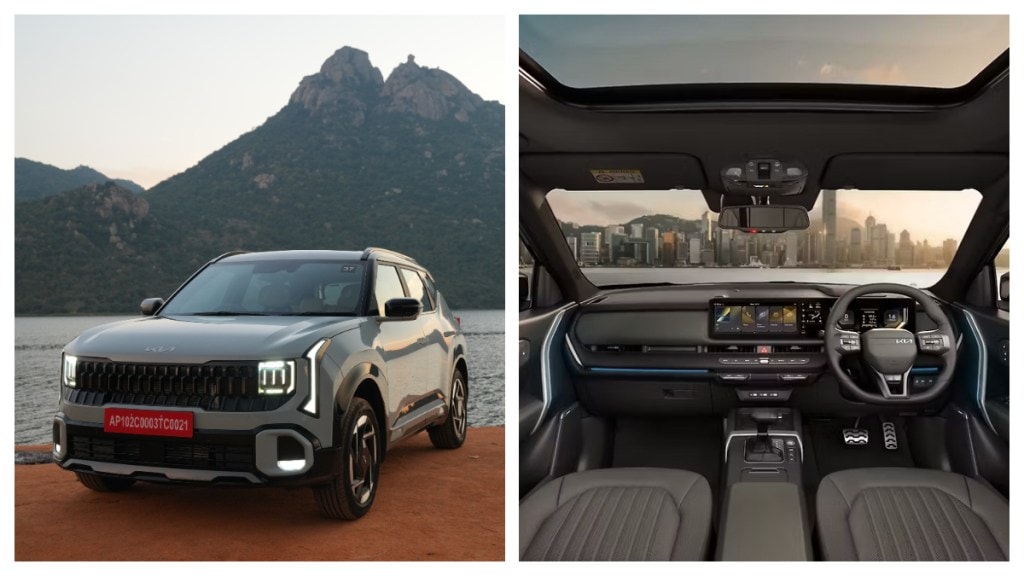
In the highly-competitive midsize SUV segment, Kia India has stopped playing defence – with the new Seltos, it wants to win. Is it that amazing a car? We tested it on and off the road.
What is it?
Back in 2019, the Seltos firmly placed Kia on the automotive map of India – on the eighth day of the launch, it made Kia the seventh-largest carmaker; in the third month, fifth-largest; and in the seventh month, third-largest.
But in 2026, the competition is fiercer than ever – Hyundai Creta and Maruti Suzuki Victoris, as well as the new Tata Sierra.
This ‘art of car’, however – with a new design, tech, and performance – is Kia’s weapon of choice.
What has changed?
In one word – aggression. The new Seltos is bigger – 4,460 mm long and 1,830 mm wide – and has a longer wheelbase (2,690 mm). Its black high-gloss grille, dark gunmetal accents, ice-cube-shaped LED headlamps, connected LED taillamps, and R18 alloy wheels give it a tough SUV character – from certain angles, it looks intimidating.
How’s the cabin?
It’s in the league of luxury cars – spacious, with black and white two-tone design, white accents, and leatherette seats. The dashboard has a big 30-inch screen, and the dual-tone steering wheel is good to hold and nice to look. Features are aplenty – in the top variants we tested, there’s a 10-way powered driver’s seat, ventilated front seats, 8-speaker Bose sound system, ambient lights, and dual-panel sunroof. Its longer wheelbase means more legroom for rear passengers – as much as the Sierra.
How’s the firepower?
Petrol: There are two choices – the naturally-aspirated 1.5-litre (115 PS, 144 Nm), and the turbo-petrol 1.5-litre (160 PS, 253 Nm) – and we drove the latter. It’s pin-drop silence quiet, but that silence is like the calm before the storm. Acceleration is intense – it flies from 0-100 km/h in about 9 seconds – and even at high speeds and on wet roads, it rides almost sticking to the road. The steering feedback – mechanical signals that front tyres send to the steering wheel – is accurate, and you feel every bump and dip in the road through the steering wheel. Acceleration through the gears is also impressive – you can easily overtake long trucks on a highway. But while doing all this, the engine consumes a lot of fuel – our test car barely returned 11-12 km/litre.
Diesel: It’s a highway mile-muncher – quiet at idle, and turns really silent once it warms up at cruising speeds. Initial acceleration isn’t as quick as the turbo-petrol, but the top-end performance is good. You can drive all day at above 100 km/h and the engine won’t complain. The fuel efficiency we got was close to 16 km/litre on the highway.
Ride & handling
The new Seltos is built on the global K3 platform and that makes a lot of difference – the previous Seltos had a stiff and sporty, yet a bit bumpy, ride, but the new model feels more settled at high speeds. Going over potholes, it doesn’t produce that ‘thud’ sound, but feels cushiony.
The art of war
Sun Tzu said that you can win a war even before fighting. The new Seltos is priced Rs 10.99-19.99 lakh, ex-showroom – just Rs 20,000 extra over the outgoing Seltos, less than the Sierra (Rs 11.49-21.29 lakh), and in the same range as the Creta (Rs 10.73-20.2 lakh). While the Sierra is tough competition and the Creta has solid brand value, the Seltos has solid positioning – an SUV that feels a segment higher in premium appeal and space, before a customer even looks at the technical specs of its rivals.
Pointers
— Designed on the global K3 platform, the new Seltos is 4,460 mm long (145 mm more than the 2019 model)
— Its wheelbase has been increased by 80 mm (now 2,690 mm), which means more legroom for rear passengers
— Its width has been increased by 30 mm (now 1,830 mm), offering better shoulder room, and boot space is 447 litres (up by 14 litres)
— Available in four trims (HTE, HTK, HTX, and GTX) and four option packs (Convenience, Premium, ADAS, and X Line)
— Three engine choices (1.5-litre petrol, 1.5-litre turbo-petrol, and 1.5-litre turbo-diesel), and five transmission options (6-MT, 6-iMT, IVT, 7-DCT, and 6-AT)
— Main competitors are Hyundai Creta, Tata Sierra, Maruti Suzuki Victoris and Grand Vitara, and Toyota Hyryder
— Priced from Rs 10.99-19.99 lakh, ex-showroom; our pick is the HTK (O) 1.5-litre turbo-petrol variant mated to 7-DCT gearbox for its value (Rs 16.29 lakh)


