


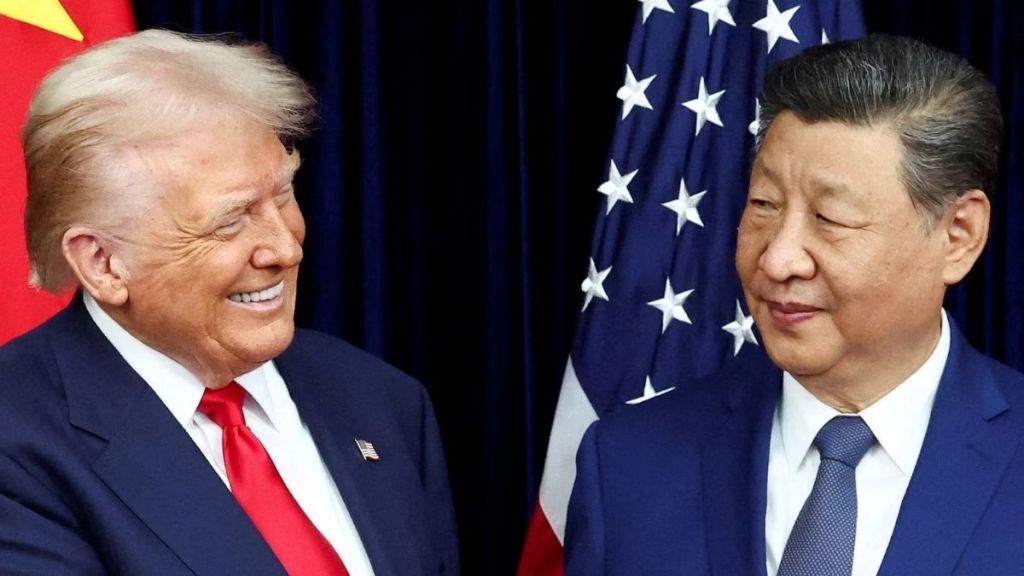

Chinese President Xi Jinping will visit the United States from September 23 to 25 at the invitation of US President Donald Trump, China’s Foreign Ministry said on September 21. The visit will bring the leaders of the world’s two largest economies together for talks on bilateral relations and wider global issues.
Chinese Foreign Ministry spokesperson Guo Jiakun said Xi and Trump would hold “in-depth exchanges of views” on major issues involving China-US relations, world peace and development.
The visit comes six months after Trump travelled to China for talks with Xi. Beijing described the two reciprocal visits within such a short period as having “historic, milestone significance”.
Trade, tariffs, artificial intelligence, technology restrictions and rare earths are expected to feature prominently as Washington and Beijing seek to manage their economic rivalry while keeping communication channels open.
Trade and tariffs
Trade is likely to be one of the main issues on the agenda. US Treasury Secretary Scott Bessent and US Trade Representative Jamieson Greer have already held talks with Chinese officials ahead of the leaders’ meeting.
The discussions included possible tariff reductions on less sensitive goods such as consumer products, agricultural goods, energy and medical devices, reported AP.
US officials also want measurable progress on commitments already made under the countries’ economic framework.
Tariffs remain a major source of tension. The Trump administration has used them as a central tool of its China policy, while Beijing has responded with its own measures.
The leaders could therefore focus on maintaining the existing trade truce and identifying areas where economic pressure can be reduced.
AI and technology
Artificial intelligence is another major area of competition between Washington and Beijing.
The rivalry covers AI models, computing power, semiconductors, data and access to advanced technology. The US has imposed restrictions on China’s access to some advanced chips and semiconductor equipment, citing national-security concerns.
At the same time, the two countries have discussed whether they can cooperate on specific AI-related risks.
Bessent said the US had proposed a “notification mechanism” for serious AI incidents during discussions with Chinese Vice Premier He Lifeng, according to AP. Such a mechanism could provide a channel for the two governments to communicate if an AI-related incident creates national-security risks.
The proposal would represent limited cooperation rather than a broader agreement on AI. Washington and Beijing remain competitors in advanced technology and disagree over export controls and the pace of AI development.
The summit could therefore test whether the two countries can establish narrow safeguards while continuing their wider technological competition.
Rare earths and critical materials
Rare earths are another potential area of discussion. China plays a major role in the global supply chain for rare earth minerals, which are used in electronics, electric vehicles, renewable-energy equipment and defence systems.
For Washington, greater certainty over access to critical materials could reduce supply-chain risks for US manufacturers. For Beijing, rare earths remain an important part of its economic relationship with the US.
Any understanding on supplies could therefore have implications beyond the two countries, particularly for manufacturers dependent on Chinese-linked supply chains.
Taiwan and other geopolitical issues
The leaders could also discuss geopolitical issues, including Taiwan. The US maintains unofficial relations with Taiwan and provides the island with military equipment, while Beijing considers Taiwan part of China and opposes US support for it.
Taiwan would remain among the difficult issues surrounding the summit. The leaders could also discuss the conflict involving Iran and wider developments in the Middle East.
Why the meeting matters for global economy
The Trump-Xi meeting matters beyond the US and China because their economic relationship affects global trade, manufacturing and technology supply chains.
A renewed tariff escalation could increase costs for companies that rely on cross-border production. Greater clarity on trade rules, meanwhile, could give businesses more certainty.
Technology restrictions create a similar problem. US controls on advanced chips affect Chinese technology companies, while China’s position in the rare-earth supply chain creates risks for manufacturers in the US and elsewhere.
Financial markets have already responded to expectations surrounding the meeting. Reuters reported on September 21 that China’s yuan reached its strongest level against the US dollar in more than three and a half years. Analysts cautioned, however, that the currency’s recent strength did not necessarily signal a lasting change in Chinese currency policy.
Beijing has said it wants to strengthen dialogue and cooperation while “properly” managing differences. The US, meanwhile, continues to pursue policies aimed at protecting its economic and technological interests.