


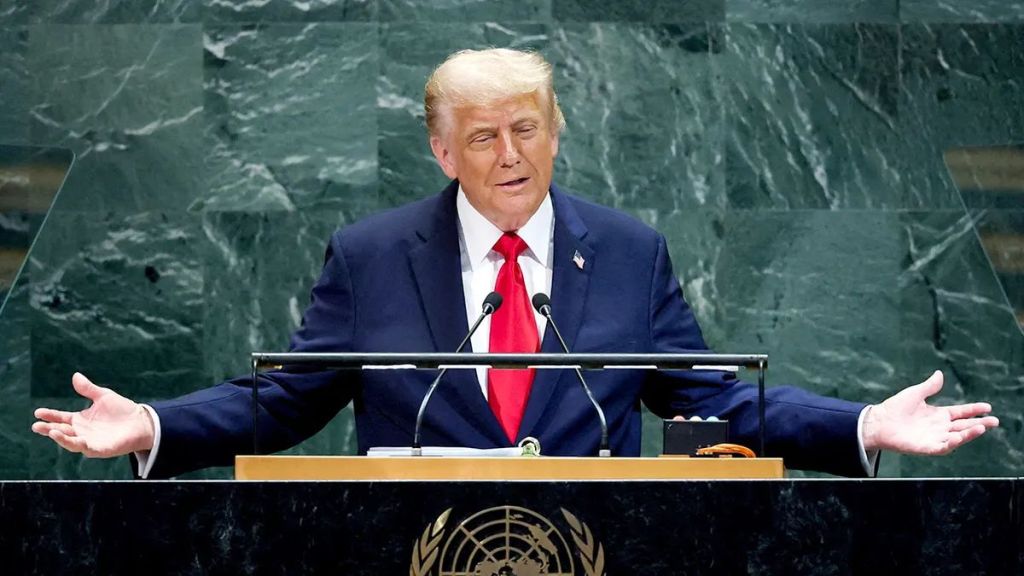

US President Donald Trump called on countries at the UN General Assembly to join the United States in imposing “complete economic isolation” on Iran. Trump said the pressure should continue until Iran stops attacks on commercial ships, abandons its nuclear ambitions and ends its support for terrorism. He added that Iran’s “terror regime” is acting out of “weakness and desperation”.
Trump also said that a deal with Iran remains possible once the US midterm elections conclude, though he presented an alternative of seeking to “annihilate the Islamic Republic.” He further addressed American munitions stockpiles and expressed intentions to create a “large military presence” on Greenland, while maintaining that he is someone who has “made peace.”
Earlier in the day, Iran had offered to reopen the strategic waterway within seven days if the United States takes initial steps to ease its military pressure, a senior Iranian government official told Kyodo News on Tuesday. Tehran has also conveyed the proposal to Washington through mediators, along with a call for fresh negotiations aimed at securing a permanent end to hostilities between the two countries.
This comes as Iranian President Pezeshkian arrives in New York for the 81st UN General Assembly with both sides facing pressure to find a way out of a conflict that has disrupted one of the world’s most important energy corridors. At the same time, Trump has indicated that he is open to meeting Pezeshkian during the UNGA’s high-level week.
Will Trump meet Iran president Pezeshikan at UNGA?
Trump’s openness to a meeting adds a diplomatic dimension to a conflict that has largely been defined by military and economic pressure. Ahead of the UNGA, Fox News journalist Trey Yingst said he asked Trump whether he would be willing to meet Pezeshkian at the UN General Assembly. Trump was quoted as replying, “He said he would probably be open to it.” Pezeshkian is scheduled to address the General Assembly on Wednesday, September 23. He is also expected to hold meetings with foreign leaders and officials on the sidelines of the session.
For Tehran, the UNGA provides an opportunity to speak directly to the international community and also engaging countries involved in mediation. As he left Iran for New York, Pezeshkian said Tehran would use the opportunity to defend its position. “We emerged with our heads held high, and this is a source of dignity and pride for all of us. Therefore, we will firmly defend our positions in international forums,” Pezeshkian said before flying out of Iran, according to footage broadcast by state television, as reported by AFP.
“We will make the best possible use of this opportunity to convey Iran’s plight to the international community. We will firmly tell our adversaries that, despite all the unfairness and injustices, the Iranian people have stood their ground,” he said.
Hormuz is the key pressure point
The Strait of Hormuz has emerged as one of the biggest pressure points in the conflict. The maritime corridor carried about one-fifth of the world’s hydrocarbons before the war. Traffic has been severely disrupted, with Iran firing on commercial ships and demanding approval for passage. The United States, meanwhile, is maintaining a counterblockade of Iranian ports while increasing economic pressure on Tehran.
This makes Iran’s seven-day reopening proposal significant. Tehran is effectively linking the return of normal shipping through Hormuz to a reduction in US military pressure and a renewed negotiating process. The proposal has been conveyed through mediators and includes a demand for fresh talks aimed at securing a permanent end to hostilities.The question now is whether the potential Trump-Pezeshkian meeting can provide a political channel for such a proposal.
Pezeshkian carries Iran’s message to New York
Pezeshkian’s presence at the UN is itself unusual. He is the highest-ranking Iranian official to set foot on American soil since the Middle East war began in late February with US-Israeli strikes on Iran. Iran’s president is expected to use his UN address to focus on the war with the US and Israel, as well as what Tehran describes as the failures of previous negotiations.
“We will forcefully raise Iran’s positions in international forums. The issues we will raise at the United Nations are expressing the oppressed state of the Iranian nation, the crimes that have occurred, and the distrust that has been created,” Pezeshkian said, according to ANI. “We went to the negotiating table several times and signed agreements, but unfortunately, the whole world saw how commitments were not fulfilled and the writings were trampled underfoot,” he reportedly said. Tehran is also expected to use the UNGA to engage countries involved in mediation, potentially creating another channel for talks with Washington.
Can UNGA become a negotiating table?
The UN General Assembly brings together a large concentration of world leaders and diplomats, making New York one of the few places where senior officials from countries on opposing sides can be in the same diplomatic space. Pezeshkian is expected to hold talks with several foreign leaders on the sidelines. Trump is also scheduled for a series of meetings with foreign leaders, including Gulf leaders who have a direct stake in the Iran conflict.
A direct Trump-Pezeshkian meeting, if it takes place, would therefore come against the backdrop of several overlapping pressures including the war, the disruption of Hormuz, the nuclear issue, sanctions and growing regional economic risks. Iran has now put a concrete proposition on the table. Reopen Hormuz within seven days, but only if Washington first takes steps to ease military pressure and agrees to renewed negotiations. Whether that proposal can become the starting point for talks may depend on what happens in New York.