


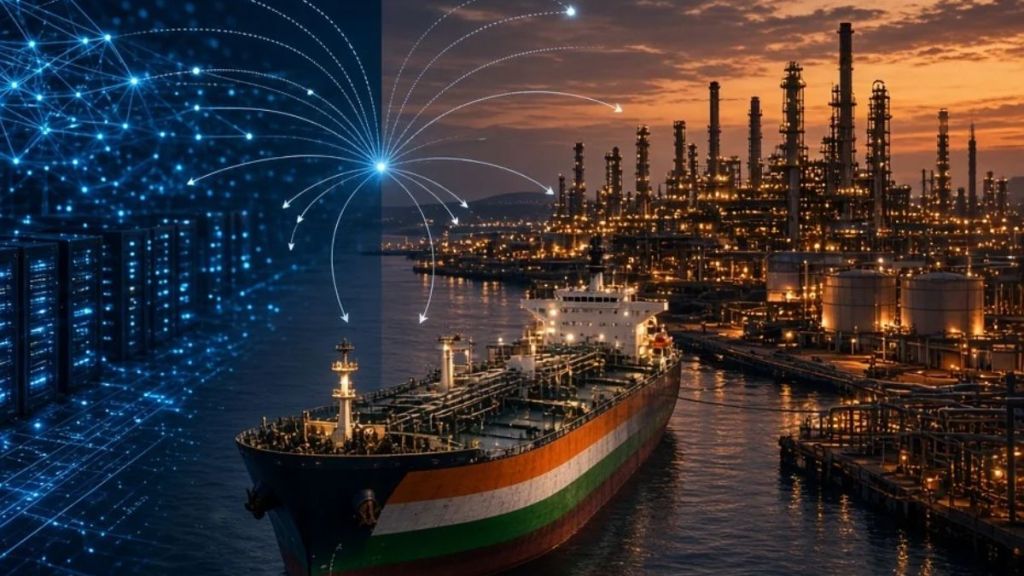

In the age of artificial intelligence (AI), we often hear that computing power is the new oil. Data centres are compared to refineries, while graphics processing units (GPUs), which power AI systems, are seen as the new oil barrels. The comparison has become so common that governments and companies are competing for electricity, chips and cooling systems with the same urgency once seen in the race for oil.
But recent developments show that traditional energy still holds enormous power.
Last week, US Secretary of State Marco Rubio travelled to Jamnagar in Gujarat, home to the world’s largest single-site oil refinery, instead of visiting a semiconductor factory or a large data centre. During his visit, Rubio described India as a “refining superpower.”
Around the same time, Indian Oil Minister Hardeep Singh Puri and the heads of India’s state-owned oil refining companies announced plans to add around 16.5 million tonnes of diesel production capacity next year.
India’s total refining capacity is expected to rise from around 267 million tonnes a year to 300 million tonnes, Reuters reported. In the longer term, the country aims to increase this capacity to 400 million tonnes a year.
From the United States to Indonesia, traders and government representatives are trying to secure diesel supplies from India, the world’s second-largest exporter of diesel transported by sea.
How India became a key diesel supplier
India is in a strong position to meet part of this demand because it has one of the world’s most advanced and flexible oil refining systems.
The country’s refineries can process different types of crude oil and turn them into valuable fuels, including diesel. This flexibility is particularly important when supplies of certain types of crude become difficult to obtain.
Reliance Industries’ Jamnagar refinery complex is a major example. It can process a wide range of crude oils, including heavy Venezuelan crude that many Western refineries find difficult to handle.
India’s state-owned refiners are also preparing to increase production at a time when global markets need more fuel.
The expansion comes as conflicts and refinery closures disrupt global fuel production. Refineries that are still operating are running at historically high levels to help meet demand and ease shortages.
Indian Oil Corporation (IOC), the country’s largest oil refiner, plans to add around 18 million tonnes of annual refining capacity. This is expected to help the company produce an additional 8 million tonnes of diesel every year.
“We will be exporting diesel due to refinery expansion,” IOC chairman A S Sahney said.
Hindustan Petroleum Corporation (HPCL) is also preparing to increase output. Its new refinery in Rajasthan, which has a capacity of 9 million tonnes a year, is expected to produce 3 million tonnes of diesel in 2027 once operations stabilise, chairman Vikas Kaushal said.
Bharat Petroleum Corporation (BPCL) plans to produce an additional 1.5 million tonnes of diesel a year from 2027, chairman Sanjay Khanna said.
Numaligarh Refinery, a subsidiary of Oil India in eastern India, is also expanding its operations. The refinery’s capacity is expected to reach 9 million tonnes a year by March 2027, adding 3 million tonnes to its annual diesel production capacity.
Two decades of investment are now paying off
India’s growing importance in the diesel market is not the result of a sudden change. It comes after years of investment in its refining industry.
Over the past two decades, India has continued to expand its refining capacity even as parts of the Western world shut older plants or held back from investing in new ones.
India still depends heavily on imported crude oil. However, it has used its refining capacity to turn this dependence into an advantage.
The country imports crude oil, processes it in its refineries and exports higher-value products such as diesel.
This has given India a stronger position in global energy markets. Diesel has quietly become an important source of both economic and diplomatic influence for the country.
Why global demand for Indian diesel is rising
India’s growing refining capacity is expected to strengthen its position as a key supplier of refined fuels when global markets are facing shortages.
The wars involving the United States and Iran, and Russia and Ukraine, have disrupted oil supplies and trade flows. These disruptions have also increased freight rates, raising the cost of moving fuel across the world.
At the same time, refinery closures have reduced the amount of fuel available in the market. The refineries that remain operational are running at high levels to meet demand.
This has created an opportunity for India to supply more diesel to countries looking for reliable sources of fuel.
India’s position as a swing supplier is particularly important. This means it can increase or redirect supplies to meet changing demand in global markets.
Refinery expansion will free up more fuel for exports
The expansion of India’s state-owned refineries will also change how some companies meet domestic demand.
Companies such as HPCL currently buy refined fuel from private companies to sell through their own retail outlets. As their own refining capacity increases, they will need to purchase less fuel from other companies for sale in India.
India’s refining industry can also process a wide range of crude oil grades and flexible petrochemical feedstocks. This allows companies to take advantage of price differences in global markets and produce higher-value fuels and other products.
Private refiners Reliance Industries and Nayara Energy currently export refined fuels, while state-owned companies mainly focus on meeting domestic demand.
The expansion of state-run refineries could give India more fuel to sell overseas while helping companies meet the country’s own requirements.
Rubio calls India a refining superpower
India’s growing role in global fuel markets has also drawn attention from the United States.
US Secretary of State Marco Rubio recently visited Reliance Industries’ large refining complex in Jamnagar, Gujarat, and described India as a refining “superpower”.
The visit highlighted India’s importance at a time when countries are trying to secure fuel supplies amid global conflicts and disruptions to trade.
Puri said India wanted to establish itself as a global refining hub as rising fuel demand supports the country’s economic growth.
With more refining capacity coming online and global markets facing supply challenges, India is preparing to increase diesel exports and strengthen its position in the international energy trade.