


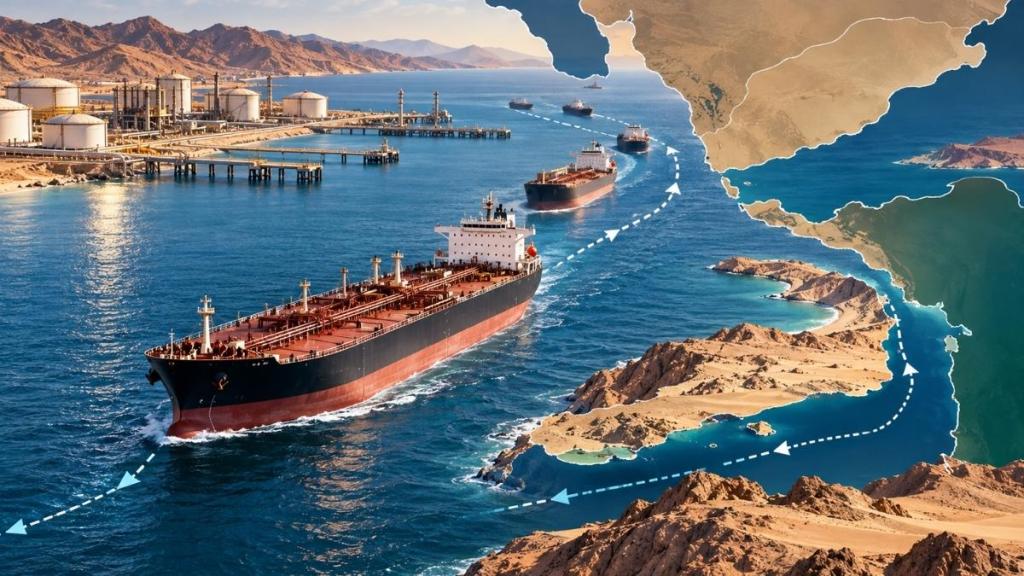

Saudi Arabia’s Jazan region has become an important pressure point for global oil markets as the Iran war spreads beyond the Strait of Hormuz.
The region sits on Saudi Arabia’s Red Sea coast, close to the Bab el-Mandeb shipping route. The region is critical for Saudi Arabia as the kingdom uses its Red Sea infrastructure to move crude towards international markets while the Strait of Hormuz faces disruption.
On September 8, Saudi oil assets in Jazan were targeted by Iran-backed Houthis. Abha and Najran regions were also hit. Saudi authorities confirmed fires at the sites and said 73 people were wounded, reported Reuters. NASA satellite images showed a thick cloud of black smoke over the Jazan refinery and white smoke rising from an oil distribution centre in Abha.
The attacks came after the Houthis declared a maritime embargo against Saudi Arabia on July 20. Reuters had already reported on August 12 that Saudi oil shipments from the Red Sea had become harder to track as tankers switched off their Automatic Identification System signals because of the threat of Houthi attacks.
The importance of Jazan goes beyond one refinery or oil facility. It is part of a wider Saudi export network that provides a route outside the Strait of Hormuz. That makes any prolonged disruption in the region important for oil markets, particularly for Asian buyers.
Why does Jazan matter to Saudi oil exports?
Saudi Arabia has more than one route for moving crude. This has become increasingly important because much of the Gulf’s oil infrastructure sits on the Persian Gulf side of the Arabian Peninsula, making the Strait of Hormuz the main route for oil leaving the region.
But traffic through Hormuz has fallen sharply during the war.
The US Energy Information Administration said in its August 11 Short-Term Energy Outlook that crude oil and petroleum liquids moving through the Strait of Hormuz averaged 4.9 million barrels per day in the second quarter of 2026. That compared with 21.6 million barrels per day in the fourth quarter of 2025, before the conflict began.
Saudi Arabia has therefore relied more heavily on routes that bypass Hormuz.
One of them is the East-West pipeline, which carries Saudi crude from the eastern part of the country towards the Red Sea port of Yanbu. From there, tankers can move crude towards markets outside the Gulf.
The Bab el-Mandeb Strait is another important link. It connects the Red Sea with the Gulf of Aden and the wider Indian Ocean.
Jazan lies on the Saudi side of this Red Sea system. Its refinery and oil facilities therefore form part of an energy network that has become more important as Hormuz traffic has fallen.
The EIA said on August 11 that Saudi Arabia could divert flows through the Suez Canal and Egypt’s SUMED pipeline. But it also said these alternatives are “longer, more expensive, and more limited in capacity” than the normal routes.
That means a disruption around Jazan would not stop Saudi Arabia from exporting oil altogether. Instead, it could further constrain one of the routes available for moving Saudi crude towards international markets.
The impact is already visible in shipping patterns.
The Houthis’ threat to block Saudi exports through the Red Sea could force more than 3 million barrels per day of Saudi crude that had been travelling through Bab el-Mandeb to take much longer routes, reported Reuters. Three tankers carrying Saudi crude to China and India had already turned around and headed towards the Suez Canal at the time.
The effect can therefore appear in shipping schedules even before a complete physical shutdown.
Tankers loading Saudi crude at Yanbu increasingly operated without visible tracking signals, reported Reuters. Vortexa estimated that Yanbu loadings fell to 2.38 million barrels per day in the week beginning August 3, from 2.71 million barrels per day the previous week.
Kpler produced a much lower estimate of 1.78 million barrels per day, down from 4.04 million barrels per day. AXSMarine, however, estimated that loadings increased to 850,000 barrels per day from about 420,000 barrels per day.
What happens if Jazan and the Red Sea route face longer disruption?
The immediate effect would be additional pressure on Saudi Arabia’s ability to move crude through its Red Sea network. The global impact would depend on how much infrastructure and shipping traffic remained available.
Saudi Arabia has already been redirecting some exports through alternative routes.
Saudi Aramco resumed loadings from Ras Tanura in August. But exports from Yanbu remained under pressure because of the Houthi naval blockade, reported Reuters.
Yanbu exports fell to 1.429 million barrels per day in August, according to provisional Kpler data, compared with an average of 3.9 million barrels per day in the previous three months, as reported by Reuters. At the same time, exports through Egypt’s Sidi Kerir rose to 2.139 million barrels per day in August, more than double the June level.
This shows that Saudi Arabia can redirect some cargoes when one route becomes difficult.
But rerouting does not remove the disruption. Longer journeys take more time and can increase shipping costs.
War-risk insurance costs had risen and tanker operators had changed their sailing strategies. DHT CEO Svein Moxnes Harfjeld said most very large crude carrier loadings had shifted north and northwest, reported Reuters.
The impact can also reach Asian refineries. More than 3 million barrels per day of Saudi crude destined for Asia could face longer journeys if the Bab el-Mandeb route became unavailable, reported Reuters. Asian refiners had already prepared for delays in Middle Eastern cargoes.
The problem becomes more serious when several energy routes face disruption at the same time.
The International Energy Agency said its Middle East Maritime Chokepoints Shipping Monitor, last updated on September 2, tracks changes in shipping through three major regional chokepoints. The IEA said the war had created the largest supply disruption in the history of the global oil market and had also disrupted natural gas and other commodity flows.
Why haven’t oil prices jumped even more?
Oil markets have not reacted with a simple one-for-one jump every time a shipment is disrupted. Middle Eastern crude shipments had fallen to about 11 million barrels per day from 18 million barrels per day before the war, according to Argus. Yet Brent crude remained below $100 a barrel despite renewed attacks, reported Reuters.
Several factors have helped limit the price response. Significant volumes had still moved through Hormuz before the latest escalation. Gulf producers had also used alternative routes and ship-to-ship transfers. Meanwhile, the United States, Canada and Guyana were expected to increase production by a combined 1.4 million barrels per day in 2026.
The EIA’s August 11 forecast also showed why alternative supplies and inventories matter. It expected Brent to average about $85 a barrel in the third quarter of 2026 and $78 in the fourth quarter, assuming Hormuz traffic gradually increased and shut-in production restarted. The agency expected most shut-in production to return in the first quarter of 2027.
Those figures are forecasts based on assumptions made on August 11 and do not account for every subsequent development in September.
Jazan disruption could also hit fuel supplies
The impact would not be limited to crude oil. Fuel oil supplies were expected to remain critically tight in the third quarter because war-related disruptions had strained refineries and shipping, reported Reuters. Middle Eastern fuel oil exports fell 45% year on year between March and August, according to Kpler data cited by Reuters.
The price of very low sulphur fuel oil in Singapore had risen 76% since the Iran war began, reaching just under $825 a metric tonne on September 1, reported Reuters.
This creates another link between a regional security problem and the global economy. If ships are forced to take longer routes, they need more fuel. If refineries face disruptions, supplies of specific petroleum products can tighten even when crude oil continues to reach some markets.
What does Jazan disruption mean for world?
A disruption at Jazan would not automatically shut down global oil supplies. Saudi Arabia has alternative export routes, while other producers can add some supply.
Jazan and the wider Red Sea network matter because they provide an alternative to the Strait of Hormuz. If that alternative also faces sustained disruption, Saudi Arabia would have fewer routes available for moving crude to overseas buyers.
The impact would ultimately depend on the scale and duration of the disruption, the availability of alternative routes, tanker movements, refinery capacity and additional supply from other producers.
For global oil markets, the bigger risk is therefore not one damaged facility. It is the possibility that multiple routes used to move Middle Eastern oil become constrained at the same time.