



The US military campaign against Iran has left Washington with a bill running into tens of billions of dollars, depleted stocks of key weapons and unusually long deployments for thousands of American personnel. Even as the intensity of the fighting has declined, the financial and operational burden on the Pentagon continues to grow.
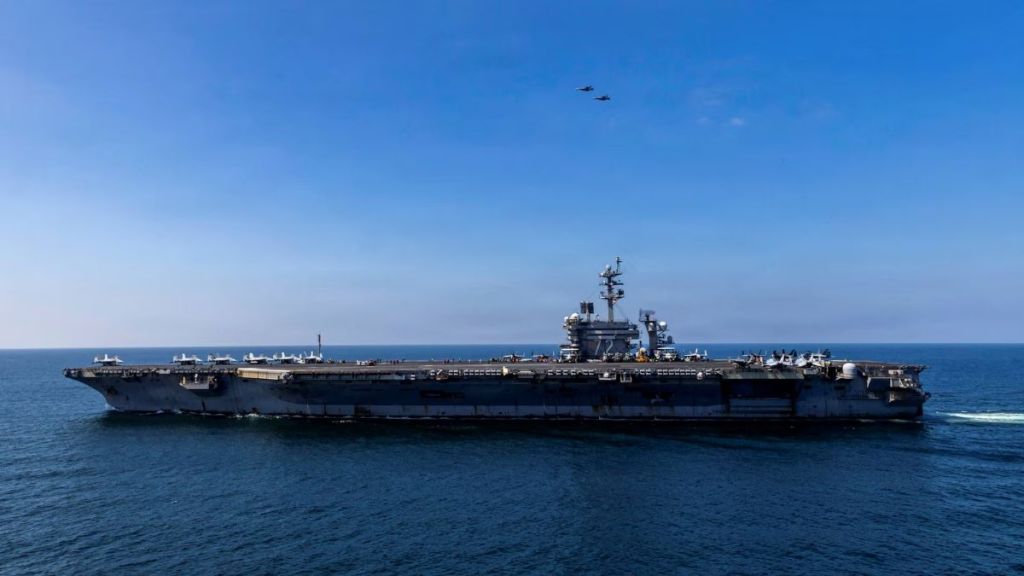
The scale of that commitment was reflected in the deployment of the USS Abraham Lincoln. The nuclear-powered aircraft carrier left Thailand on Sunday following a five-day port visit that offered its crew a brief respite after 286 consecutive days at sea.
Carrying roughly 5,000 sailors and Marines, the Lincoln had participated in the US naval blockade and combat operations against Iran. Its time at sea went well beyond the six-to-nine-month duration of a typical naval deployment and set what Democratic lawmakers described as a modern-day record, according to Reuters.
The extended deployment represents only one part of the wider cost. The US has spent tens of billions of dollars on the conflict, fired thousands of expensive weapons and kept ships, aircraft and personnel deployed for months. It has also used a significant share of some missile inventories that the Pentagon must now replenish.
How much has Iran war cost the US?
The most direct estimate came from US Defense Secretary Pete Hegseth during a Senate hearing on July 21. Hegseth told the Senate Appropriations Committee that the Iran war had cost the United States about $37.5 billion at that point, reported news agency AP.
Hegseth was asking lawmakers for additional money for the Pentagon and called the supplemental funding an “urgent, necessary” injection of money. “Without these funds, we face critical shortfalls,” Hegseth told senators.
But the final bill remained uncertain. General Dan Caine, chairman of the Joint Chiefs of Staff, was asked whether the requested funding would be enough to complete the mission. “I can’t answer the question on what it will cost, because the enemy has a vote,” Caine said, as reported by The Times of Israel.
A separate estimate from the Center for Strategic and International Studies, or CSIS, put the additional cost to the US Department of Defense at between $34 billion and $42 billion in its June 23 analysis, with a central estimate of about $40 billion.
CSIS stated that its calculation covered only additional costs caused by the war. It did not include defence spending that would have occurred even without the conflict.
The estimate included six broad categories – deploying and redeploying forces, ammunition, higher operating activity, equipment losses and damage, damage to bases and higher fuel prices.
Ammunition was by far the largest category, accounting for about $26.1 billion in the CSIS estimate. By the time of the ceasefire, US Central Command commander Admiral Brad Cooper said American forces had fired 13,629 strike munitions against more than 13,000 targets, according to CSIS.
Those weapons included systems used against Iranian targets as well as weapons used to defend US forces from Iranian missiles and drones.
The cost of individual weapons varies sharply. CSIS cited a basic bomb equipped with a JDAM guidance kit at roughly $100,000, compared with about $2.6 million for a Tomahawk cruise missile.
When thousands of weapons are fired, those differences quickly add up.
CSIS said Iranian missile and drone attacks declined by 80% to 90% during the third phase of the campaign. As the intensity of combat declined and US forces gained air superiority, American forces shifted towards shorter-range and cheaper weapons.
But spending continued even after the most intense strikes ended. CSIS estimated that the additional operating cost remained about $4 million per day until forces returned home or resumed normal operations.
Are US weapons stocks depleting?
The cost of the war is also a readiness issue for the Pentagon. The Washington Post reported on August 26 that the conflict had worsened shortages of key US munitions and raised concerns among American allies in Asia.
The concern extends beyond the Middle East. US military planners must also consider the Indo-Pacific, where China has developed a large arsenal of ballistic, hypersonic and anti-ship missiles.
The Washington Post cited CSIS analysis showing that US forces had fired more than 850 Tomahawk missiles during the first four weeks of the Iran war. CSIS later estimated that the number had passed 1,000.
Before the war, the US stockpile was estimated at between 3,100 and 4,500 Tomahawks.
Other weapons were also heavily used. According to April CSIS figures cited by The Washington Post, the Pentagon had used roughly a quarter of its prewar stock of Joint Air-to-Surface Standoff Missiles and as much as three-quarters of its Precision Strike Missiles.
Missile-defence weapons created another concern. Patriot and THAAD interceptors are particularly important because the United States has fewer alternatives when defending bases and troops from incoming missiles.
“Between Iran and the western Pacific, there’s a lot of overlap,” Mark Cancian, a retired Marine colonel and senior adviser at CSIS, told The Washington Post.
CSIS war games had already raised concerns about US ammunition levels in a major conflict with China. Those simulations found that US forces could consume many critical weapons within weeks.
In those simulations, US forces generally used about 5,000 long-range missiles in four weeks of a conflict with China.
That does not mean a conflict with China will happen or that the Iran war has made one inevitable. It illustrates the scale of the ammunition problem US military planners are examining.
The CSIS estimates put the remaining US inventory of Patriot and THAAD interceptors at around 1,000 by late July, reported The Washington Post.
Craig Kavanagh, a senior fellow at CSIS, highlighted the challenge posed by China’s missile arsenal. “China has 3,000 ballistic missiles or more. So that’s just bad math,” he said.
The Pentagon has responded by pushing defence companies to increase production. The Washington Post reported that Lockheed Martin received a $58.6 billion contract aimed at tripling Patriot interceptor production by 2030.
What did USS Lincoln’s 286 days reveal?
The USS Abraham Lincoln provides a physical example of the demands placed on US forces. The carrier left Thailand on September 6 after its port visit. Before that, it had reached Thailand on September 2 following 286 days at sea.
The carrier had roughly 5,000 personnel and had taken part in the naval blockade and combat operations connected to the Iran war, reported Reuters.
The deployment was far longer than the six-to-nine-month period Reuters described as typical for naval deployments.
The ship’s crew had little opportunity for a normal port break during the deployment, making the Thailand visit a rare respite.
Captain Dan Keeler, the Lincoln’s commanding officer, thanked Thailand for its hospitality. “We would like to thank the people of Thailand for their incredible hospitality,” Keeler said in a statement, according to Reuters report.
The deployment also illustrates the human burden of an extended war.
The AP reported that sailors and their families had raised concerns about mental health, food shortages and conditions aboard the ship.
A carrier is not simply a weapons platform. Thousands of people live and work on it for months, while the Navy must also deal with the additional maintenance demands created by an unusually long deployment.
Not every dollar spent on Lincoln during the war represents a completely new expense. Some crew compensation and normal ship and aircraft operating costs are already part of the defence budget.
The additional cost comes from the higher operational tempo and longer deployment.
CSIS estimated that the higher operational tempo added about $750 million to the war cost. Equipment losses and damage added another estimated $1.8 billion to $3.5 billion, while additional fuel costs were about $1.4 billion.
CSIS also estimated about $1 billion in additional costs for federal departments outside the Pentagon, including the Department of Homeland Security, Veterans Affairs and the Department of Energy.
Why the final bill remains uncertain
Even these estimates do not capture every economic consequence of the war. CSIS said there are wider and highly uncertain costs to the US and global economies and did not put a precise figure on them.
Much larger numbers have circulated. CSIS said early estimates of a trillion-dollar war assumed a much longer and more intense conflict. An Iran War Cost Tracker figure of $113 billion came from projecting an early reported Pentagon estimate of $1 billion a day.
CSIS rejected that method as a reliable measure of the eventual cost because the pace of US strikes declined after the ceasefire and the military shifted towards cheaper weapons.
The figures therefore depend heavily on what is included and when the calculation is made.
Hegseth’s July 21 estimate put the war’s cost at $37.5 billion at that point, while CSIS’s June 23 assessment estimated the additional Department of Defense cost at $34 billion to $42 billion.
Those figures come from different dates and methodologies and should not be treated as competing final bills.
The cost can also continue to rise after combat ends. Weapons have to be replaced, damaged equipment repaired and forces returned to their normal bases.
For the Pentagon, the Iran war therefore creates two financial clocks. The first measures what the conflict costs while US forces are fighting. The second measures what Washington must spend afterwards to restore military inventories, repair equipment and rebuild readiness.
The second clock can run for years. That is the larger lesson from the USS Abraham Lincoln’s 286-day deployment.
The war required a nuclear-powered aircraft carrier and thousands of personnel to remain at sea for an extraordinary period. It consumed billions of dollars in ammunition, damaged or depleted military equipment and created pressure to increase weapons production.
The carrier’s five-day stop in Thailand offered its crew a break. But for the US military, the financial and logistical consequences of the Iran war do not end when a ship leaves the battlefield.
As Caine told senators in July, “the enemy has a vote.” The final cost will depend on how long the US remains involved, how much equipment and ammunition it has to replace and how long it takes to restore military stocks.