


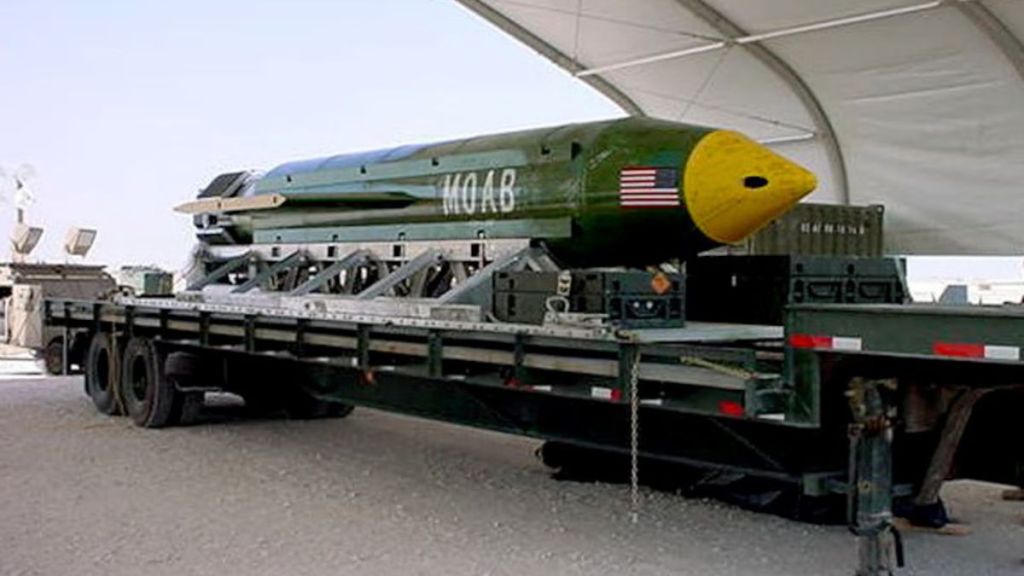

The US military has prepared plans to use its GBU-43/B Massive Ordnance Air Blast bomb, known as the ‘Mother of All Bombs’, against Iranian targets if President Donald Trump orders a strike, reported CBS. The reports come as Iranian attacks on Gulf infrastructure and commercial ships put pressure on Washington’s war plans and keep oil prices near $105 a barrel.
The publication reported on Thursday, citing people familiar with the plans, that the Pentagon is considering using the bomb against military sites in Iran. CNN, which first broke the story, said the possible targets also include nuclear facilities and energy infrastructure. Sources pointed to the heavily fortified Pickaxe Mountain complex near Natanz as one possible target.
What is the ‘Mother of All Bombs’?
The GBU-43/B MOAB weighs about 21,600 pounds and is the largest non-nuclear bomb in the US arsenal. The US military used it in combat once, in 2017, when it targeted a network of caves used by the Islamic State group in Afghanistan.
Unlike bunker-busting bombs used earlier in the war against Iran, the MOAB is designed to cause widespread damage through a powerful blast rather than penetrate deep underground.
A person familiar with the plans told CNN that the bomb is “great for huge area clearance but not much else”. The source said its main advantage could be the psychological impact of using such a powerful weapon.
Experts quoted by Military.com questioned whether the bomb could reach deeply buried targets and warned that its use could put civilians living nearby at risk.
Another source described the proposed options as a “fireworks show” that could give Trump a way to end the conflict.
Neither the White House nor the Pentagon confirmed the reported plans. A White House spokesperson told CBS News that the administration does not comment on sensitive military plans that “may or may not exist”. The spokesperson added that Trump keeps all options open to ensure Iran never gets a nuclear weapon.
A Pentagon official said the Department of War prepares for a wide range of possible situations. Trump, speaking to Newsmax on Thursday, said he would not use nuclear weapons and had no plans to send ground troops into Iran.
“The mother of all bombs is not nuclear,” he said.
Trump faces a deadline before the US midterm elections
The reported military plans come as Trump faces questions about whether he will keep his promise not to attack Iran before the US midterm elections on November 3.
The Atlantic reported on October 7 that the Pentagon was developing options for strikes against Iran. A day later, Trump wrote on Truth Social that the US would not attack Iran before the elections. However, several of Trump’s advisers were unsure whether he would stick to that commitment.
An Israeli official told Axios that the chances of US strikes against Iran would rise significantly after the midterm elections.
Trump has also criticised people leaking information about the military plans. Speaking at a rally in Bullhead City, Arizona, on Wednesday, he said those responsible should be dealt with very strongly.
Damage to Gulf infrastructure
As Washington considers its next move, a Reuters investigation published on October 15 found that Iran and groups allied with it have carried out at least 135 drone and missile attacks on 84 infrastructure sites across the Gulf since the US and Israel began bombing Iran on February 28.
According to the same report, the attacks have damaged or disabled important equipment at key facilities, triggering further problems across the region. The findings offer a clearer picture of how Iran has continued to challenge the US military despite Washington’s greater military strength.
The attacks have hit several important parts of the Gulf’s energy and technology infrastructure.
Five of Saudi Arabia’s nine biggest oil refineries have been hit. In the United Arab Emirates, at least 19 strikes on the port of Fujairah disrupted refined oil exports for a month.
Kuwait stopped crude oil exports in April, marking the first such halt since 1991.
The attacks have also affected technology infrastructure. Amazon data centres in the UAE and Bahrain were hit, while services in Bahrain remained down six months later. Ryan Stevens, a former US Marine special operations airstrike coordinator who reviewed the findings, said the attacks showed “precision, targeting expertise, and patience.”
Attacks on ships near the Strait of Hormuz reach wartime high
The threat has also grown at sea, with attacks on commercial vessels raising fresh concerns about oil supplies and shipping costs.
Data from Vanguard, the International Maritime Organization and the United Kingdom Maritime Trade Operations showed that at least 10 vessels had been attacked in or near the Strait of Hormuz since Sunday. Six attacks were reported in a single day, the highest daily number of attacks during the war.
There have been 23 attacks since the beginning of October, nearly twice the monthly average. A container ship, the GFS Pride, was also reported to have sunk.
ranian Rear Admiral Habibollah Sayyari told reporters in Tehran on Thursday: “The Strait of Hormuz is closed.”
US Central Command has rejected that claim, saying American forces and their partners control the waterway. Iran’s parliament speaker, Mohammad Bagher Qalibaf, said Tehran must remain prepared to fight even as negotiations continue.
The conflict has also spread through attacks linked to Iran-backed Houthi rebels. The Saudi-led coalition said the Houthis had attacked Riyadh’s airport 20 times this month.
In Yemen, a missile strike on the presidential palace in Aden killed four people on Thursday.
The growing security risks have also affected diplomatic plans. The European Union-Gulf summit scheduled to take place in Riyadh on October 24 has been postponed.
US inflation rises as petrol prices jump
US inflation rose to 3.7% in September, while gasoline prices increased 34.2% from a year earlier. The national average price of gasoline reached $4.33 a gallon, compared with $2.98 before the war.
White House economic adviser Kevin Hassett blamed the rise in energy costs on attacks against Saudi assets.
Reuters also reported that Washington is considering easing sanctions on Iranian tankers that operate as part of the country’s shadow fleet. The move could help reduce shipping and freight costs, although analysts expect the impact to be limited.
The risks are particularly serious for countries that depend heavily on imported oil. Before the war, the Strait of Hormuz carried about one-fifth of the world’s oil supply.
Every new attack on shipping, along with any decision to expand military strikes, adds to concerns about supplies and can push crude prices higher.
Oil and bond markets have reacted to developments throughout October. With attacks continuing across the Gulf and Washington weighing its military options, there is little sign that the additional risk built into oil prices will disappear soon.