


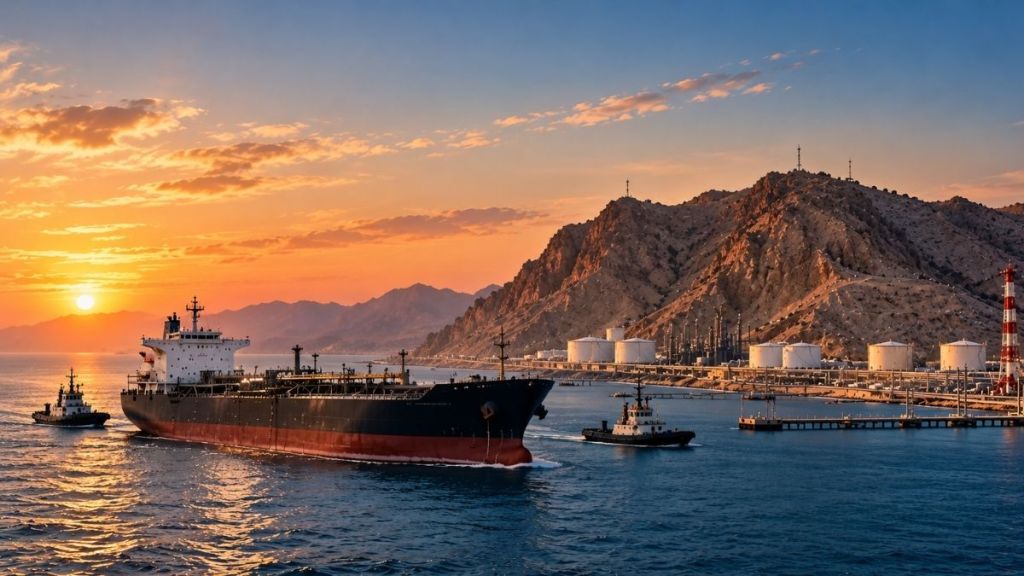

Iran on Saturday accused the United States of targeting an Iranian tanker near Kharg Island, the country’s main oil export hub, reported AP citing Iran’s semi-official Tasnim news agency.
Four US missiles hit the tanker near Kharg Island’s anchorage, about 10 km from the island, reported AP. However, Iranian authorities made no immediate official announcement, and US Central Command has not issued a statement yet.
This latest development follows days after the United States resumed strikes on Iranian targets after a period of relative calm.
A day earlier, US President Donald Trump had threatened to strike Iran’s Pickaxe Mountain, a heavily fortified underground site near the country’s damaged Natanz uranium enrichment complex. Trump told reporters on Friday that the United States may hit the site “very soon”, Reuters reported.
What is Pickaxe Mountain?
Pickaxe Mountain is the informal name for Kuh-e Kolang Gaz La, a mountainous site south of Natanz in central Iran. Reuters reported that the site contains two deeply buried tunnel complexes and is located close to the heavily damaged Natanz uranium enrichment facility.
The site has attracted attention because Iran has built a large underground facility inside the mountain. The Institute for Science and International Security, which has studied satellite imagery of the area, said construction began in late 2020.
The institute said Iran described the underground halls as a replacement for an advanced centrifuge assembly facility at Natanz that had been damaged.
That connection is significant because centrifuges are essential to uranium enrichment. However, satellite imagery cannot establish exactly what equipment is inside the tunnels or what activities are taking place there.
Iran has said the site is not being used for nuclear activities. Reuters reported in July that satellite imagery showed two pairs of fortified tunnel entrances, with construction still underway.
Pickaxe Mountain is therefore separate from Natanz’s main enrichment facilities, although its proximity to the complex and its reported centrifuge-related purpose have made it a site of international interest.
Is Pickaxe Mountain a nuclear site?
The concern around Pickaxe Mountain comes at a time when international monitoring of Iran’s nuclear programme has been disrupted.
Natanz has been at the centre of Iran’s uranium enrichment programme for years and has been repeatedly targeted during the conflict. US and Israeli attacks have severely damaged Iran’s nuclear infrastructure, while IAEA inspectors have not returned to the bombed sites, Reuters reported.
The IAEA also cannot verify what remains of Iran’s enriched uranium stockpile.
Before the attacks, the agency estimated that Iran had 440.9 kg of uranium enriched to up to 60% purity. If enriched further, that amount was enough for 10 nuclear weapons according to an IAEA yardstick, Reuters reported.
Iran says it does not intend to build nuclear weapons and has the right under the Nuclear Non-Proliferation Treaty to develop nuclear technology for peaceful purposes.
But in a report cited by Reuters on September 1, the IAEA said it had lost continuity of knowledge about Iran’s previously declared inventories of enriched uranium. It called the lack of information and access a “matter of proliferation concern”.
Has Iran moved nuclear equipment to Pickaxe Mountain?
There is no independent confirmation of what is currently inside the facility. In July, The Wall Street Journal reported, citing US and Israeli officials, that Israeli intelligence assessed that Iran had moved thousands of centrifuges to Pickaxe Mountain.
However, the IAEA has not issued any official statement verifying the claim.
Reuters reported that inspectors had still not returned to Iranian nuclear sites hit in the conflict, leaving the agency without a complete picture of Iran’s nuclear material at those locations.
That does not establish that Pickaxe Mountain contains Iran’s enriched uranium stockpile. It means there is currently no independent verification of what equipment or nuclear material may be at the site.
The Institute for Science and International Security has described Pickaxe Mountain as a declared, centrifuge-related site under construction.
Why would a strike on Pickaxe Mountain be difficult?
The site’s underground design is central to the military challenge. Reuters described Pickaxe Mountain as a heavily fortified site containing two deeply buried tunnel complexes. The mountain itself provides protection for the facilities inside.
The Institute for Science and International Security has monitored the site through satellite imagery and reported hardened tunnel entrances and continued construction activity.
The institute assessed that the western tunnel entrances remained open in imagery from July 9. It also identified entrances, power supplies and ventilation-related infrastructure as potential vulnerabilities.
These are assessments by an independent research organisation, not confirmation of a US military plan.
The actual weapons or operational plans Washington might use against the site have not been publicly disclosed by the US government.
The United States has already used powerful bunker-penetrating weapons against Iranian nuclear facilities during the conflict. But Pickaxe Mountain presents a different physical challenge because its tunnels are located deep inside a mountain.
That does not mean the site cannot be attacked. It means its physical structure creates a different military problem from striking an exposed facility.
Trump has said the United States may strike the site “very soon”. Reuters had not reported that the US had already attacked Pickaxe Mountain as of September 4.
Trump’s threat comes alongside a renewed diplomatic dispute over Iran’s nuclear programme.
The United States, Britain, France and Germany were seeking an International Atomic Energy Agency Board of Governors resolution that would refer Iran to the UN Security Council, Reuters reported. The proposed move would mark the first such referral in 20 years.