


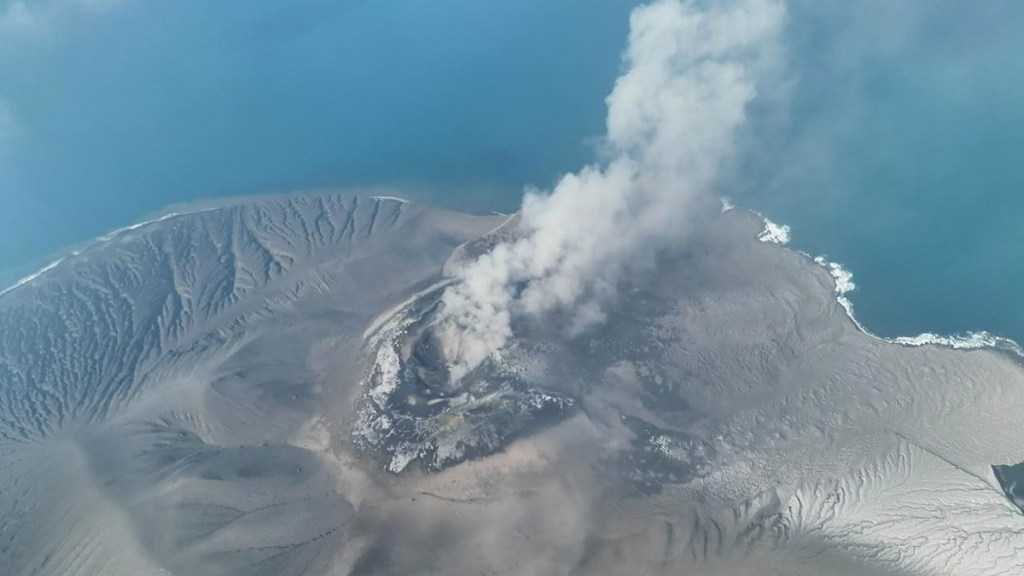

Heavy volcanic ash drifted over parts of Indonesia on Monday — leaving tens of thousands stranded as eight airports closed their doors. Mount Anak Krakatau erupted repeatedly over the weekend, spewing ash up to 50,000 feet and severely disrupting regional air travel. The volcanic activity also adds to ongoing flight route disruptions in southeast Asia amidst the US-Israeli war against Iran.
“We cannot ascertain when this will end due to the dynamic weather…To date, 1,558 flights have been delayed at the eight affected airports, with 170,000 passengers stranded,” news agency AFP quoted the Transport Ministry as saying in a statement on Sunday.
The numbers have only continued to rise as eight Indonesian airports — including two that serve Jakarta — remained closed on Monday morning. Authorities have maintained a ‘Level III’ alert for the region and warned that “the probability of further eruptions in the coming periods remains high”.
Meteorological agency BMKG posted on its website that the eruptions have seen ash reach as high as 20,000 feet (6,000 metres) on the Java side of the volcano and 50,000 feet (15,000 metres) on the Sumatra side and some parts of Banten province in Java. Officials however confirmed that there was no immediate threat of a tsunami from the seismic activity.
Passengers stranded as US-India routes narrow
The West Asia conflict had forced many Indians to reroute their travel plans earlier this year — using Southeast Asian hubs to reach the United States. Iranian airspace has remained closed for much of this year, while India also faces restrictions while using routes above Pakistan. Key transit hubs such as Dubai, Abu Dhabi, Doha, and Kuwait have also become points of concern for travellers amid repeated attacks from Iran.
The volcanic eruption in Indonesia adds a secondary pressure point for airlines and travellers. Over 1,500 flights have been delayed or cancelled — with regional leaders such as Singapore Airlines and Scoot announcing significant changes. And while the bottleneck is concentrated on regional flights directly entering or bordering Indonesian airspace, it has also intensified the operational pressure for other hubs in Southeast Asia.
The impact is already being felt, with Transport Minister Dudy Purwagandhi urging airlines to consider diverting flights to alternative airports on Sunday night. The Ministry reportedly confirmed that the pause was mainly affecting flights to and from Singapore as well as international routes including Doha, Sydney and Kuala Lumpur. Official updates indicate Singapore Airlines, Scoot, AirAsia, and Garuda Indonesia all cancelled short-haul flights connecting Jakarta or Bali with Singapore and Kuala Lumpur.
News agency AP also quoted Lukman F. Laisa (the Ministry of Transportation director general of civil aviation) as saying that flight schedules could face cascading disruptions affecting aircraft rotations, fleet availability and terminal capacity as airlines work to restore operations. The Indonesian DGCA said it was closely monitoring the eruption’s impact on air travel and coordinating with airlines, airport operators, air navigation services and the meteorology agency.
Heavy ash drifts over Indonesia
As per Indonesia’s Centre for Volcanology and Geological Hazard Mitigation, volcanic ash has spread across parts of Jakarta and Lampung province in southern Sumatra. AirNav Indonesia has also closed airspace around Soekarno-Hatta and Halim Perdanakusuma airports in Jakarta — as well as six other airports — because of volcanic ash.
Reuters quoted disaster mitigation agency BNPB as saying that it would conduct a weather modification operation to promote rain. BNPB chief Suharyanto told a press conference that the volcanic ash could be “washed away quickly” if it rained heavily enough.
The government on Sunday authorised schools in areas affected by volcanic ash to temporarily move to online learning at home. The measure is intended to reduce students’ exposure to ashfall and allow local authorities to adjust classroom activities based on conditions on the ground.
What led to the eruption?
Indonesia sits on the Pacific ‘Ring of Fire’ and earthquakes and volcanic eruptions are a frequent part of life. Anak Krakatau was created after the 1883 Eruption of Krakatoa. The name translates to ‘child of Krakatau’ and references one of the most powerful and destructive volcanic events in recorded history. The monumental eruption in 1883 — which is considered to be ‘loudest sound ever recorded in history’ — had triggered a period of global cooling.
More recently, an eruption of Anak Krakatau in 2018 had caused a tsunami that killed at least 430 people in Sumatra and Java. Researchers believe volcanic activity triggered an underwater landslide and caused a large chunk of its southwest slope to collapse and displace a large volume of water. Scientists cited by AP added that Anak Krakatau island was only about a quarter of its original size after that eruption.
Five volcanoes at Alert Level 3
The volcanic island of Anak Krakatau sits halfway between Java and Sumatra islands in the Sunda Strait. The mountain has shown signs of activity since Friday — erupting repeatedly from 3:53 am on Sunday. Closed-circuit camera footage showed lava flares from the volcano but no casualties have been reported. Authorities have warned residents and visitors to stay at least three kilometers away from the active crater. But the nearest settlement is more than 16 kilometers away and no evacuation orders have been issued this time.
The head of Indonesia’s Geological Agency told AP that activity at Anak Krakatau has intensified since July — indicating a continued supply of magma and volcanic gases beneath the surface. Lana Saria however warned that officials cannot predict whether a larger eruption will occur. She added in a video briefing that the main hazards include volcanic ash, high concentrations of gas and the ejection of hot rocks and other material around the crater area.
Anak Krakatau remains a highly active volcano — with authorities currently maintaining a Level 3 warning for five locations in Indonesia. It has remained at the second-highest warning level since July 2. Four other volcanoes also remain on Level 3: Semeru, Merapi, Lewotobi Laki-laki and Sinabung.
According to a Reuters report citing monitoring agency PVMBG, Mount Semeru in East Java also erupted on Sunday. The volcano some 850 km from Anak Krakatau sent an ash column one km above the summit. Officials have advised residents to stay at least 5 km from the crater and warned of the risk of hot ash clouds and lava flows up to 17 km from the summit.