


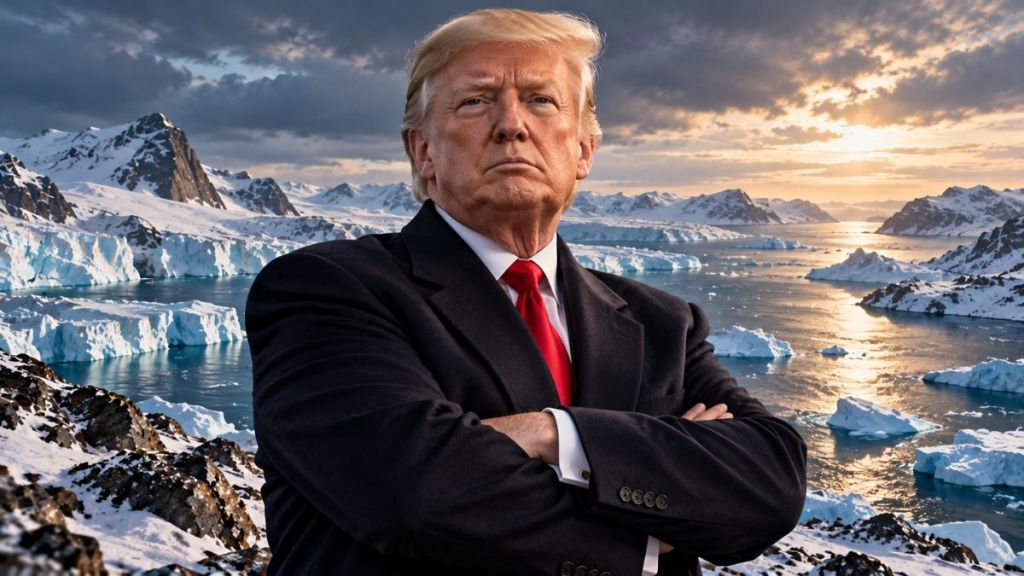

US President Donald Trump’s new claim that “massive” oil, gas and mineral exploration is about to begin in Greenland has brought attention to a dispute that has strained relations between Washington and its NATO allies. The announcement, made on October 14 on his Truth Social platform, comes less than a month after the United States reached a security agreement with Denmark and Greenland.
Trump’s post raises an important question: if a deal has eased tensions over Greenland’s future, why is the US president continuing to speak about the island as though it belongs to America?
The answer is in three overlapping interests, including military security, access to valuable natural resources and the struggle for influence in the Arctic. The latest announcement also raises questions about who controls Greenland’s resources and whether the agreement has truly settled the dispute over sovereignty.
What did Trump announce?
“Massive Oil, Gas, and Mineral Exploration is getting ready to begin in our new and beautiful Greenland!” Trump wrote on Truth Social on Wednesday. He also claimed that the island holds enormous quantities of oil that could be extracted relatively easily. “The amount of easily available Oil is far greater than that of almost … anywhere in the World,” he wrote, attributing the claim to experts.
Trump did not identify the projects involved, name the companies expected to carry out the exploration or explain what role the US government would play. His announcement therefore does not establish that large-scale exploration has actually begun.
The wording is significant, however. Trump called the island “our new and beautiful Greenland”, even though Greenland is a self-governing territory within the Kingdom of Denmark, not part of the United States.
The post also shows that Trump’s interest extends beyond military access. He wants the US to benefit from Greenland’s economic potential, particularly its energy reserves and mineral deposits.
Why is Greenland important to the US?
Greenland is the world’s largest island, located between the Arctic and the North Atlantic. Its geographical position makes it strategically important for monitoring military activity, protecting North America and tracking potential threats approaching from the Arctic.
Trump emphasised this advantage in his latest post. “Any future attack on the United States will have to come across Greenland, where our defence will routinely knock down drones, missiles, or any other form of weapon not yet even conceived,” he wrote.
“It gives us time, location, and sightline, like nowhere else in the world!” The US already has a military presence at Pituffik Space Base in northwestern Greenland. The installation supports missile warning, missile defence and space surveillance operations for the United States and NATO.
Trump wants to expand this presence further. His proposed Golden Dome missile defence system, along with additional military bases, would strengthen the island’s role in American security planning.
Greenland is also important because the Arctic is becoming an increasingly significant arena of geopolitical competition. Russia has substantial military interests in the region, China seeks greater access to Arctic trade routes and resources.
Washington is concerned that its rivals could gain influence over strategically important infrastructure and mineral supplies. A stronger American presence in Greenland would help the US limit those opportunities.
The mineral wealth behind the dispute
Greenland’s natural resources provide another reason for Washington’s interest. The island has deposits of rare earth elements and other minerals used in smartphones, computers, electric vehicle batteries, renewable energy technologies and advanced defence equipment.
China dominates important parts of the global rare earth supply chain, including processing. The Trump administration wants to reduce American dependence on Chinese supplies and secure alternative sources of critical minerals.
Greenland could contribute to that effort. Its potential oil and natural gas reserves also attract attention, particularly when energy prices are a concern for American consumers.
However, possessing natural resources does not mean they can be extracted easily or profitably. Greenland has a harsh Arctic climate, limited infrastructure, difficult geological conditions and expensive transport requirements. Mineral deposits are often embedded in rock that requires substantial investment to extract and process. Offshore oil and gas projects face additional environmental and technical challenges.
Greenlandic lawmakers decided in 2021 to stop issuing new oil and gas exploration licences, citing environmental concerns and the need to avoid worsening the climate crisis.
The gap between estimated resources and commercially viable production is therefore substantial.
Naaja H. Nathanielsen, who represents Greenland in Denmark’s parliament, questioned the suggestion that extraction could provide an immediate economic benefit.
“I recognize the worry in the U.S., but I think it’s not a quick fix,” she told The Associated Press. “There’s no Greenlandic barrels of oil on ground in any near future.”
How did the dispute reach this point?
Trump’s interest in Greenland is not new. In 2019, during his first presidency, he publicly floated the idea of buying the island. Denmark and Greenland rejected the proposal, insisting that Greenland was not for sale.
The issue became more serious during Trump’s second term, when he repeatedly argued that the United States needed control of Greenland for national security. His administration did not rule out using force, raising concerns in Denmark and across NATO, the military alliance that includes both countries.
The crisis escalated in January 2026. Trump’s demands for control of Greenland triggered opposition from European allies. Denmark’s Prime Minister Mette Frederiksen warned that a US military takeover would threaten the future of NATO itself.
Trump also threatened tariffs against eight European countries as part of his campaign to acquire the island. The confrontation prompted protests in Greenland and Denmark, while Greenland’s leaders made clear that they did not want to become part of the United States.
Greenland’s Prime Minister Jens-Frederik Nielsen expressed the island’s position directly, saying that Greenland chose Denmark over the US.
The dispute eventually moved towards negotiations. In January, Trump said he would not use force to acquire Greenland and announced a framework for a future agreement on Arctic security after meeting NATO Secretary General Mark Rutte at the World Economic Forum in Davos.
What does the September deal actually mean?
On September 22, 2026, Trump signed a security agreement with the leaders of Denmark and Greenland. The agreement provides a framework for an expanded American military presence, including two proposed bases and support for the Golden Dome missile defence system.
It also reaffirms Danish sovereignty and Greenlanders’ right to self-determination. In other words, the agreement allows greater US military involvement without transferring ownership of the island to Washington.
The distinction is important because the deal does not give the United States special rights to explore or extract Greenland’s oil, gas or minerals. It also places limits on investment by countries outside NATO in certain strategic sectors.
The agreement therefore represents a compromise, rather than the outcome Trump originally sought. Washington gains a stronger security position in the Arctic, while Denmark and Greenland retain their sovereignty.
The two sides may nevertheless interpret the outcome differently. Trump can point to expanded military access as a strategic gain. Denmark and Greenland can point to the preservation of their political independence.
The latest resource announcement introduces a new question: will the US seek greater economic influence over Greenland even without acquiring the territory itself?
Can the new deal end the Greenland dispute?
The agreement has eased tensions, but it has not eliminated the underlying disagreements. Trump’s latest post is a reminder that his administration continues to present Greenland as central to American security and economic interests. His description of the island as “our new and beautiful Greenland” is particularly striking because the agreement explicitly preserves Danish sovereignty and Greenlanders’ right to decide their future.
Greenland’s political leaders have also made clear that resource development cannot happen overnight. In comments to The Associated Press, Nathanielsen said she expected the president’s post to be aimed partly at Americans concerned about fuel prices before the November midterm elections.
Her assessment points to a possible domestic political dimension. Promising access to new oil and mineral resources may appeal to voters concerned about energy costs and American dependence on foreign supplies. Greenland’s difficult operating conditions, however, mean that such resources are unlikely to provide an immediate solution.
The next stage of the dispute may therefore focus less on outright ownership and more on military access, investment rules, mining licences and the companies allowed to develop strategic resources.
Trump’s announcement of “massive” exploration does not, by itself, establish that a new extraction programme has begun. The projects, companies, permits and investment arrangements behind his claim remain unclear.
Trump’s campaign to acquire Greenland has changed from a proposal to purchase territory, through threats and diplomatic confrontation, towards a negotiated security arrangement. His latest comments suggest that economic interests may now become another source of tension.