


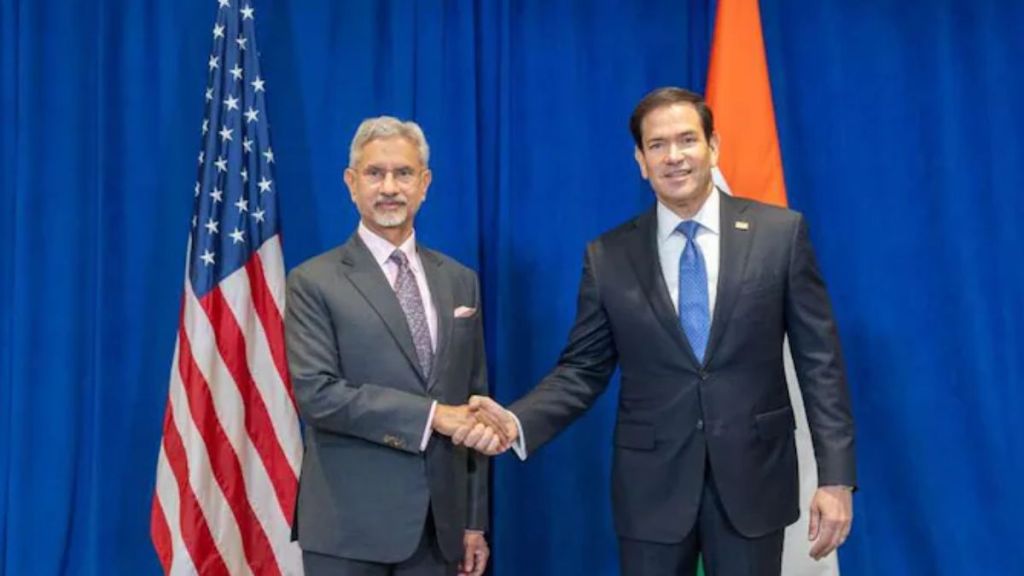

US Secretary of State Marco Rubio will visit Mumbai and Jamnagar this month, with energy cooperation on the agenda as Washington pressures India over Russian oil purchases. His second India visit this year is part of an October 17-22 tour beginning in Uzbekistan. He will meet senior Indian officials and business leaders to discuss strategic ties, energy and investment, the US State Department said.
The tour coincides with Washington’s October 18 deadline under the Graham Act for duties targeting buyers of Russian energy. India’s oil imports remain a sticking point as a bilateral trade deal awaits finalisation.
Yet Washington is pursuing its own energy arrangement with Moscow. US President Donald Trump said in a Truth Social post on Friday that Russia had agreed to supply more than 300,000 tonnes of diesel immediately to American and global markets, with further diesel shipments to follow, after talks with Russian President Vladimir Putin.
What brings Rubio to India again?
The official note shared by the US State Department confirms that Marco Rubio will meet with senior Indian government officials to “strengthen” the strategic partnership between the United States and India, “exchange views on regional and global dynamics, and discuss prospects for enhanced energy cooperation”.
On top of that, the American diplomat is scheduled to meet with business leaders to promote “opportunities for commercial investment and economic cooperation.” Official statements have refrained from directly name-dropping industry leaders Rubio could meet in Mumbai and Jamnagar.
Back in May, weeks before Rubio came to India for his first-ever official visit to the country, US Ambassador to India Sergio Gor celebrated New Delhi’s commitment to invest over $20.5 billion in various sectors, including tech, manufacturing, and pharmaceuticals.”These partnerships are creating real American jobs and building stronger supply chains. Proof that when the world’s largest democracies do business together, everyone wins,” Gor posted on X at the time.
Rubio himself eventually reiterated that India remains one of America’s most important strategic partners. His remarks surfaced amid prevailing concerns about a supposed rift between the two sides due to Trump’s tariff regime and his repeated attempts to claim credit for resolving tensions between India and Pakistan following Operation Sindoor last year.
Notably, Gujarat’s Jamnagar is home to Reliance Industries’ refining hub. Mukesh Ambani, the current Chairman and Managing Director of India’s largest conglomerate, has been repeatedly taunted on X by Elon Musk, who questioned why Starlink’s launch in India has stalled.
What happened during Rubio’s first India visit?
During his first India visit earlier this year in May, the US State Secretary first landed in Kolkata and participated in a tour of Mother House, the global headquarters of the Missionaries of Charity.
Thereafter, he flew to New Delhi and held bilateral talks with his Indian counterpart, Dr S Jaishankar, amid a much-stalled trade deal, which still hasn’t been formally finalised. At the time, he also met with counterparts from Australia and Japan, as part of the 11th Quad Foreign Ministers’ Meeting in New Delhi.
The tour was largely overshadowed by the global debate surrounding Donald Trump’s tariff policies, which also hurt several Indian exports. Questions tied to the Republican POTUS’ ongoing immigration crackdown, in addition to the impact of several ongoing global conflicts, were also raised during a joint presser headed by Rubio and India’s External Affairs Minister.
The same topic could make a resounding comeback in the headlines, especially since the Trump administration very recently suspended eight companies, including Microsoft, TCS, Infosys, and HCL, from a major employment-based US Green Card process. Most of these firms, which are either based in India or have major operations in the South Asian country, also heavily rely on the H-1B visa program.
Official US immigration data shows that Indian nationals have dominated approvals in the non-immigrant work visa category, largely used by US employers in STEM fields. The Trump administration has long accused American companies of indulging in “visa abuse” or “visa fraud” by employing this classification to replace American workers with “cheap foreign labour.”