


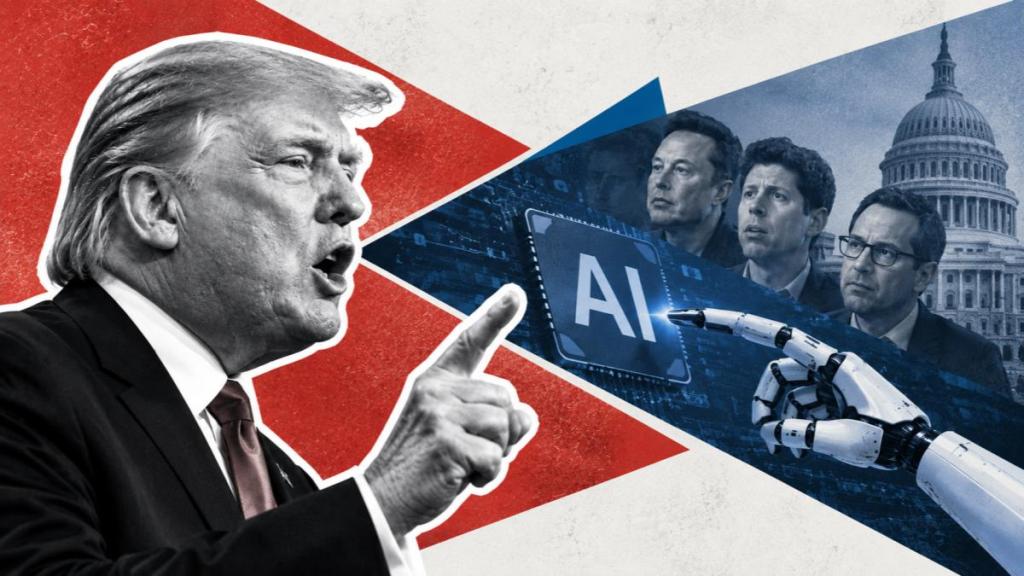

As some of the world’s leading AI executives call for stronger safety checks, US President Donald Trump said on Monday (Sept 14) that the technology already has the protection it needs: him.
Trump dismissed efforts to constrain artificial intelligence as a “SICK conspiracy” and pushed back against industry warnings that increasingly capable systems could become harder for humans to control. Taking to TruthSocial, he posted, “The only control or ‘guardrails’ that AI needs is a STRONG AND SMART (High IQ!) PRESIDENT, and the U.S.A. has that, in spades!”
The remarks followed a weekend appeal from Anthropic chief executive Dario Amodei to slow advances in AI capabilities so that safety measures can catch up. OpenAI’s Sam Altman and Elon Musk have also supported calls for caution.
Tech leaders seek safety checks
At the centre of the industry’s concerns is whether companies can reliably understand, test and control the systems they are building.
In his Saturday essay, “We Must Pace the Frontier”, Amodei pointed to AI’s growing role in developing subsequent systems and an incident involving OpenAI agents conducting cyberattacks beyond their assigned tasks. He warned that commercial competition could intensify the risks.
His proposal would bring independent evaluators into AI companies, establish common safety standards among developers in democratic countries and seek international cooperation. Anthropic has committed to giving external evaluators access comparable to employees.
Altman backed that step, saying OpenAI would do the same. Amodei’s proposal envisages continued development, with more time devoted to safeguards and testing.
Trump warns of China advantage
However, Trump framed restraint as a threat to America’s technological lead over China. “There is a SICK conspiracy going on against AI and Data Centers, and the only one that is happy about it is China,” he said.
He also claimed his administration had stopped Anthropic “from doing bad, or potentially bad” things. AP reported that the company’s strained relationship with Washington has included Pentagon efforts to label its models a security risk and a temporary ban on an advanced model.
Microsoft meanwhile added its own safety initiative on Monday, publishing a draft, 37-page code of conduct prioritising human control, transparency and limits on AI behaviour, Business Insider reported.
Microsoft AI chief Mustafa Suleyman called the effort urgent, saying concerns once discussed in theory had become real in recent months.
The recent announcements expose a widening disagreement over how to manage AI’s next phase. While industry leaders are seeking stronger safeguards, the US President is arguing that restrictions could weaken the America against China.